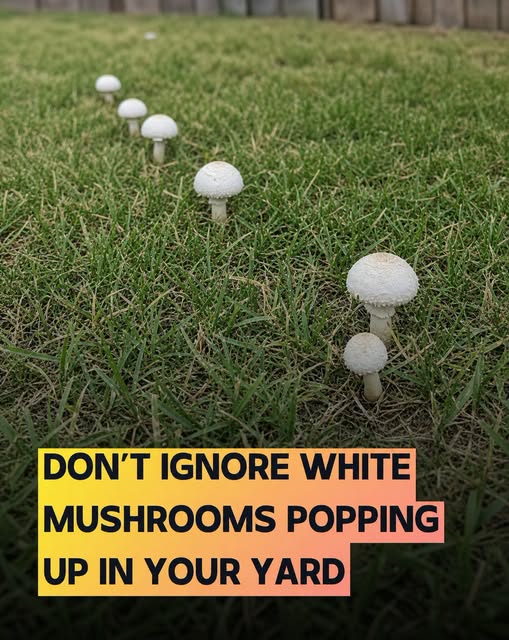
Spotting those little white caps scattered across your lawn can feel strangely unsettling.
One day, the grass looks perfectly normal.
The next morning, small white mushrooms have appeared almost overnight, poking through the blades like tiny warning signs.
They look harmless.
But they can tell you something important about what is happening beneath the surface.
Sometimes, they are evidence of healthy soil.
Other times, they can point toward excessive moisture, decaying organic material, compacted ground, or even problems affecting nearby trees.
The key is understanding what your lawn is trying to tell you before reaching for chemicals or pulling every mushroom from the ground.
### Those mushrooms are part of a hidden world
What you see above the grass is only a tiny portion of the organism.
Most fungi live underground as networks of microscopic threads called mycelium.
Those networks spread through soil, decomposing leaves, dead roots, pieces of wood, and other organic material.
When conditions become favorable, the fungus produces mushrooms.
The mushroom is essentially the reproductive structure—the part designed to release spores and help the fungus spread.
So when white caps suddenly appear across your yard, the fungus itself usually isn’t new.
It may have been living beneath your lawn for weeks, months, or even years.
The mushroom is simply the part you can finally see.
And that changes the way you should think about them.
The mushroom isn’t necessarily the problem.
It may actually be a **clue** pointing toward something happening underground.
### Sometimes, mushrooms mean your soil is alive
Not every mushroom is a warning.
In many cases, fungi are performing an important job.
They break down dead leaves.
They decompose fallen branches.
They recycle nutrients from buried wood.
They help transform organic material into substances that plants can eventually use.
If you have old mulch, buried tree roots, compost, leaf litter, or decaying wood beneath the grass, fungi may simply be doing their job.
That means a few mushrooms appearing after rain aren’t necessarily something to fear.
They can be evidence that decomposition is happening.
And decomposition is one of the processes that keeps soil functioning.
Without organisms breaking down dead material, nutrients would remain trapped instead of returning to the soil.
### But then there’s the moisture problem
If mushrooms suddenly appear in large numbers, pay attention to how wet your lawn has been.
Fungi thrive when moisture is abundant.
If you’re watering too frequently, watering for too long, or dealing with poor drainage, you may be creating ideal conditions for mushrooms.
The same can happen after prolonged rainfall.
Water remains in the soil.
Organic material stays damp.
And suddenly, fungal fruiting bodies appear.
In that situation, removing the mushrooms won’t solve the underlying issue.
They may simply return.
The better question is:
**Why is this part of the lawn staying so wet?**
Look for areas where water collects.
Check whether the soil remains damp long after rainfall.
Pay attention to irrigation patterns.
Sometimes reducing unnecessary watering is enough to make the mushrooms far less noticeable.
### Compacted soil can contribute too
Another clue is where the mushrooms appear.
If they repeatedly show up in areas where people walk, park equipment, or otherwise heavily use the lawn, compacted soil may be part of the problem.
Compaction reduces the spaces between soil particles.
That can interfere with air and water movement.
Roots may struggle.
Drainage can become uneven.
And the overall health of the turf can decline.
If the grass is thin while mushrooms continue appearing, the situation deserves more attention.
Aeration can help improve soil structure in some lawns by creating pathways for air and water.
But timing and technique matter, so avoid treating aeration as a universal cure.
The goal is to address the condition that is stressing the lawn—not simply attack the mushroom.
### Don’t forget the thatch
Heavy thatch can also contribute to fungal activity.
Thatch is the layer of living and dead grass material that accumulates between the green blades and the soil surface.
A thin layer can be beneficial.
But excessive buildup can interfere with water penetration, air circulation, and nutrient movement.
It can also retain moisture near the surface.
If your lawn has a thick layer of thatch and mushrooms are becoming increasingly common, that may be another piece of the puzzle.
Proper dethatching, when actually needed, can improve the lawn’s growing environment.
But aggressive dethatching when there isn’t a problem can damage healthy turf.
Again, observation matters.
### Pet waste can create strange hotspots
Another surprisingly common source of lawn problems is concentrated animal waste.
Dog urine and feces introduce nutrients into small areas of soil.
When nitrogen becomes concentrated in one location, grass can respond differently from the surrounding lawn.
You may see unusually dark green patches, burned areas, thinning grass, or fungal growth nearby.
If mushrooms repeatedly appear in the same places where pets use the lawn, clean up waste promptly and pay attention to the pattern.
The location itself can provide useful information.
Your lawn often tells you what is happening if you pay attention to where changes occur.
### Watch the trees too
One of the most important clues is the relationship between mushrooms and nearby trees.
If mushrooms appear around the base of a tree or seem to follow its root zone, don’t automatically assume they’re harmless.
Fungi are natural decomposers, and many live around healthy trees without causing disease.
But certain fungi can also be associated with decaying roots or wood.
If you notice mushrooms alongside other signs—such as thinning foliage, dead branches, cavities, cracks, leaning, unusual growth, or a noticeable decline in the tree—take the combination seriously.
The mushroom itself may not tell you exactly what is happening.
But it can be a reason to inspect the tree more carefully.
If a large or valuable tree appears unhealthy, an arborist can help determine whether there is an underlying structural or disease problem.
### Fairy rings can look especially mysterious
Then there are fairy rings.
They may appear as circular or arc-shaped patches of darker grass, sometimes accompanied by mushrooms.
The pattern can look almost unnatural.
But there is a biological explanation.
Certain fungi spread outward through the soil, creating expanding colonies.
As the colony changes the soil environment and processes organic material, the grass above it can respond differently.
In some cases, the grass becomes darker and grows more vigorously.
In others, the turf becomes thin or damaged.
The result can be a ring or arc that seems almost deliberately drawn into the lawn.
It isn’t magic.
It’s fungal biology happening beneath your feet.
### Don’t automatically destroy every mushroom
One of the most common reactions is to grab a bag, chemical, or shovel and eliminate everything immediately.
But that isn’t always necessary.
Removing visible mushrooms can make the lawn look cleaner, but it doesn’t necessarily remove the underground fungus.
If the conditions remain favorable, new mushrooms may appear.
The more useful approach is to address the environment.
Improve drainage if necessary.
Avoid excessive irrigation.
Remove heavy accumulations of organic debris.
Manage thatch appropriately.
Aerate compacted soil when warranted.
Clean up pet waste.
And monitor nearby trees.
Once the underlying conditions change, fungal fruiting may naturally decrease.
### One important warning: don’t eat them
Even if a mushroom looks familiar, don’t assume it is safe to consume.
Lawn mushrooms can be difficult to identify accurately, and some species can cause serious poisoning.
Keep children and pets away from unknown mushrooms.
If you don’t need them in the lawn, remove them safely and dispose of them rather than experimenting with them.
And if a pet or person may have eaten an unidentified mushroom, contact an appropriate medical or veterinary poison resource promptly.
### The smartest response is observation
Those white caps aren’t automatically good.
They aren’t automatically bad either.
They’re information.
A few mushrooms appearing after heavy rain may simply reflect moisture and decomposition.
A sudden explosion of mushrooms across constantly wet grass may point toward irrigation or drainage problems.
Mushrooms appearing alongside thinning turf could indicate stress.
Mushrooms around a declining tree deserve closer attention.
And mushrooms appearing where organic material is breaking down may simply be doing exactly what fungi are supposed to do.
The mistake is assuming every mushroom tells the same story.
Your lawn is an ecosystem.
Beneath those blades of grass are roots, bacteria, insects, fungi, organic matter, minerals, water, and countless interactions that you rarely see.
The mushroom is simply one of the few parts that occasionally rises above the surface.
So the next time you see those strange little white caps, don’t panic.
Don’t immediately reach for chemicals.
Look around.
Check the soil.
Notice the moisture.
Look at the grass.
Look at nearby trees.
Think about mulch, leaves, buried wood, pets, drainage, and recent weather.
The answer may be completely harmless.
Or the mushrooms may be the first visible clue that something needs attention.
Either way, they are telling you something.
And once you learn how to read that signal, those mysterious white caps stop looking like unwanted invaders.
They become what they really are:
**tiny windows into the hidden life of your lawn.**