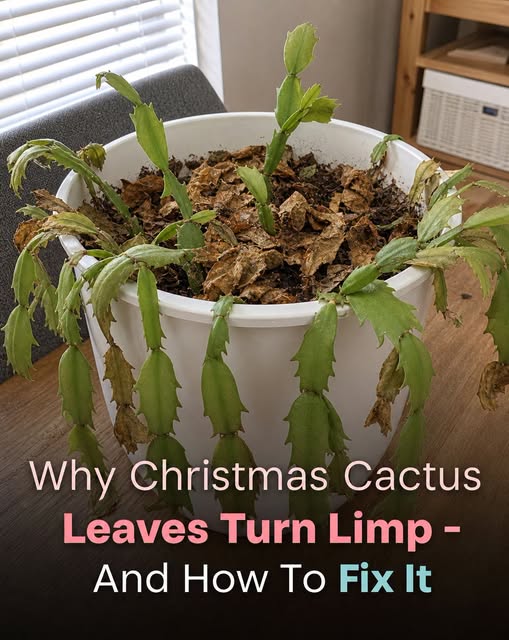
The first sign is so small you almost miss it.
A single segment droops where firm, glossy green should be.
Then another.
Within days, the Christmas cactus that once looked healthy and full suddenly appears tired, soft, and strangely deflated.
At first, it is tempting to assume the plant simply needs more water.
But that can be exactly the wrong thing to do.
A limp Christmas cactus may be thirsty.
Or it may be drowning.
And sometimes, the real problem is hidden beneath the soil where you can’t see it.
The good news is that a drooping Christmas cactus is not necessarily a dying Christmas cactus.
In many cases, the plant is sending you a warning before the damage becomes irreversible.
The trick is learning what that warning actually means.
### If the soil is wet, stop watering
Overwatering is one of the most common reasons a Christmas cactus becomes limp.
It sounds strange because plants need water to survive.
But roots need oxygen too.
When the soil remains constantly saturated, the tiny spaces around the roots fill with water instead of air. The roots can begin to weaken, and eventually rot can develop.
The result can look surprisingly similar to dehydration.
The leaves become limp.
The plant loses its firmness.
Growth slows.
And the entire cactus can appear as though it is simply running out of energy.
So before reaching for the watering can, put your finger into the soil.
If it feels wet several inches down, don’t add more water.
Instead, allow the soil to dry.
If the pot feels unusually heavy, the soil stays wet for days, or you notice a sour or unpleasant smell, you may be dealing with root problems.
That’s when simply waiting may not be enough.
Carefully remove the plant from its pot and inspect the roots.
Healthy roots should generally be firm.
Rotten roots may appear dark, soft, or mushy.
If you find damaged roots, remove the unhealthy portions with clean tools and repot the plant in fresh, well-draining potting mix.
Make sure the container has drainage holes.
Without proper drainage, excess water has nowhere to escape, and the cycle can begin again.
### But what if the soil is completely dry?
That’s a different story.
If the soil feels extremely dry, looks pale, and pulls away from the sides of the pot, your Christmas cactus may simply be dehydrated.
In that case, give it a thorough watering rather than offering only a few drops.
Water slowly enough that the entire root ball can become moist, allowing excess water to drain completely from the bottom.
Then don’t immediately water again.
Let the soil begin to dry before the next watering.
Christmas cactus isn’t a desert cactus in the traditional sense.
It naturally comes from humid, forested environments, where it experiences moisture but also needs air around its roots.
That means the goal isn’t to keep it bone-dry.
It’s to avoid both extremes.
Too much water can suffocate the roots.
Too little water can leave them unable to support the plant.
The healthiest plant lives somewhere between those two problems.
### Don’t trust the calendar alone
One of the easiest mistakes is watering simply because it has been “a week.”
Plants don’t drink according to our schedules.
The amount of water a Christmas cactus needs can change depending on temperature, humidity, light, pot size, soil composition, and the season.
A plant sitting in a warm room with bright indirect light may dry faster than one sitting in a cool, humid corner.
So instead of following a rigid schedule, check the soil.
The plant will tell you more than the calendar will.
### Sometimes the problem is the roots
There is another possibility that is easy to overlook.
The plant may be rootbound.
As a Christmas cactus grows, its roots can eventually fill much of the container.
When that happens, the soil may dry unusually quickly, and the crowded root system can have difficulty accessing moisture and nutrients efficiently.
You may notice that water runs straight through the pot instead of soaking into the root ball.
Or the plant may become limp again shortly after watering.
If the roots are tightly packed around the inside of the container, it may be time to repot.
But don’t make the mistake of moving it into an enormous pot.
A container only about 2 inches wider than the existing one is often enough.
A pot that is dramatically larger can hold too much moisture around the roots and create another overwatering problem.
Gently loosen the root ball, remove damaged roots if necessary, and refresh the growing medium.
Then give the plant time to adjust.
### Light matters too
Water isn’t the only thing that can affect the appearance of a Christmas cactus.
Light plays a major role in overall health.
These plants generally do well with bright, indirect light.
Too little light can lead to weak, stretched growth.
Too much intense direct sunlight can scorch the segments and stress the plant.
The ideal location is often somewhere bright but protected from harsh afternoon sun.
And consistency matters.
Sudden changes in temperature or environment can also cause stress.
Keep the plant away from cold drafts, heating vents, and places where temperatures swing dramatically.
A stable environment gives the plant a much better chance of recovering.
### Don’t panic over a few limp segments
One or two soft segments don’t necessarily mean the entire plant is in trouble.
Plants occasionally experience stress.
The important thing is to look for a pattern.
Is the entire plant becoming limp?
Is the soil staying wet?
Does the soil smell unusual?
Are the roots dark and mushy?
Or is the soil completely dry?
Are the segments shriveling?
Is the plant sitting in direct sunlight?
These clues can help you determine what is actually happening.
The biggest mistake is treating every problem as dehydration.
A limp Christmas cactus does not automatically need more water.
Sometimes the roots are already sitting in far too much.
Adding even more water can make the problem dramatically worse.
### Give the plant time
Once you’ve corrected the underlying problem, don’t expect an overnight transformation.
If the plant has been dehydrated, it may take some time for the segments to regain their firmness.
If the roots have been damaged, recovery can take longer.
Plants don’t heal according to our schedules.
Give the roots time to recover.
Keep the light steady.
Avoid constant watering.
Don’t repeatedly move the plant from one location to another.
And resist the temptation to “help” it every few hours.
Sometimes the best thing you can do for a stressed plant is stop interfering and give it stable conditions.
### And then comes the reward
A Christmas cactus that looks exhausted today can eventually become full, green, and vibrant again.
The drooping segments may recover.
New growth can appear.
And with the right conditions, the plant can eventually return to the beautiful display that made you want to grow it in the first place.
The important lesson is simple:
**Don’t treat limp leaves as a watering instruction. Treat them as a question.**
Is the soil too wet?
Too dry?
Are the roots damaged?
Is the plant crowded?
Is the light wrong?
Is the temperature unstable?
Once you identify the real problem, the solution becomes much easier.
Your Christmas cactus isn’t necessarily giving up.
It may simply be trying to tell you that something beneath those glossy green segments isn’t right.
Listen before you water.
Check the soil before reaching for the can.
Look at the roots when necessary.
Give the plant good drainage, appropriate light, and stable conditions.
And remember that sometimes a plant that looks almost dead is simply asking for the right kind of help.
With a little patience, that tired, drooping cactus can become healthy again—and when the holiday season arrives, it may reward you with the lush green growth and colorful blooms you’ve been waiting for.