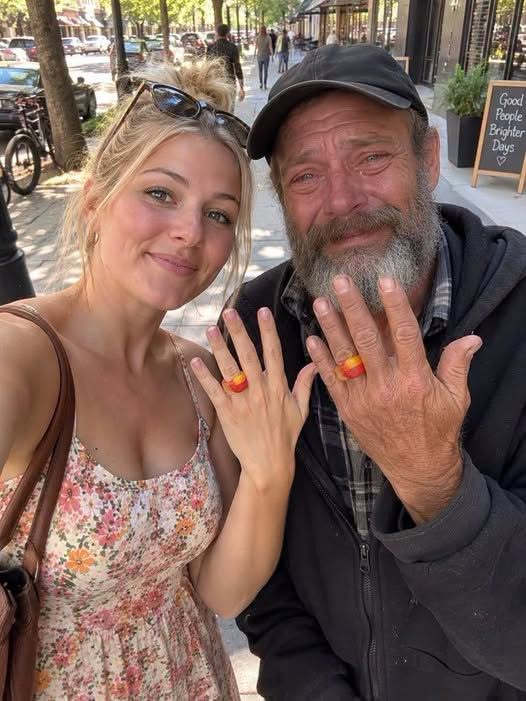
I Married a Homeless Man Until His Final Letter Revealed the Truth
She Married a Man With Nothing, Never Expecting That the Letter He Left Behind Would Reveal the Secret He Had Carried Until His Final Days.
When I first met Daniel, he was sitting outside a small grocery store, wearing a worn-out coat and holding a cardboard cup between his hands. Most people walked past him without looking twice. Some avoided eye contact, while others hurried away as if his presence made them uncomfortable.
I almost did the same.
But something about his face made me stop. Despite his tired appearance, there was a gentleness in his eyes that I rarely saw in strangers. When I offered him a warm meal, he thanked me with a sincerity that stayed with me long after I had returned home.
That simple encounter changed my life.
Over the following weeks, I began seeing Daniel regularly. I brought him food, listened to his stories, and learned that he had spent months sleeping wherever he could find shelter. He never begged for money, never complained about his circumstances, and never spoke bitterly about the world.
Whenever I asked about his past, he would smile faintly and say, “Some things are better left behind.”
At first, I assumed he was simply ashamed of his situation. I never imagined that he was protecting a secret.
As our conversations grew longer, I discovered a man who was thoughtful, intelligent, and surprisingly well-read. He remembered small details about my life, listened when I spoke, and offered advice that was often wiser than anything I heard from people who had everything.
Slowly, friendship turned into something deeper.
My family was horrified when I told them I had fallen in love with a homeless man.
“How can you build a future with someone who has nothing?” my sister asked.
I understood their concerns, but I had seen something in Daniel they refused to recognize. He treated me with kindness, respected my decisions, and never made me feel that I owed him anything for the help I offered.
When I eventually asked him to marry me, he stared at me in disbelief.
“You don’t know everything about me,” he whispered.
“Then tell me,” I replied.
He lowered his eyes.
“Not yet. But if you still want me after everything, I promise you won’t regret it.”
I should have asked more questions. Instead, I believed that love and patience would eventually reveal whatever he was unable to share.
We married in a small civil ceremony attended by only a handful of people. There were no expensive decorations, no grand reception, and no elaborate honeymoon. We celebrated with a modest dinner and walked home beneath the evening lights.
Daniel had very little to offer financially, but he worked whenever opportunities arose. He helped neighbors with repairs, carried groceries for elderly residents, and accepted temporary jobs without complaint. I continued working at my own job, and together we began building a quiet life.
For the first time in years, Daniel seemed peaceful.
Yet there were moments when I caught him staring at old buildings or watching expensive cars pass by with an expression I couldn’t understand. Sometimes, he would begin telling me a story about his childhood, then suddenly stop.
Whenever I asked what was wrong, he would take my hand and say, “One day, you’ll understand why I had to disappear.”
Those words frightened me, but I never pressed him.
Then, three years after our wedding, Daniel became seriously ill.
His condition deteriorated faster than either of us expected. I accompanied him to medical appointments, stayed beside him through difficult nights, and tried desperately to believe that we still had years together.
During one of his final evenings at home, he asked me to sit beside his bed.
“There is something I need you to promise me,” he said.
I held his hand and tried not to cry.
“Anything.”
“When I’m gone, look inside the wooden box beneath our bed. Don’t open it before then.”
I wanted to ask what he meant, but exhaustion had already overtaken him. He closed his eyes, and I spent the night beside him, listening to his breathing.
Several days later, Daniel passed away.
The house felt unbearably empty without him. His cup remained beside the kitchen sink, his coat hung near the door, and the chair where he used to read stood untouched.
For weeks, I could barely bring myself to move his belongings.
Then I remembered his promise.
One rainy afternoon, I pulled the wooden box from beneath our bed. Inside were several old photographs, a sealed envelope, a small notebook, and a set of documents carefully wrapped in cloth.
My hands trembled as I opened the envelope.
The letter began with words I would never forget.
My beloved wife,
If you are reading this, I am no longer there to explain the truth to you. I know I asked you to trust me without giving you all the answers, and for that, I am deeply sorry.
I stopped reading, overwhelmed by emotion.
Then I continued.
When you first met me, you believed I had lost everything. In some ways, I had. But the reason I was living on the streets was not the one you imagined.
The next paragraph revealed that Daniel had once lived a very different life. Years earlier, he had been involved in a bitter family dispute that cost him his home, his relationships, and nearly everything he believed about the people closest to him.
He had walked away from his former life rather than continue a battle that threatened to consume him.
But the letter contained another revelation.
Daniel had not been entirely without resources. He had deliberately kept his circumstances private while trying to determine whom he could trust and what kind of life he truly wanted. The documents in the box explained what had happened to his former property and why he had never discussed it with me.
I sat on the bedroom floor, surrounded by papers, realizing that the man I had loved had carried an enormous burden in silence.
Then I reached the final page.
You never loved me because of what I owned. You loved me when you believed I had nothing. That is why I knew your heart was genuine.
But there is one more truth you must understand. The documents in this box are not simply records of my past. They contain the answer to a question I was too afraid to ask while I was alive: whether the people who once abandoned me would ever accept the life I chose.
I stared at the page, confused.
Daniel had left instructions for me to contact a lawyer whose name appeared at the bottom of the letter. Attached to the instructions was a document referring to an unresolved legal matter involving his former family and an inheritance dispute.
Suddenly, the pieces of his past began to fit together.
The man I had married had not been defined by homelessness, nor had his worth depended on the property or money he might once have possessed. He had been a person trying to escape a painful history, searching for a place where he could be loved without fear of losing himself again.
The lawyer later helped me understand the documents and the legal steps available to me. Not every question was answered immediately, and some details required further investigation. But the letter had finally given me the beginning of the explanation Daniel had promised.
That night, I returned to the last lines of his letter.
If there is anything I hope you remember, it is this: you gave me something no house, fortune, or family name could ever guarantee. You gave me a home where I did not have to pretend to be someone else.
Thank you for seeing me when the rest of the world looked away.
I pressed the letter against my chest and cried until there were no tears left.
I had married a man I believed had nothing, only to discover that his past was far more complicated than I had ever imagined. His final letter did not erase the unanswered questions or bring him back to me.
But it gave me something I desperately needed: the chance to understand the man behind the worn coat, the quiet smile, and the secrets he had carried for so long.
And it taught me a lesson I would never forget.
Sometimes, the person the world considers worthless is carrying a story no one has bothered to hear. And sometimes, the greatest inheritance we leave behind is not money or property, but the truth about who we really were.