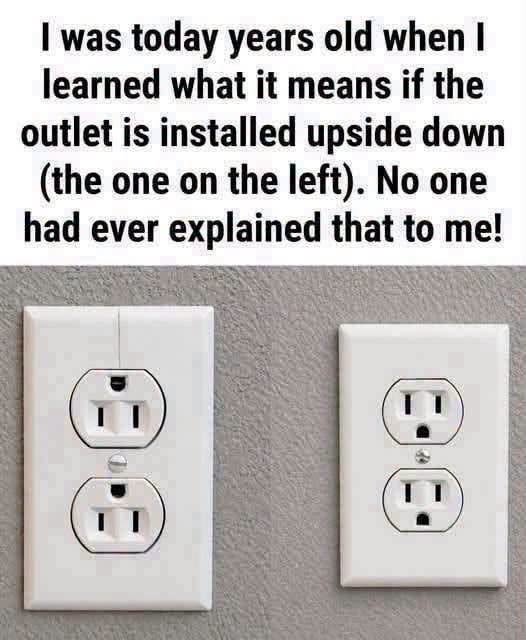
Why Is Your Electrical Outlet Installed Upside Down? The Practical Reason Might Surprise You
If you have ever looked at an electrical outlet and noticed that its grounding slot faces upward, you might have wondered whether an electrician installed it incorrectly. At first glance, the arrangement can look unusual, especially if most of the outlets in your home have their grounding slots facing downward. However, this orientation is sometimes intentional and may reflect a practical decision made during installation rather than a mistake.
One possible explanation goes back to the way homes were illuminated before overhead lighting became common in every room. In many older houses, wall switches were used to control lamps plugged into receptacles rather than ceiling fixtures. This arrangement allowed residents to turn on a table lamp or floor lamp as they entered a room without having to walk across a dark space to reach the light itself.
In homes designed around this approach, electricians sometimes installed outlets connected to wall switches. Depending on the installation practices used, an outlet with its grounding slot at the top could serve as a visual clue that the receptacle was intended for a particular purpose. The orientation might help distinguish a switched outlet from other outlets in the same room, although it was never a universal identification system.
This practice was especially useful in living rooms, bedrooms, and other spaces where lamps provided the primary source of light. A switch near the doorway could control a lamp across the room, making everyday routines more convenient. Instead of manually operating the lamp each time, a person could use the wall switch to illuminate the space immediately upon entering.
There is another practical detail worth understanding: sometimes, only one half of a duplex receptacle is controlled by a wall switch. The other half remains continuously powered. This arrangement allows a homeowner to connect a lamp to the switched socket while using the other socket for a device that needs uninterrupted power, such as a clock, charger, or another household appliance.
For example, imagine a bedroom with no ceiling light controlled by the main wall switch. A floor lamp plugged into the switched half of an outlet can provide the room’s primary lighting. Meanwhile, a bedside clock connected to the continuously powered half can keep running even when the wall switch is turned off. This setup offers convenience without requiring a separate wall switch for every device.
However, the grounding-slot orientation alone cannot confirm whether an outlet is switched. An outlet facing one direction may be continuously powered, while another facing the opposite direction may be connected to a wall switch. Electricians have different installation preferences, and local electrical requirements and established practices can vary.
The Role of the Grounding Slot
To understand why the orientation attracts attention, it helps to know the basic parts of a typical three-prong electrical receptacle. In many North American outlets, two openings provide the connections for the electrical supply, while the rounded or differently shaped opening is the grounding connection.
The grounding connection is an important part of the electrical safety system. When properly installed, it provides a path for fault current under certain fault conditions, helping protective devices such as circuit breakers operate as intended. It does not make an outlet harmless, and it should never be treated as a substitute for proper wiring, equipment condition, or electrical protection.
Turning an outlet so that its grounding slot faces upward does not automatically make it safer or less safe in every situation. The practical implications depend on the receptacle design, the equipment being plugged in, the installation, and the applicable electrical requirements.
One argument sometimes offered in favor of grounding-up installation involves a metal object falling behind a partially withdrawn plug. In a hypothetical situation, the object might contact the grounding pin before reaching the other electrical contacts. However, the actual outcome depends on the object’s shape, how the plug is positioned, and the geometry of the receptacle. This possibility should not be treated as a guarantee of protection.
For that reason, it is important to distinguish between a possible reason for choosing an orientation and a requirement that applies to every outlet. There is no universal rule that all receptacles must face one particular direction simply because the grounding slot is positioned at the top or bottom. Applicable local codes, manufacturer instructions, and the electrician’s installation practices are more relevant than assumptions based on appearance alone.
How Can You Tell Whether an Outlet Is Controlled by a Switch?
If you suspect that an outlet in your home is connected to a wall switch, a simple functional check may help clarify its purpose. You do not need to remove the receptacle cover or inspect the wiring to perform this basic test.
First, choose a small, working lamp that can be plugged directly into the outlet. Make sure the lamp itself is functioning properly before beginning. Plug it into one socket of the receptacle, turn the lamp on, and then operate nearby wall switches one at a time.
If the lamp turns off and on in response to a particular switch, that socket is likely controlled by the switch. If nothing changes, the socket may have a continuous power supply, although the result alone does not establish how the outlet is wired.
For a duplex receptacle, repeat the test using the other socket. It is possible for one half to be switched while the other remains powered continuously. Testing each socket separately is therefore more informative than checking only one side.
Remember that not every switch near an outlet controls that outlet. A switch may operate a ceiling fixture, another light, a fan, or a different electrical device entirely. If the purpose of a switch remains unclear, avoid making assumptions based solely on the position of the controls or the orientation of the receptacle.
Never remove an outlet cover, insert tools into the openings, or attempt to identify the wiring by touching electrical components. If you need to know exactly how the circuit is configured, a qualified electrician can inspect it using appropriate procedures and equipment.
What If the Outlet Looks Unusual or Has Become Loose?
An unusual orientation is not, by itself, evidence that an outlet is defective. Many receptacles are installed in different orientations for reasons that have nothing to do with damage or poor workmanship. Nevertheless, appearance should not distract you from signs of an actual electrical problem.
Warning signs include cracks in the outlet face, discoloration, scorch marks, a burning smell, buzzing or crackling sounds, unusual warmth, or plugs that repeatedly fall out of the receptacle. These symptoms may indicate a problem that needs professional attention.
If you notice any of these warning signs, stop using the outlet. Do not attempt to tighten internal connections or reposition the receptacle while it is energized. If there is smoke, active sparking, or a fire, move away and contact emergency services as appropriate. Otherwise, arrange for a qualified electrician to assess the problem.
It is also worth remembering that an outlet can appear perfectly normal while still having an electrical fault. A neat installation does not guarantee that the wiring is correct, just as an unconventional orientation does not automatically mean something is wrong.
Why Older Homes May Have Different Outlet Arrangements
Homes often reflect the technology and design preferences of the period in which they were built or renovated. In older properties, the location of lighting fixtures, the number of available wall switches, and the original electrical layout may differ considerably from modern expectations.
Some rooms may have been designed around portable lamps rather than ceiling fixtures. Others may have undergone renovations in which new lighting was added but older receptacles remained in place. Over time, these changes can produce a mixture of outlet orientations and switching arrangements within the same home.
An outlet that once served a specific purpose may also have been repurposed by a later homeowner. The lamp originally connected to a switched socket might have been replaced by another device, or a renovation might have changed the way the room is illuminated.
This is why it is unwise to assume that every unusual outlet reflects a deliberate historical convention. Sometimes there is a practical explanation; sometimes the orientation reflects the electrician’s personal preference, the requirements of the installation, or a later modification.
If you are purchasing an older house, renovating a room, or replacing receptacles, consider having the electrical system assessed as part of the broader inspection. A professional can identify switched outlets, evaluate grounding and wiring, and determine whether any improvements are needed.
The Bottom Line: Orientation Is a Clue, Not a Diagnosis
An electrical outlet with its grounding slot at the top may have been installed that way deliberately. In some homes, the arrangement may reflect a tradition of identifying switched receptacles used to control lamps, particularly when wall switches served as the main way to illuminate a room.
In other cases, the orientation may simply reflect an electrician’s preference or a particular installation practice. It does not automatically tell you whether the outlet is switched, whether it is wired correctly, or whether it meets all applicable requirements.
If you want to investigate the function of an intact outlet, use a small lamp and test nearby switches, checking each socket separately. Pay attention to signs of damage, and never open the receptacle or handle its wiring to satisfy your curiosity.
Ultimately, the most useful lesson is that an unusual detail in your home may have a practical explanation, but appearances alone rarely tell the whole story. Understanding how the outlet behaves—and seeking professional help when something seems wrong—is a much more reliable approach than judging its orientation.
Sometimes, what looks like an installation mistake is simply a design choice. The important thing is knowing the difference between an unusual arrangement and a genuine electrical safety concern.