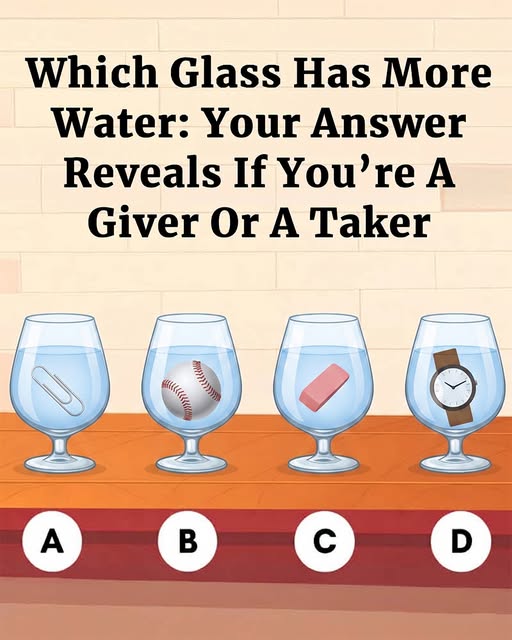
At first glance, the puzzle looks incredibly simple. Four identical glasses, labeled A, B, C, and D, are filled to what appears to be a similar level. Inside each glass is a different object: a paperclip, a baseball, an eraser, and a wristwatch.
The question seems easy: Which glass contains the most water?
Most people look at the glasses and make a quick decision based on the objects they see. Some focus on the size of the objects, while others try to guess which one takes up the least space. But this little visual challenge has an interesting twist. It combines a basic principle of physics with a psychological interpretation that encourages people to think about their instincts, habits, and relationships with others.
Before choosing an answer, however, it helps to understand what is happening inside each glass.
## The Hidden Logic Behind the Puzzle
The key to solving this challenge is a scientific principle known as water displacement. Whenever an object is placed inside a container of water, it occupies space that would otherwise be available to the liquid. Depending on the object’s volume and whether it sinks or floats, it displaces some of the water.
In simple terms, the more space an object occupies below the waterline, the less water the glass can contain at the same overall level.
Imagine filling four identical glasses with water. Now place a different object inside each one. Even if the water appears to reach the same height in every glass, the actual amount of water inside each glass may be different.
The object taking up the least submerged volume leaves the greatest amount of space for water.
Looking at the four objects:
– **Glass A – Paperclip:** The smallest object, occupying very little space.
– **Glass B – Baseball:** The largest object, taking up considerably more room.
– **Glass C – Eraser:** A medium-sized object that displaces more water than the paperclip.
– **Glass D – Wristwatch:** An object that generally occupies more space than a paperclip, depending on its design.
Based on the intended comparison, the paperclip displaces the least water. That means the glass containing it can hold the greatest amount of water.
<text weight=”semibold” color=”success”>Correct answer: Glass A, the paperclip.</text>
The important point is that the question is not asking which glass looks fullest. It is asking which one contains the greatest quantity of water. Those two things are not always the same.
There is one scientific detail worth remembering: the exact answer depends on the submerged volume of each object, not simply its name or apparent size. A floating object, for example, displaces water according to its weight, while a fully submerged object displaces water according to its volume. The intended answer assumes the paperclip occupies the least space in the water.
## What Your Choice Might Say About You
Beyond the physics, this puzzle introduces a psychological interpretation. Each answer is associated with a different way of approaching decisions and relationships. These descriptions are intended as a fun reflection exercise rather than a scientific personality test. Choosing one glass cannot reliably determine whether someone is generous, selfish, analytical, or emotional.
Still, the explanations can encourage an interesting question: What do we notice first when we are faced with a decision?
### If You Chose A – The Paperclip
You may be someone who pays attention to small details that other people overlook. Rather than automatically focusing on the biggest or most noticeable object, you look carefully at the situation and try to understand what is happening beneath the surface.
In the personality interpretation of this puzzle, choosing A is associated with a giver mindset. You may appreciate small gestures, remember thoughtful actions, and understand that generosity does not always have to involve something large or expensive.
People with this outlook often believe that little things can make a meaningful difference. A kind word, a few minutes of someone’s time, or a simple act of consideration can sometimes mean more than an impressive gift.
You may also prefer to think before making decisions rather than allowing appearances to influence your judgment. You recognize that something small can have a significant impact.
### If You Chose B – The Baseball
The baseball is the largest object in the group, making it one of the easiest details to notice. If you chose B, the interpretation suggests that you may naturally pay attention to what stands out most.
You might be drawn to visible results, obvious opportunities, and things that immediately capture your attention. When faced with several choices, you may initially focus on the biggest or most noticeable feature.
In this puzzle’s interpretation, that tendency is loosely connected with a taker mindset. However, that does not mean you are selfish or unwilling to help others. It simply suggests an opportunity to slow down and consider details that may not be immediately obvious.
Sometimes the most important part of a situation is not the thing that attracts the most attention. Looking beyond appearances can reveal information that might otherwise be missed.
### If You Chose C – The Eraser
The eraser represents a middle position in the puzzle. If you selected C, the personality interpretation describes you as someone who values balance and tends to consider different sides before reaching a conclusion.
You may appreciate fairness and believe that relationships work best when both people contribute. You understand that giving and receiving are both natural parts of human relationships.
You might be generous when someone genuinely needs help, but you also recognize the importance of personal boundaries. You do not necessarily believe that one person should always give while another constantly receives.
This balanced approach can be valuable in friendships, family relationships, and professional situations. Healthy connections usually require mutual respect, understanding, and effort from everyone involved.
### If You Chose D – The Wristwatch
The wristwatch is an object that can carry more meaning than its physical appearance suggests. It represents time, responsibility, memories, and the importance people place on different moments in life.
If you chose D, the puzzle’s interpretation suggests that you may be someone who thinks carefully about context and meaning. You might consider several possibilities before making a decision, sometimes spending more time analyzing a situation than other people would.
You may also be sensitive to timing and emotional details. You understand that doing the right thing is not always just about what someone gives, but also when and why they choose to give it.
This thoughtful approach can help you understand people more deeply. However, there may be times when overthinking makes simple decisions feel more complicated than they need to be.
## Giver Versus Taker: Understanding the Difference
The deeper theme of this puzzle is the difference between giving and taking. In everyday relationships, these two behaviors are not always as simple as they appear.
A giver is generally someone who willingly offers time, support, knowledge, or resources to help others. A taker, on the other hand, tends to focus more heavily on what they can receive from a relationship.
But real people are rarely defined by only one category.
Even generous people need help sometimes. Someone who usually supports others may eventually need someone to support them. Likewise, accepting help does not automatically make a person selfish.
Healthy relationships require a balance. Giving should not mean constantly sacrificing your own needs, and receiving should come with appreciation and respect.
The most important question is whether people treat one another with consideration. Do they recognize the effort others make? Are they willing to offer help when it matters? Do they respect boundaries instead of expecting everything from someone else?
These questions reveal far more about a person’s character than choosing one glass in a visual puzzle.
## Why Simple Puzzles Make Us Think
One reason challenges like this attract so much attention is that they begin with something familiar. Most people understand glasses, water, and everyday objects. There is no complicated equipment or advanced mathematics required.
Yet a simple question can make people pause and reconsider what they initially assumed.
The puzzle also demonstrates how easily our attention can be influenced by appearances. We may notice the largest object first, overlook a tiny detail, or make a decision before examining all the available information.
Taking a moment to think carefully can change the way we approach even ordinary situations.
That lesson extends beyond puzzles. In daily life, we often make judgments about people, opportunities, and circumstances based on what we see immediately. But the most important information is not always visible at first glance.
## Final Thought
Sometimes, the smallest object in the room can make the biggest difference.
In this challenge, the paperclip may look insignificant compared with a baseball, an eraser, or a wristwatch. Yet its small size is exactly what gives Glass A the advantage when it comes to holding the most water.
The physics provides a clear answer, while the personality interpretations offer an opportunity for reflection.
So, which glass did you choose when you first looked at the puzzle? Did you notice the paperclip immediately, or did another object catch your attention?
Whatever your answer, remember that a single choice cannot define your personality. But taking the time to look beyond appearances, question your first impression, and consider the details can teach you something valuable.
Sometimes, the biggest lesson really does come from the smallest things.