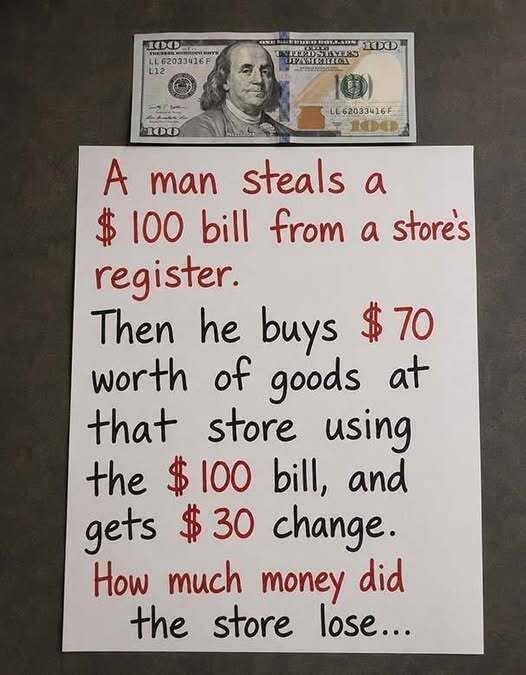
A simple question about a stolen $100 bill has confused more people than anyone expected. At first, it sounds easy enough to solve. A man walks into a store, steals a $100 bill from the cash register, and leaves. A little later, he returns to the same store, picks out $70 worth of merchandise, and pays for everything using the exact same $100 bill he stole earlier. The cashier accepts the money and gives him $30 in change.
Now comes the question: how much money did the store actually lose?
It sounds like a straightforward calculation, but the moment people start thinking about it, the answers begin to differ. Some say the store lost $200 because the thief took $100 from the register and then walked away with another $70 in merchandise and $30 in cash. Others insist the loss was only $100 because the original bill eventually returned to the register.
The puzzle is interesting because both explanations can sound convincing at first. The mistake comes from counting the same $100 bill twice, as though it represents two separate losses.
To understand the answer, it helps to slow down and look at what happened in order.
**Step One: The Initial Theft**
When the man steals the $100 bill, the store immediately loses $100 in cash. The register is now short by that amount. At this point, there is no merchandise involved, no purchase, and no complicated calculation. The thief simply takes $100 that belongs to the store.
**Step Two: The Man Returns to Buy Something**
The thief comes back and selects $70 worth of goods. He then hands the cashier the same $100 bill he stole earlier.
From the cashier’s perspective, the payment looks like an ordinary transaction. The store receives a $100 bill and gives the customer $30 in change. The thief leaves with $70 worth of merchandise and $30 in cash.
But something important has happened: the original $100 bill is back in the store’s possession.
**Step Three: Calculate What Is Missing**
The store originally lost $100 when the man stole the money. However, that same $100 bill was later returned through the purchase.
The original cash loss has therefore been canceled out. The store now has the $100 bill again, but it has given away two things in exchange: $70 worth of merchandise and $30 in change.
Add those amounts together:
– $70 in merchandise
– $30 in cash
Total loss: $100.
The store did not lose $200 because the original stolen bill was used to pay for the second transaction. Counting it once as stolen money and again as payment would count the same physical bill twice.
Another way to understand the puzzle is to imagine that the thief never stole the bill in the first place. If he had simply walked into the store with his own $100, bought $70 worth of goods, and received $30 in change, the store would have exchanged $100 in value for $100 in payment. There would have been no financial loss from the transaction itself.
The theft changes the situation because the customer did not bring his own money. He used the store’s money to pay for the purchase. In the end, the store has recovered its original $100 bill, but the thief has still walked away with $70 worth of goods and $30 in change.
That is the entire trick.
The puzzle catches people because they focus on the two separate moments when money changes hands instead of looking at the final result. They see the first $100 disappearing and the later $100 being handed over, then accidentally treat them as two different amounts of money.
But money must be counted according to its actual movement, not according to how many times it appears in the story.
So, how much did the store lose?
Exactly $100.
The thief walked away with $70 worth of merchandise and $30 in cash, while the original $100 bill ended up back in the register. The answer may seem surprising at first, but once every part of the transaction is separated and counted correctly, the mystery disappears.
Sometimes the hardest part of a simple math puzzle is not doing the calculation. It is avoiding the temptation to count the same thing twice.