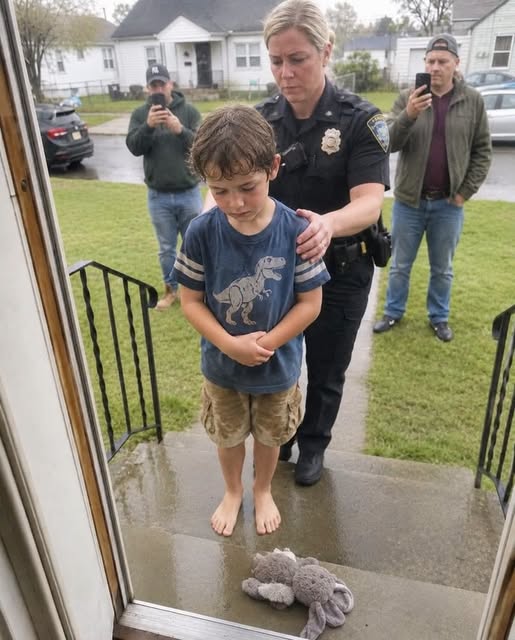
The little boy’s voice cracked as he spoke to the 911 operator. He was frightened, confused, and desperately trying to understand why his mother had not come home. She had promised him she would be back in thirty minutes. But thirty minutes had turned into hours, and then into days.
By the time four days had passed, the little boy was still alone inside the house. He was weak, hungry, and running out of strength. Every passing hour made him wonder whether his mother had forgotten him or whether something terrible had happened. He kept waiting for the familiar sound of the front door, hoping that the person he loved most would finally walk inside.
When emergency services received the call, officers immediately understood that they were dealing with a child who needed help. Neighbors had already begun talking. Some were angry, others were confused, and many had reached the same conclusion: the mother had abandoned her child.
But one officer was not convinced.
Her name was Officer Lena Brandt, and when she stepped inside the small house, she decided to look carefully before judging what had happened.
What she discovered would change the entire story.
## A Child Waiting for His Mother
The little boy, Eli, had been trying to make sense of the situation with the limited understanding of a child. His mother, Teresa, had told him she was going out and would return shortly. Thirty minutes was a promise he could understand. Four days was something entirely different.
He did not know about hospital procedures, road accidents, or the complicated circumstances that can separate a parent from a child without warning.
He only knew that his mother was missing.
By the time officers arrived, Eli needed immediate attention. He was exhausted and frightened, and the house was unusually quiet. The people outside had already formed their opinions, but the officer entering the home knew that the most important thing was to make sure the child was safe.
She approached him gently, reassured him that help had arrived, and began trying to understand what had happened.
Eli repeated the same explanation: his mother had promised to come back in thirty minutes.
For a child, that promise had become the center of everything. He had no way of knowing why it had not been kept.
## The Clues Inside the House
As Officer Brandt looked around, she noticed several details that did not fit the story of a mother who had simply walked away.
There was a shopping list left behind. Nearby was a medical reminder, along with medication belonging to Eli. These were ordinary objects, but together they suggested that Teresa had been planning to return and continue caring for her son.
The officer began looking at the situation differently.
The house did not tell the story of someone who had intentionally disappeared from her child’s life. Instead, the details suggested a mother who had been trying to manage difficult circumstances while making sure her son had what he needed.
There were signs of preparation and concern. The shopping list indicated that Teresa had intended to buy necessities. The medicine showed that Eli’s health required attention. The medical reminder suggested that his care was part of her daily responsibilities.
The more the officer examined the situation, the more important one question became:
If Teresa had intended to return, what had happened to her?
## The Sacrifice Nobody Knew About
The truth was that Teresa had been facing an incredibly difficult situation.
She had been struggling to provide for her family while also caring for a sick child. Money was tight, and ordinary expenses had become difficult to manage. Food, prescriptions, and medical needs were competing for the limited resources she had available.
But Teresa was determined to make sure Eli had what he needed.
In an act of desperation, she had sold her wedding ring to obtain money for groceries and medication. It was not simply another piece of jewelry. It represented memories, promises, and an important part of her personal history.
Yet she had been willing to give it up because her son’s needs came first.
She was not thinking about what she might lose emotionally. She was thinking about how to get food into the house and make sure Eli had the medicine he needed.
After arranging to buy the necessary supplies, Teresa set out to return home.
But she never made it back.
On the way, she was involved in a serious accident that left her unconscious and unable to communicate. She was taken to a hospital, where medical staff worked to treat her injuries.
While Teresa was receiving medical care, her little boy remained at home, waiting for the mother who had promised to return in thirty minutes.
Neither of them knew how much time was passing.
## When the Truth Finally Came Out
Once the circumstances of the accident were established, the entire situation began to make sense.
Teresa had not deliberately abandoned her child. She had been trying to provide for him when an unexpected emergency separated them.
The shopping list, medical reminder, and medication were no longer just objects inside a house. They were pieces of a story that had been misunderstood.
The neighbors who had been quick to judge suddenly had to confront the possibility that they had been completely wrong.
Some had whispered about Teresa. Others had assumed the worst without knowing what she had been going through. They had seen a child alone and immediately believed they understood the reason.
But they had not known about the wedding ring.
They had not known about the difficult choices Teresa had been making to keep food on the table. And they certainly had not known that she was lying unconscious in a hospital, unable to return to the little boy who was waiting for her.
When the truth became known, the neighborhood’s anger turned into shame and sadness.
People began to understand how easily appearances can lead to unfair conclusions. A situation that initially looked like neglect was actually the result of a terrible accident and a mother’s determination to care for her child.
## A Mother’s Return
Eli’s immediate safety became the priority. He needed food, medical attention, reassurance, and the support of responsible adults while his mother remained hospitalized.
After Teresa’s condition improved, she was able to recover and eventually reunite with her son.
One can only imagine what that moment meant to both of them.
For Eli, it meant that the person he had been waiting for had finally returned. The uncertainty and fear of those days could begin to give way to the comfort of having his mother beside him again.
For Teresa, it meant seeing her child safe after a period of separation she had never intended to happen.
She had left home believing she would return in half an hour. Instead, an accident had taken her away for days.
The reunion was a reminder of how quickly life can change and how helpless people can become when an unexpected emergency interrupts even the simplest plans.
## The Lesson the Neighborhood Never Forgot
The story left a lasting impression on the people who had witnessed it.
The neighbors had been ready to condemn Teresa without knowing the full circumstances. They had judged her actions based on what they could see, without considering what might have happened beyond their immediate view.
But the truth revealed something very different.
They saw a mother who had sacrificed something deeply personal to provide for her sick child. They saw a woman who had been doing everything she could with limited resources. And they learned that her absence had not been a choice.
The experience reminded everyone that there is often more to a person’s circumstances than what appears on the surface.
A parent struggling financially is not automatically an uncaring parent. A child left without supervision during an emergency is not proof that someone has deliberately abandoned them. And a person who cannot explain their situation may be facing circumstances that others cannot imagine.
That does not mean concerns about a child’s safety should be ignored. Eli needed help, and the neighbors were right to take his situation seriously by contacting emergency services. But there is a difference between protecting a child and rushing to condemn a parent before the facts are known.
Sometimes the most helpful response is to make sure someone is safe first and understand the full story afterward.
## Love Sometimes Requires More Than Anyone Sees
Teresa’s story is about more than a terrible accident. It is about the sacrifices parents make when they are trying to provide for their children, often without anyone knowing how difficult their circumstances have become.
Selling a wedding ring to buy food and medication is not an ordinary decision. It is the kind of choice that reflects how much a parent may be willing to give up to make sure a child has what they need.
But it is also a reminder that people should not have to face such difficult circumstances alone. Communities, neighbors, and support services can make an enormous difference when families are struggling.
The little boy who called 911 did exactly what he needed to do. He asked for help when he was frightened and alone. The officer who listened carefully helped uncover the truth. And the people around Teresa were given an opportunity to reconsider their assumptions.
In the end, Eli survived, Teresa recovered, and a family was given the chance to be together again.
The story leaves us with a simple but important lesson: never assume you know someone’s entire story from a single moment.
The person being judged may be fighting a battle nobody else can see. The parent being criticized may be making sacrifices that would break someone else’s heart. And the silence people mistake for indifference may actually be the result of circumstances beyond anyone’s control.
Sometimes love looks like flowers, hugs, and happy family photographs. Other times, it looks like a mother selling her wedding ring so her child can eat and receive his medicine.
And sometimes, the most important thing we can do for another person is to stop judging long enough to understand what they are going through.