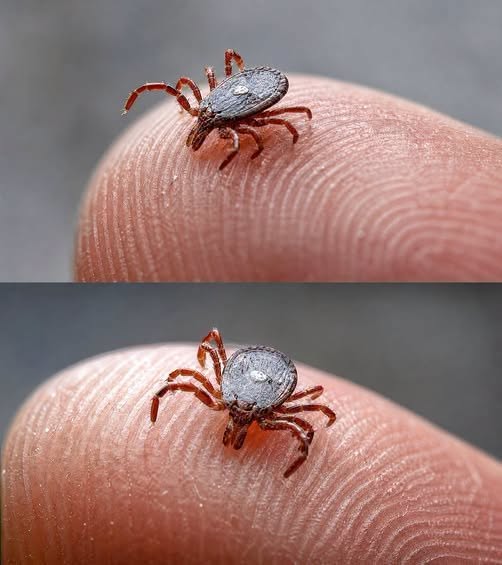
Finding it attached to your skin can feel like a betrayal. One tiny tick, almost motionless and silently feeding, while your mind immediately races through everything it could potentially leave behind. Infection? A strange rash? An allergic reaction? Something that might remain invisible for days or even weeks? You remove it, examine the spot, and tell yourself the problem is over—but the worry doesn’t always disappear with the tick. Suddenly every itch feels suspicious, every headache gets your attention, and every unexplained ache makes you wonder whether something has begun inside your body. Then you hear about something even stranger: a meat allergy that can sometimes develop after a tick bite.
Lone star ticks are small, but the uncertainty surrounding a bite can feel enormous. Recognizable in adult females by the distinctive pale or white spot on their backs, these ticks are found across large parts of the United States and can encounter people in wooded areas, tall grasses, brush, parks, yards, and other outdoor environments. Their size makes them easy to overlook, especially during their younger stages, when they can be extremely small.
Discovering one attached to you does not automatically mean you will become sick. Many tick bites never result in serious illness. Still, knowing how to respond correctly can reduce unnecessary risk and make the days afterward less confusing. The first priority is removing the tick as soon as reasonably possible without crushing or unnecessarily twisting it.
Fine-tipped tweezers are generally recommended for removal. Grasp the tick as close to the surface of the skin as possible and pull upward with steady, even pressure. Afterward, clean the bite area and your hands thoroughly. Depending on local guidance, you may discard the tick appropriately or keep it in a sealed container or bag in case identification later becomes useful.
Once the tick is gone, the hardest part can simply be waiting. There may be nothing dramatic to see immediately. The bite site might remain slightly red or irritated, and then seemingly return to normal. But some tick-associated illnesses do not announce themselves at the moment of the bite, which is why paying attention to how you feel during the following days and weeks can be important.
Symptoms such as fever, a spreading or unusual rash, significant fatigue, headaches, muscle aches, or other flu-like symptoms deserve attention, particularly when they develop after a recent tick exposure. Not every headache or tired day means an infection has occurred, but a healthcare professional should be contacted when concerning symptoms appear or worsen.
Lone star ticks have been associated with several illnesses, including ehrlichiosis and other conditions. This is also one reason identifying the type of tick and remembering approximately when the bite occurred can sometimes be helpful when speaking with a medical professional. Details that seem insignificant at first may provide useful context later.
But there is another unusual concern connected with lone star tick bites that has received increasing attention: alpha-gal syndrome. Unlike a typical food allergy that may cause symptoms within minutes, alpha-gal syndrome can involve a delayed allergic reaction to a sugar molecule called alpha-gal, which is present in most mammals but not in humans.
After certain tick bites, some people may develop antibodies that cause their immune system to react after consuming products containing alpha-gal. Foods such as beef, pork, and lamb can become unexpected triggers. For someone who has eaten these foods for decades without any problem, the sudden appearance of an allergic reaction can be deeply confusing.
The timing makes the connection even harder to recognize. Symptoms can occur several hours after eating rather than immediately after the meal. Someone might eat a hamburger at dinner, feel completely normal afterward, and then wake later with hives, itching, stomach pain, nausea, diarrhea, or swelling without realizing that the meal and the reaction could be connected.
In more serious cases, allergic reactions can involve difficulty breathing, dizziness, or other signs of anaphylaxis, which require emergency medical attention. Because reactions can vary considerably from one person to another, unexplained recurring symptoms after eating mammalian meat or certain mammalian-derived products should be discussed with a qualified healthcare professional, especially when there is a history of tick exposure.
Importantly, finding a lone star tick does not mean alpha-gal syndrome is inevitable. The association represents a potential risk, not a guaranteed outcome. Constantly interpreting every sensation as evidence of illness can create unnecessary anxiety. Awareness is useful precisely because it allows you to recognize meaningful patterns without assuming the worst.
Prevention remains one of the simplest ways to reduce future encounters. When spending time in wooded or grassy areas, wearing appropriate clothing and using an effective tick repellent can help. Staying toward the center of trails when possible and avoiding unnecessary contact with dense brush can further reduce exposure.
After returning indoors, checking your body carefully is another important habit. Ticks can hide around the waist, behind the knees, under the arms, around the hairline, behind the ears, and in other difficult-to-see areas. Showering after outdoor activity and checking clothing can help find ticks before they remain attached for long periods.
Pets deserve attention too. Dogs and other animals that spend time outdoors can bring ticks into the home, so regular checks and veterinarian-recommended tick prevention can protect both the animal and the people living around it. Maintaining yards by controlling tall grass, brush, and leaf litter may also make the immediate environment less attractive to ticks.
A tick bite can certainly be unsettling, especially once you learn about the infections and unusual allergic conditions associated with certain species. But knowledge turns uncertainty into something more manageable. Remove the tick correctly, clean the area, remember when the exposure occurred, and pay reasonable attention to your health afterward.
If concerning symptoms appear, seek medical guidance rather than trying to diagnose yourself from every ache or rash. And if delayed allergic reactions repeatedly occur after eating mammalian meat, mention both the food pattern and any history of tick bites to a healthcare professional. By checking yourself and your pets, taking sensible precautions outdoors, and responding promptly when meaningful symptoms develop, a frightening discovery on your skin becomes something you can handle with awareness rather than something that has to follow you with constant fear.