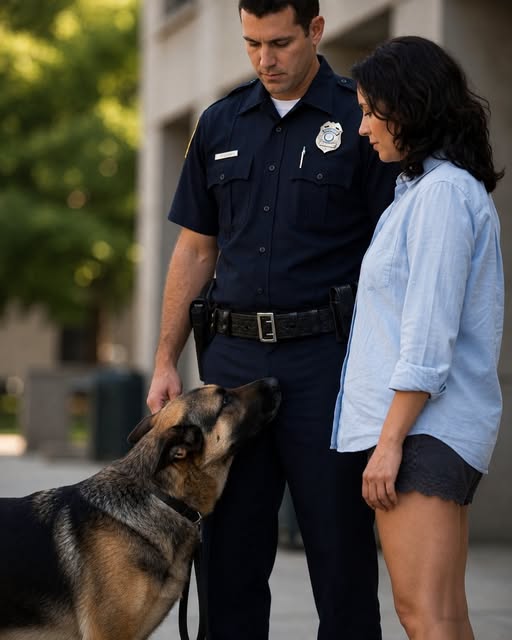
Dogs don’t care about your boundaries in quite the same way humans do. They can march straight past your comfort zone and head for one of the most private areas of your body, often at exactly the moment when friends, relatives, or complete strangers are watching. That sudden, humiliating crotch sniff can leave you stepping backward while everyone else laughs, but to the dog, nothing embarrassing has happened at all. The behavior isn’t random, and it isn’t a joke. In those few seconds, your dog may be collecting an extraordinary amount of information, decoding chemical signals and noticing details about your body that no human nose could possibly detect.
Dogs experience the world primarily through scent. Humans tend to rely heavily on vision and language when meeting someone new, but dogs gather much of their information through their noses. Every person carries a constantly changing mixture of natural odors, and to a dog, those smells can reveal clues about who that person is and what is happening inside their body.
The groin area happens to be especially interesting because it contains numerous apocrine sweat glands. These glands release substances that contribute to individual body odor and can carry chemical information. Similar glands are found in areas such as the armpits, but because dogs naturally investigate at roughly groin height, that part of the body can become an obvious target when they approach a person.
While you might be turning red with embarrassment, your dog is not thinking about social rules. From the animal’s perspective, sniffing is simply investigation. Dogs use scent when greeting other dogs, exploring unfamiliar environments, identifying objects, and determining whether something has changed. Investigating a human follows much the same logic.
A dog’s sense of smell is enormously more sensitive than ours. Their noses contain far more scent receptors than human noses, and a significant portion of the canine brain is dedicated to processing odor information. Depending on the substance involved, trained dogs can detect remarkably tiny concentrations of particular odors—sometimes at levels that seem almost impossible from a human perspective.
That sensitivity is why dogs have been trained for jobs ranging from locating missing people and detecting explosives to identifying certain biological changes. Research has also explored their ability to recognize odor patterns associated with stress, hormonal changes, and some medical conditions. This does not mean an ordinary pet can diagnose someone’s health by sniffing them, but it demonstrates just how much chemical information can exist in smells humans barely notice.
Hormonal shifts can also alter body odor. Dogs may therefore become unusually interested in someone whose scent has changed, including during certain biological or emotional changes. Stress itself can influence the chemicals released through sweat, potentially creating an odor profile that a sensitive canine nose notices even when the person believes nothing about them has changed.
To your dog, then, an intrusive sniff can function somewhat like an extremely detailed introduction. Humans shake hands, exchange names, notice facial expressions, and ask questions. Dogs investigate scent. The difference is that their preferred method of gathering information can collide spectacularly with human expectations about privacy and personal space.
Fortunately, respecting a dog’s natural instincts does not mean allowing the behavior whenever guests arrive. Punishing a dog harshly for sniffing may create confusion or anxiety because the animal is being corrected for performing a behavior that comes naturally. A more effective approach is often to teach the dog an alternative greeting that satisfies the desire to interact while keeping everyone comfortable.
One technique trainers commonly use involves teaching a “touch” or hand-targeting cue. The dog learns to place its nose against a person’s hand or closed fist when given the command. Each successful response can be followed by praise or a small reward, gradually turning the alternative behavior into something the dog actively wants to perform.
With repetition, the greeting becomes predictable. A guest enters, the dog approaches, and instead of immediately investigating the person’s body, the owner gives the familiar cue. The dog touches the offered hand, receives reinforcement, and begins learning that this polite interaction is more rewarding than pushing its nose somewhere unwanted.
Consistency matters. If intrusive sniffing sometimes receives laughter, attention, petting, or excitement and other times receives punishment, the dog may struggle to understand what humans actually expect. Calmly redirecting the same behavior again and again provides a clearer message: curiosity is acceptable, but there is a better way to greet people.
Guests can participate as well. Offering a hand for the trained greeting gives the dog something appropriate to investigate and can make nervous visitors feel more comfortable. Over time, many dogs begin offering the polite behavior automatically because they associate it with attention, praise, and positive interaction.
Understanding the reason behind the behavior can also make those awkward moments less frustrating. Your dog is not deliberately trying to embarrass you in front of company. It has no concept of the social humiliation humans attach to having their private space invaded. It is simply following one of its strongest biological tools for understanding the world.
The goal, therefore, does not have to be eliminating curiosity. It can be teaching your dog how to express that curiosity in a way that fits comfortably into human life. You protect your guests’ personal space without treating the dog’s natural behavior as something shameful or wrong.
And eventually, that awkward moment can become something much easier to manage. Instead of apologizing while pulling your dog away from a startled visitor, you offer the familiar cue, your dog touches the waiting hand, and everyone moves on. What once produced an uncomfortable laugh becomes a small ritual of communication—a compromise between the extraordinary world your dog experiences through its nose and the boundaries humans expect each other to respect.