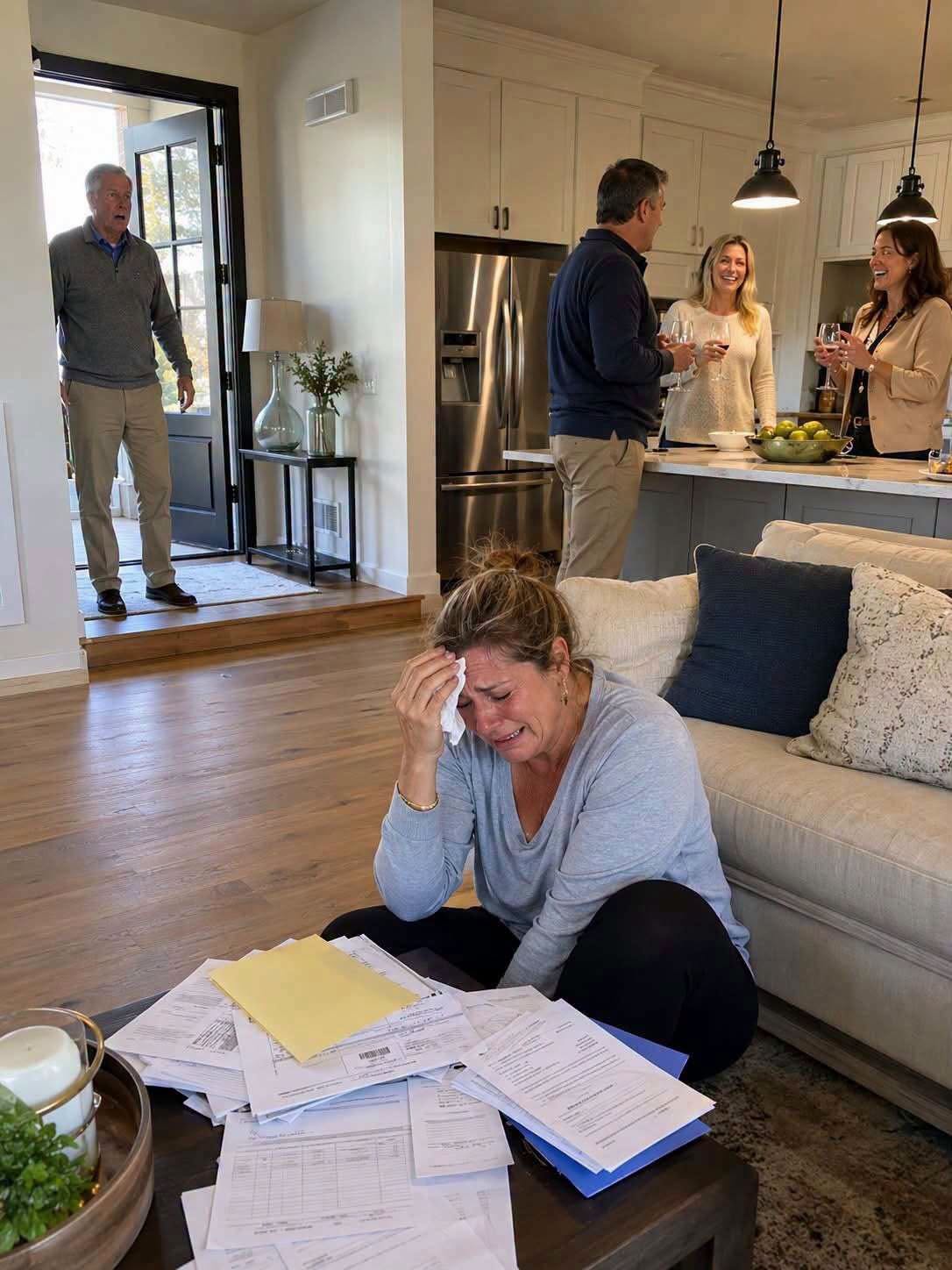
As the disagreements continued, Michael became increasingly frustrated with her refusal to cooperate. What had initially appeared to be a disagreement about money gradually turned into something far more troubling. Sarah tried to explain that the house was hers and that she had every right to decide what happened to it. She did not want to lose her mother’s gift to rescue a business whose future was uncertain, especially when she had never freely agreed to take on that responsibility. However, Michael seemed unwilling to accept that her answer could be final. He continued insisting that she needed to understand how much was at stake, as though his financial difficulties gave him the right to make decisions about her property. The tension between them grew, and it became increasingly clear that the conversation was no longer simply about finding a solution to the restaurant’s problems.
During one particularly heated confrontation, Michael grabbed Sarah by the arm as she attempted to pull away from him. Startled by his sudden aggression, she struggled to free herself. In the confusion that followed, she lost her balance and struck her head against the coffee table. The impact left her injured, and the situation immediately became much more serious than an argument over money or property. For a moment, everything seemed to happen at once. The argument, the physical contact, and Sarah’s injury transformed what had already been a frightening situation into an emergency that required immediate attention. It was clear that the priority was no longer to persuade Michael to listen or to settle the disagreement peacefully. Sarah needed protection, and the incident needed to be documented properly.
I realized that it was important to preserve what had happened rather than allow the situation to become a confusing argument about competing versions of events. I photographed Sarah’s injury and the documents connected to the proposed property transaction, making sure to record the details that might later help establish what had taken place. I then called 911 and kept the line open while the situation continued to unfold. Even though the atmosphere in the house was tense, I knew that getting help was more important than trying to handle everything privately. As I waited for the police and paramedics to arrive, I confronted the people gathered in the kitchen about what had happened and the troubling paperwork we had discovered. I wanted it to be understood that Sarah’s injury and the attempt to obtain control over her property could not simply be dismissed as an ordinary family disagreement.
The documents raised concerns that went beyond Michael’s attempts to persuade Sarah to sell the house. Among the paperwork was an authorization that appeared to direct the proceeds from any sale into a business account, a detail Sarah had not known about and had never knowingly agreed to. This discovery made the situation even more alarming. If the property had been sold under those arrangements, the money generated by the transaction might have been directed toward a business account rather than handled according to Sarah’s own wishes. The authorization suggested that there were financial arrangements she had not been properly informed about, raising serious questions about the purpose of the proposed transaction and whether her interests were being protected. Sarah had believed that Michael was asking her to consider selling the house to help the restaurant, but the paperwork indicated that the situation might be more complicated than he had admitted.
When the police and paramedics arrived, they took control of the immediate situation. Everyone involved was separated so that the responders could assess what had happened, provide medical assistance, and gather information without the confrontation continuing. The paramedics examined Sarah’s injury, while the police began recording the circumstances surrounding the incident. The photographs and documents became important pieces of information that could help clarify the events leading up to the emergency. Instead of allowing the argument to continue or relying solely on what each person claimed afterward, the authorities were able to begin documenting the incident and considering the evidence available to them. Although the presence of emergency responders did not immediately resolve every question, it created a record of what had happened and ensured that Sarah’s injury was taken seriously.
At the hospital, Sarah received treatment for the cut on her head. The experience had left her shaken, not only because of the physical injury but also because of the realization that someone she had trusted had allowed a dispute over money to escalate into physical aggression. She had entered the conflict believing that she was defending her right to keep her mother’s property, but she had ended up needing medical attention because she refused to give in to pressure. As she recovered, there was time to reflect on the seriousness of what had happened and the decisions that needed to be made next. The house represented her connection to her mother, but it had also become the center of a conflict that threatened her sense of safety. Protecting her inheritance now meant more than simply refusing to sell it; it meant ensuring that no one could continue pressuring her or making arrangements involving the property without her knowledge and consent.
In the days that followed, we worked to clarify the legal status of the house and determine whether any action had been taken to transfer or sell it. After reviewing the situation and confirming the relevant records, we established that nothing had been filed to complete the proposed transaction. The house remained legally hers, and the attempted arrangement had not resulted in a completed transfer. That confirmation brought a measure of relief after everything that had happened. Despite the pressure, the confrontation, and the troubling authorization included in the paperwork, Sarah had not lost the property her mother had left her. She still had the right to decide what would happen to it, and no completed sale had taken that decision out of her hands.
Knowing that the house remained hers was important, but we also understood that we could not simply return to our previous routines and assume that the problem had disappeared. The circumstances surrounding the confrontation had damaged our trust in Michael, and the possibility that he might continue trying to influence the property arrangements could not be ignored. We changed the locks to help protect the house and reduce the risk of another unwanted confrontation. We also consulted an attorney to understand Sarah’s rights, review the documents, and determine the appropriate steps for protecting her property and financial interests. Rather than relying on promises or trying to settle everything through another emotional conversation, we wanted clear information and proper legal guidance.
During this period, Michael continued sending Sarah messages, but the tone of his communication changed repeatedly. At times, he offered excuses and attempted to explain his behavior as the result of stress caused by the restaurant’s financial problems. At other times, his messages became angry, as though he believed Sarah was responsible for the consequences of his own decisions. There were also moments when he sounded desperate, emphasizing how much he needed help and how serious the situation had become for his business. Reading these messages made it clear that he was still focused on the crisis he was facing, but he did not consistently acknowledge the fear and harm Sarah had experienced. His financial difficulties might have explained why he was under pressure, but they did not justify grabbing her, disregarding her refusal, or involving her property in arrangements she did not understand.
Sarah found it difficult to process the contrast between the person she had known and the behavior she had witnessed. She had wanted to believe that Michael’s requests were motivated by a genuine desire to protect their future, and she had tried to consider his circumstances before making her decision. Yet the events surrounding the proposed sale had forced her to confront the possibility that her trust had been used against her. The undisclosed authorization was particularly troubling because it raised questions about how much she had been told and whether her agreement had been sought with a full understanding of the financial arrangements. She began to see that helping someone through a difficult period should never require abandoning her own rights, ignoring warning signs, or accepting responsibility for decisions she had not freely chosen.
Over time, Sarah became more confident in setting boundaries. She understood that she could care about another person without allowing that person’s financial problems to dictate her decisions. She could listen to someone’s concerns without agreeing to every demand, and she could refuse a proposal without having to defend that refusal endlessly. The house had become a powerful symbol of this realization. It was her mother’s gift, but it was also her own property, and she had the right to determine its future. She did not need to sell it to prove that she cared about Michael, nor did she need to sacrifice her security to demonstrate loyalty. Whatever happened to his restaurant, the responsibility for its financial survival could not simply be transferred to her through pressure or an arrangement she had never knowingly accepted.
Several months later, the immediate crisis had passed, and Sarah had begun to feel more secure in her own home. The locks had been changed, legal advice had helped her understand her position, and the property remained in her possession. Although the experience had left emotional scars, she was no longer living with the same uncertainty about whether someone else might make decisions about her future without her consent. One day, as we sat together on the porch, she spoke about what she had learned from everything that had happened. Her voice was calmer than it had been during the confrontation, and there was a sense of determination in the way she described the choices she intended to make from that point forward.
Sarah said that she would never again sign a document simply because someone she trusted insisted that it was necessary. She would take the time to read every page, ask questions about anything she did not understand, and seek independent legal advice whenever a decision involved something as important as her home or financial security. She had learned that trust did not mean giving up the right to understand an agreement, and that love or loyalty should never require her to surrender control over her own life. She also understood that she could say no without feeling obligated to make everyone else comfortable with her decision. Her signature belonged to her, just as her property and her future belonged to her.
As I listened to her, I realized that the experience had changed the way she understood both inheritance and independence. Her mother’s gift had always been meaningful because of the memories attached to it, but it now represented something more: the importance of protecting what had been entrusted to her and recognizing that her own wishes mattered. She had faced pressure to give it up, endured a frightening confrontation, and discovered that important financial arrangements had been made without her knowledge. Yet she had also taken steps to protect herself, sought appropriate help, and refused to allow the situation to determine the rest of her life. The house remained a place where she could make her own choices, rather than a resource that someone else could claim in the name of saving a struggling business.
The experience also showed us that financial desperation can create intense pressure, but it does not excuse coercion or violence. A struggling business may require difficult decisions, and asking for help is not inherently wrong. However, help must be freely offered, informed, and based on mutual respect. No financial emergency gives one person the right to control another person’s property, conceal important information about a transaction, or use physical force when they encounter resistance. Sarah’s refusal had been clear, and respecting that refusal should have been the end of the matter. The fact that it was not made the consequences of the confrontation even more serious.
In the end, Sarah did not lose the house her mother had left her. The property remained hers, and she gained a clearer understanding of the importance of protecting her rights, asking questions, and making decisions without fear or pressure. The experience could not simply be erased, and the damage to her trust was not something that disappeared overnight. But she had taken back control over the decisions that mattered to her and had begun rebuilding a sense of safety on her own terms. Sitting on the porch months later, she no longer spoke as someone who needed permission to protect her inheritance. She spoke as someone who understood that her choices deserved respect.
Her mother’s gift was still hers—not merely because the sale had never been completed, but because Sarah had refused to let pressure, fear, or someone else’s financial desperation take away her right to decide what happened to her own life.