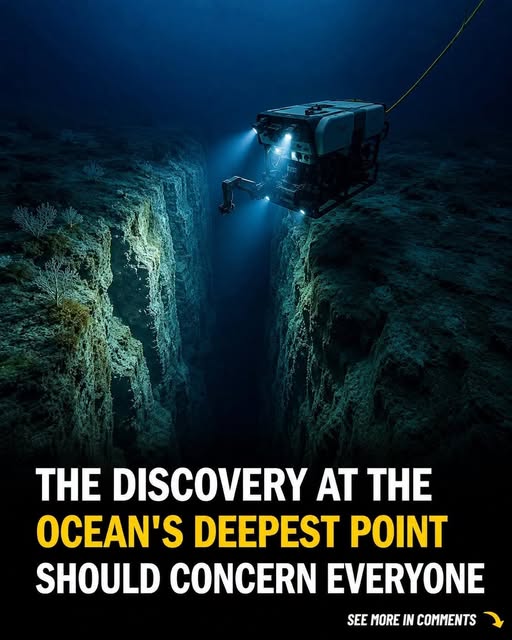
Depressing Find at the Bottom of the Mariana Trench Is a Warning to the World
The Mariana Trench is one of the most mysterious places on Earth. Hidden beneath the surface of the Pacific Ocean, its deepest region lies nearly 11 kilometers below sea level, where sunlight cannot reach, water pressure is enormous, and temperatures remain close to freezing.
For decades, scientists have explored this extraordinary environment to understand how life can survive under conditions that would be fatal to most organisms. They have discovered unusual deep-sea creatures, remarkable adaptations, and ecosystems that challenge our understanding of life on Earth.
But some of the discoveries made in the deepest parts of the ocean have revealed a troubling reality: even the most remote places on our planet are not completely protected from human pollution.
What scientists have found in the Mariana Trench is a reminder that the consequences of our everyday activities can reach places that most people will never see.
The Discovery That Shocked Scientists
One of the most disturbing findings came from a scientific study published in 2019. Researchers examined tiny shrimp-like animals called amphipods collected from six of the deepest ocean trenches on Earth, including the Mariana Trench.
The results were alarming.
Scientists found that 65 out of 90 amphipods examined had ingested at least one microscopic particle or fiber, including pieces of plastic and other synthetic materials. The animals had swallowed these particles even though they lived thousands of meters beneath the ocean’s surface.
These creatures survive in an environment where food is scarce and opportunities to feed are limited. They often scavenge on organic matter that sinks from the waters above. Unfortunately, that same process can carry human-made pollutants into their habitat.
The discovery raised an unsettling question: if pollution can reach animals living in one of the most inaccessible places on the planet, how many other ecosystems are already affected?
Scientists still need more research to understand the long-term consequences for deep-sea species, but the presence of plastic inside these animals demonstrates that the pollution problem extends far beyond beaches and coastal waters.
A Plastic Bag Nearly 11 Kilometers Beneath the Surface
The problem is not limited to microscopic particles.
Researchers have also documented larger pieces of human-made debris at extraordinary depths. One recorded discovery was a plastic bag found approximately 10,898 meters below sea level in the Mariana Trench, close to the deepest known part of the world’s oceans.
Think about what that means.
A plastic bag that may have originated from an ordinary human activity eventually reached a place where sunlight never penetrates and the pressure is more than a thousand times the atmospheric pressure at sea level.
The ocean does not simply make this waste disappear. Plastic can break into smaller pieces, spread through currents, and settle into deep-sea sediments. Some materials can persist for very long periods, although their lifespan depends on the type of plastic and the environmental conditions.
The Mariana Trench is therefore not just a symbol of the ocean’s extraordinary depth. It is also evidence that waste produced near the surface can travel much farther than many people realize.
How Does Plastic Reach the Deepest Parts of the Ocean?
Plastic pollution does not need to be dumped directly into a trench to reach it.
Several processes can transport it downward:
-
Rivers and coastal runoff: Plastic waste discarded on land can enter waterways and eventually reach the ocean.
-
Ocean currents: Floating debris can travel vast distances before sinking or becoming trapped in other parts of the marine environment.
-
Sinking organic matter: Plastic particles can attach to biological material or descend with debris as it moves through the water column.
-
Food chains: Marine animals can ingest contaminated material, allowing pollutants to move through ecological relationships.
Researchers studying deep-sea sediments have found evidence that microplastics accumulate in hadal trenches, including the Challenger Deep region. These findings suggest that the deepest ocean environments can act as repositories for pollution transported from elsewhere
This makes the problem particularly difficult to solve. Once debris reaches deep-sea environments, retrieving it can be extremely challenging, expensive, and potentially disruptive to fragile habitats.
Why This Discovery Matters for Marine Life
The deep ocean may look empty and lifeless from the surface, but it contains organisms uniquely adapted to extreme pressure, darkness, and limited food supplies.
Many of these species grow slowly, and scientists still know relatively little about their biology. This makes it difficult to predict how they will respond to long-term exposure to plastics and other contaminants.
Microplastics may be ingested by small organisms and potentially transferred through food webs. Depending on the material, its chemical composition, and the organism exposed, possible effects may include physical stress or exposure to associated chemicals. However, the exact consequences for animals living at extreme depths remain an active area of research.
The concern is not that scientists have proven every deep-sea animal is being harmed in the same way. Rather, pollution is reaching ecosystems that are poorly understood, where damage may be difficult to detect and even harder to reverse.
And that uncertainty is precisely why the findings deserve attention.
The Warning Hidden at the Bottom of the Ocean
For generations, the deepest parts of the ocean seemed almost completely separated from human civilization. They were distant, dark, and difficult to reach, giving the impression that they were protected from the environmental problems affecting the rest of the planet.
The evidence tells a different story.
Human activity has left traces even in places where almost no person will ever travel. A discarded bag, a synthetic fiber, or a microscopic fragment can become part of an environment that took millions of years to develop.
The lesson is not that the Mariana Trench is already destroyed, nor that every piece of plastic will have the same effect. It is that remoteness alone cannot protect nature from pollution.
Reducing unnecessary single-use plastics, improving waste collection, preventing litter from entering waterways, and supporting better waste-management systems can all help limit the amount of debris entering the ocean.
No single action will solve the problem, but preventing pollution before it reaches the sea is far more practical than attempting to recover it from depths approaching 11 kilometers.
The most depressing part of this discovery is not simply that scientists found plastic at the bottom of the ocean. It is that something we produce and discard in our everyday lives can reach one of Earth’s most remote ecosystems.
The Mariana Trench offers a powerful reminder: the planet’s most distant places are still connected to the choices we make on its surface.
And if pollution can reach the deepest known parts of the ocean, protecting the natural world requires us to look beyond what we can see from the shore.
Scientific context: This article is based on documented research into deep-sea plastic pollution. The findings do not establish that a single discovery has destroyed the Mariana Trench, but they do demonstrate that human-made debris has reached extreme ocean depths.