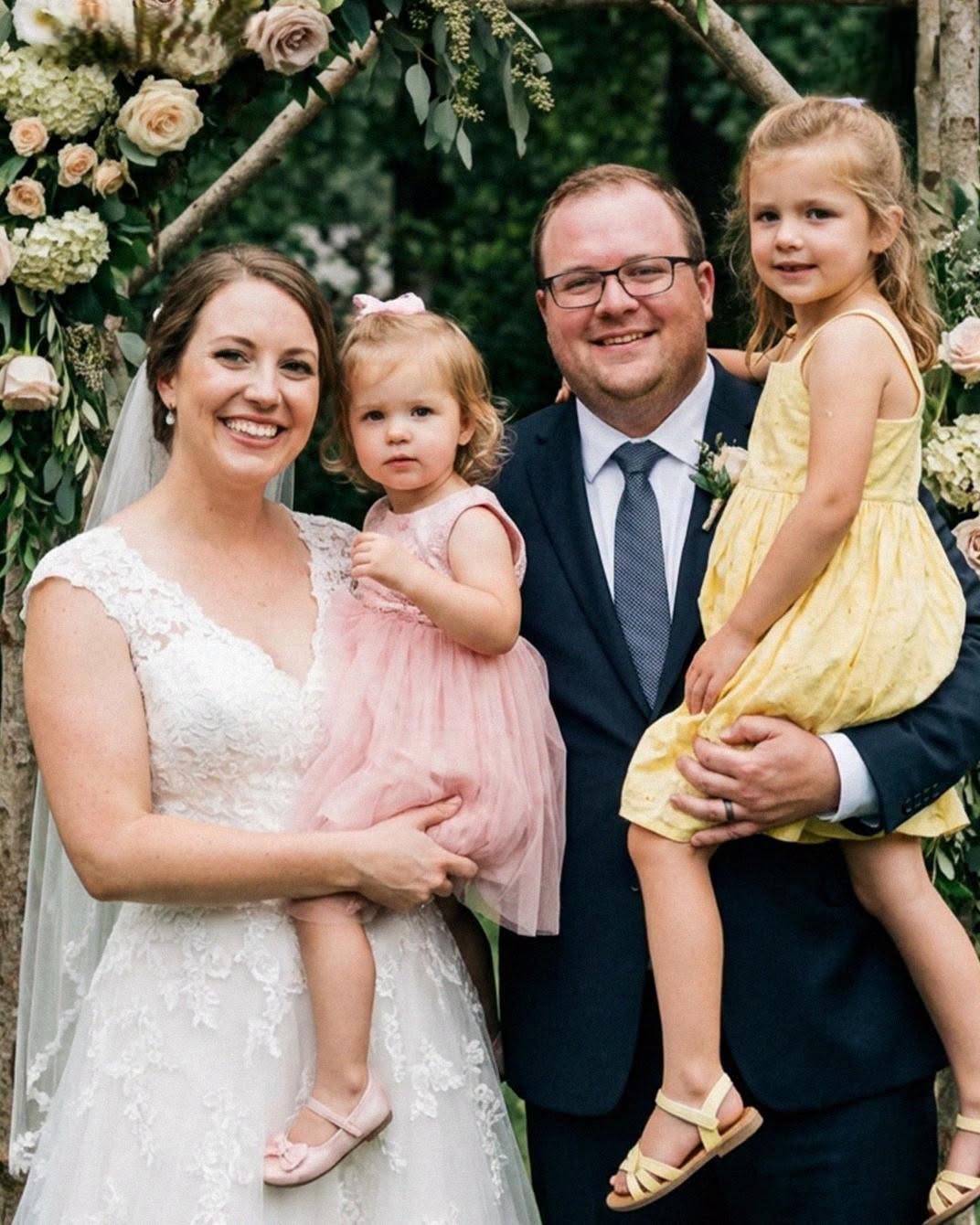
When I first met Daniel, I knew almost immediately that he carried a sadness unlike anything I had ever witnessed before. It wasn’t the kind of grief people spoke about openly or wore dramatically on their faces. His pain lived quietly beneath every smile, every pause in conversation, and every careful choice of words. On only our second date, before our relationship had even become serious, he looked directly into my eyes and shared the hardest truth of his life. His voice was calm, almost rehearsed, yet hollow in a way that told me he had repeated the story countless times simply to survive it.
He told me he was a widower.
Years earlier, he had lost his wife unexpectedly, leaving him alone to raise two little girls who had barely begun understanding the world around them. Grace had been only three years old when her mother died. Emily was still a baby—not even old enough to form lasting memories of the woman who had brought her into the world. Daniel spoke about them with overwhelming love, but every sentence carried the unmistakable weight of someone who still hadn’t figured out how to exist without the person he believed he’d spend his entire life beside.
That conversation could have frightened me away.
Instead, it made me admire him even more.
Over the months that followed, our relationship slowly deepened. I wasn’t simply falling in love with Daniel. I was gradually falling in love with the small family he was fighting so hard to hold together. By the time three years had passed and we stood together exchanging wedding vows, I couldn’t imagine my life without any of them.
Grace was six by then.
She possessed an unusual maturity for someone so young. She observed everything before speaking, often studying people with thoughtful eyes that made her seem far older than her years. There was a quiet intelligence about her, mixed with a sadness she rarely expressed aloud.
Emily, meanwhile, couldn’t have been more different.
At four years old, she was endless movement and unstoppable curiosity. She filled every room with laughter, questions, stuffed animals, scattered toys, and enough energy to exhaust every adult around her. Where Grace carefully analyzed the world, Emily simply ran headfirst into it.
I loved them both deeply.
From the beginning, I made one promise to myself.
I would never try to replace their mother.
No child deserves to feel as though someone is attempting to erase the person they lost.
Instead, I focused on becoming something different.
A safe place.
Another adult who loved them without conditions.
Someone who packed lunches, attended school plays, comforted nightmares, celebrated birthdays, and quietly reminded them every day that their family was still worthy of happiness.
Life settled into a comforting routine surprisingly quickly.
Our home was far from perfect.
Crayon drawings decorated the refrigerator.
Laundry occasionally piled higher than anyone wanted to admit.
Stuffed animals seemed to multiply overnight.
The living room constantly looked as though a tiny tornado had passed through it.
It felt wonderfully alive.
Yet amid all that warmth existed one strange detail that never seemed to fit.
The basement door.
Unlike every other room in the house, it remained locked at all times.
Not occasionally.
Always.
The heavy brass doorknob rarely showed signs of use, yet Daniel made absolutely certain it stayed secured. The contrast struck me immediately because nothing else in our home carried that sense of secrecy.
One evening while we cleaned up after dinner, I casually asked about it.
“Oh, that’s just storage,” Daniel answered almost instantly.
“What kind of storage?”
He shrugged.
“Old tools. Paint cans. Boxes we haven’t unpacked.”
He smiled reassuringly.
“Nothing exciting.”
Then he added with a small laugh, “Mostly I just don’t want the girls wandering downstairs and getting into something dangerous.”
The explanation sounded completely reasonable.
So I accepted it.
For a while.
But children notice things adults often overlook.
And children are naturally fascinated by places they’re told not to explore.
Over the following months, I began observing little moments that slowly chipped away at Daniel’s explanation.
Grace frequently lingered near the basement hallway.
She never touched the door.
She simply stood quietly staring at the brass knob whenever she thought nobody was watching.
Emily behaved differently.
She often wandered toward the hallway almost absentmindedly before suddenly remembering something and hurrying away with the unmistakable guilty expression children wear when they’ve nearly revealed a secret.
At first I dismissed these moments.
Eventually they became impossible to ignore.
Something connected those girls to that locked door.
Something Daniel hadn’t told me.
The truth arrived on an otherwise ordinary Tuesday afternoon.
Daniel had already left for work early that morning.
Both girls were home with minor colds.
Their illnesses followed the familiar rhythm every parent recognizes—one moment they were dramatically exhausted beneath blankets insisting they were too sick to move, and twenty minutes later they were chasing each other through the house playing hide-and-seek as though nothing had ever been wrong.
I stood in the kitchen stirring homemade chicken soup while Emily sat coloring at the table.
Grace quietly entered without saying a word.
Something about her expression immediately caught my attention.
She looked unusually serious.
Almost… determined.
She waited until Emily wandered briefly into the living room.
Then she looked directly into my eyes.
Her voice remained calm.
“Do you want to see where Mommy lives?”
Everything inside me stopped.
The spoon slipped from my hand and clattered softly against the pot.
“What… did you say?”
Grace repeated herself with the same quiet certainty.
“Do you want to see where Mommy lives?”
Before I could respond, Emily skipped back into the kitchen clutching her stuffed rabbit.
She smiled brightly.
“Mommy’s downstairs.”
The room suddenly felt colder.
My heartbeat became painfully loud inside my chest.
Every logical explanation vanished beneath a flood of impossible questions.
Children sometimes say strange things.
Children process grief differently.
Yet something about their complete confidence terrified me.
Grace gently reached for my hand.
“Come on.”
She began leading me toward the hallway.
Toward the basement door.
My mind exploded with horrifying possibilities.
Every true crime documentary I’d ever watched.
Every disturbing news story I’d ever read.
Every unimaginable secret someone could hide inside a locked basement.
A hidden body.
A prisoner.
Evidence of something unspeakable.
Or perhaps something psychologically devastating that Daniel had never admitted.
I should have waited.
I should have called him first.
Every rational instinct told me to stop.
Yet another part of me couldn’t ignore the urgency in Grace’s voice.
She genuinely believed she was showing me something important.
When we reached the basement door, she looked up at me expectantly.
“Daddy keeps the key.”
I stared at the old lock.
Then slowly reached into my hair.
Two small hairpins slid free from my bun.
Years earlier, a college roommate had jokingly taught me how to pick simple locks.
I had never imagined actually needing the skill.
My hands trembled violently as I inserted the pins.
The hallway became unnaturally silent.
Then…
Click.
The lock released.
The sound echoed through the house like a gunshot.
Slowly…
I opened the door.
A wave of stale, damp air drifted upward immediately.
The smell struck me first.
Moist earth.
Old concrete.
Dust.
A faint scent of candles long since extinguished.
Nothing smelled dangerous.
Yet everything felt unbearably heavy.
The girls quietly followed behind me as I descended the wooden staircase.
With every step, my fear gradually transformed into something entirely different.
Not horror.
Heartbreak.
The basement wasn’t a crime scene.
It was a memorial.
A shrine.
A living tomb built entirely from grief.
An old couch sat carefully arranged in one corner.
A familiar cardigan rested casually across one arm exactly as though someone had removed it only moments earlier and intended to return.
Shelves lined every wall.
Each overflowed with framed photographs of Daniel’s late wife.
Candles.
Fresh flowers.
Children’s drawings.
Family keepsakes.
Little handwritten notes.
A tiny tea set rested neatly on a child-sized table.
Beside it sat two miniature chairs.
On the opposite wall stood a television surrounded by carefully labeled home videos.
“Zoo Trip.”
“Grace’s Birthday.”
“Christmas Morning.”
“Our Beach Vacation.”
Every tape represented another memory frozen forever.
Grace smiled gently.
“This is where Mommy lives.”
I looked at her, unable to speak.
“Daddy brings us down here.”
Emily nodded happily.
“We watch Mommy on TV.”
Then she innocently added words that shattered my heart completely.
“And Daddy cries.”
I slowly looked around the room again.
Everything suddenly made horrifying sense.
Daniel hadn’t simply preserved memories.
He had built an entire physical world where his grief remained permanently alive.
Instead of helping his daughters understand death, he had unintentionally blurred the boundary between memory and reality.
Somehow…
These little girls genuinely believed their mother still existed downstairs.
That her presence belonged beneath the house.
That this room was where they visited her.
I felt tears sting my eyes.
Walking farther inside, I noticed a notebook resting beside the couch.
Curiosity overcame hesitation.
I carefully opened it.
Every page contained handwritten letters.
To his wife.
Some were only a few lines.
Others stretched across multiple pages.
He described birthdays she had missed.
Funny things the girls had said.
Moments when he desperately wished she could still see them growing up.
Questions he wished he could ask.
Apologies.
Confessions.
Promises.
The pages were soaked in raw grief that had never truly healed.
It felt deeply personal.
Almost sacred.
I stood frozen in the middle of that heartbreaking room, overwhelmed by compassion and confusion all at once.
I understood why Daniel couldn’t let go.
I understood how devastating his loss must have been.
But I also understood that grief had quietly become something else.
It had become a place where his daughters were still being invited to live.
Then…
Above us…
The unmistakable sound of the front door opening echoed through the house.
Footsteps.
Heavy.
Familiar.
Daniel was home.
For one suspended moment, nobody moved.
Then I heard his voice calling gently upstairs.
“Honey?”
Silence.
Another step.
Then another.
Until suddenly…
His footsteps stopped completely.
He had seen the basement door standing open.
And in that instant, I realized the one secret he had spent years protecting had finally been uncovered—not by suspicion or betrayal, but by the innocent honesty of two little girls who had never realized it was supposed to remain hidden.