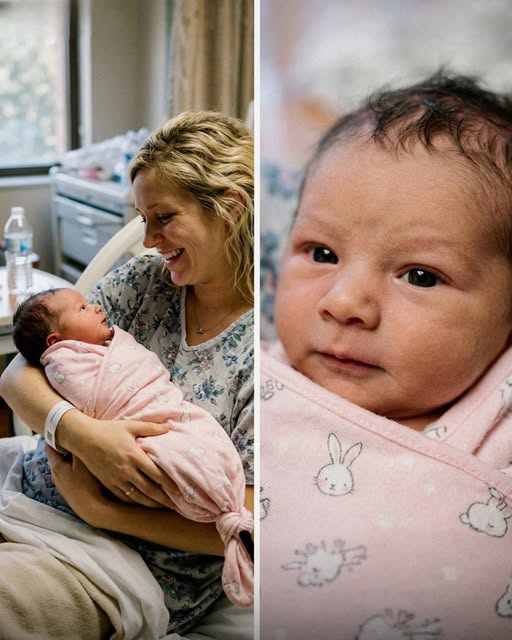
I thought the hardest part of becoming a mother would be surviving childbirth.
I was wrong.
Eighteen hours of labor pushed me to the edge of everything I thought I could endure. My blood pressure rose, then dropped without warning. The steady rhythm of the monitors turned into sharp, urgent alarms, and I caught those quick, silent glances between the doctors—the kind that say more than words ever could.
“We need to get this baby out now,” Dr. Martinez said, her voice calm but urgent.
I remember gripping Ryan’s hand so tightly my fingers ached. He didn’t pull away. Instead, he leaned closer, his voice shaking but determined.
“Stay with me, Julia. Stay with me. I can’t do this without you.”
Then everything faded.
The pain disappeared. The noise went silent. It felt like drifting—like I was being pulled somewhere far beyond that room, beyond everything. And still, somehow, I fought my way back. Maybe it was his voice anchoring me. Maybe it was the deep need to meet the life I had carried for so long.
When I finally opened my eyes hours later, Ryan was the first thing I saw.
He looked different. Drained. Older, somehow. His eyes were red, his face pale—like he hadn’t just witnessed a birth, but something far more terrifying.
“She’s here,” he whispered. “She’s perfect.”
Then they placed her in my arms.
Lily.
Seven pounds, two ounces—so small, yet so complete it hardly felt real. I had never seen anything more beautiful.
“Do you want to hold her?” I asked softly.
Ryan nodded, careful, almost hesitant as he took her from me. But the moment he looked at her face, something shifted.
It was subtle. Just a flicker—like a shadow passing over light.
He stared for a second… then quickly handed her back.
“She’s beautiful,” he said. “Just like her mama.”
But the warmth wasn’t really there.
At first, I told myself it was exhaustion. We had just been through something overwhelming. Nothing about those days was normal.
But when we got home, the distance didn’t fade.
It deepened.
Ryan still helped—feeding her, changing her—but he never truly looked at her. His eyes hovered just above her face, as if meeting her gaze required something he didn’t have. Whenever I tried to capture those quiet, perfect moments every parent wants to remember, he always found a reason to step away.
“I should check the mail.”
“I’ll start dinner.”
Small things. Innocent things.
Until they weren’t.
About two weeks later, I woke in the middle of the night to an empty bed and the soft click of the front door closing.
The first time, I ignored it.
The fifth time, I couldn’t.
“Where were you last night?” I asked one morning, trying to keep my voice steady.
“Couldn’t sleep,” he said, staring into his coffee. “Went for a drive.”
That’s when something inside me shifted.
If my husband was leaving every night while I stayed home with our newborn, I needed to know why.
So the next night, I pretended to be asleep.
I listened as his breathing deepened, then steadied. I waited until the quiet creak of the floorboards confirmed what I already knew—he was leaving again.
As soon as the door closed, I followed.
He drove farther than I expected—past familiar streets, beyond the places we used to go together, into parts of the city that felt distant and unfamiliar.
Eventually, he pulled into the parking lot of a worn-down building with a flickering sign: Hope Recovery Center.
I stayed back, watching as he sat in his car, unmoving, like he was gathering the strength to go inside.
Ten minutes later, I moved closer.
Voices drifted through a half-open window—low, steady, raw.
“The hardest part is looking at your child and remembering how close you came to losing everything.”
My breath caught.
I knew that voice.
Ryan sat in a circle with strangers, his head in his hands, his shoulders shaking.
“I keep seeing it,” he said, his voice breaking. “Her in pain. The doctors rushing. Me holding our daughter while my wife is dying beside me. I can’t look at Lily without reliving it. I feel helpless… angry… terrified.”
Tears slipped down my face before I even realized I was crying.
“I love them both,” he continued. “But every time I get close, I feel like it’s all going to be taken away again.”
An older woman spoke gently.
“You’re not broken, Ryan. You’re processing trauma.”
I sank down beneath the window, my chest tightening with a different kind of pain.
This wasn’t rejection.
It wasn’t regret.
It was fear.
The kind that buries itself deep and convinces you that loving something too much means risking everything.
For thirty minutes, I stayed there, listening.
Listening as he talked about nightmares. About avoiding holding Lily too close because he was afraid she would feel his anxiety. About keeping his distance to protect her until he could be better.
“She deserves a father who isn’t afraid,” he said.
And all this time, I thought he was pulling away from us.
But he was trying—quietly, desperately—to become stronger for us.
The next morning, while Lily slept, I called the center.
“My husband has been coming there,” I said. “I think I need help too.”
They didn’t hesitate.
That week, I sat in a room full of women carrying the same invisible weight I had been holding.
Fear. Confusion. Silence.
I learned that trauma doesn’t belong to just one person. It spreads, settles, reshapes everything—if you let it.
But it can also be faced.
Together.
That night, I waited for Ryan.
When he walked in, he froze, seeing me awake, Lily in my arms.
“We need to talk,” I said quietly.
His face went pale.
“Julia, I—”
“I followed you,” I said gently. “I know.”
He looked like he had been caught doing something unforgivable.
“I didn’t want you to worry. You’ve already been through enough.”
I stepped closer, placing Lily between us.
“We’re not meant to carry this alone,” I said. “We’re a team.”
For the first time since she was born, he looked directly at her.
Really looked.
“I was so scared of losing you both,” he whispered.
“You didn’t,” I said softly. “And you don’t have to be afraid by yourself anymore.”
Two months later, things are different.
Not perfect—but real.
Ryan holds Lily every morning now. Sometimes I catch him watching her—not with fear, but with something softer. Something steady.
Love, finally free of shadows.
And I’ve come to understand something I never expected:
Sometimes distance isn’t absence.
Sometimes it’s a quiet battle someone is fighting—just to find their way back