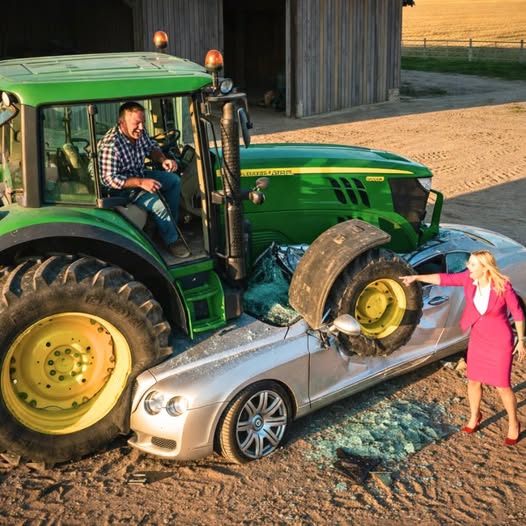
That morning didn’t begin like an ordinary morning. It didn’t ease in gently or offer any sense that it would pass like the others. It arrived already heavy, already charged with something unspoken. Dew clung to the grass like it hadn’t decided whether to stay or vanish. The cattle were restless, calling out for feed earlier than usual, their low sounds carrying across the field with a kind of impatience I couldn’t ignore. I remember standing there with a mug of coffee in my hand, still warm enough to be comforting, and realizing that even the air felt different—like it was holding its breath.
And then I saw her car.
It was parked where it had no right to be, blocking the barn entrance as if the rules of property, courtesy, and basic sense didn’t apply to her at all. Chrome shining clean in the morning light, positioned with deliberate certainty, like a statement instead of a mistake. I didn’t need to ask how long it had been there. I already knew it had been left that way on purpose.
When I walked over, she was already watching me.
There was a kind of practiced calm in her expression, the sort people wear when they believe they cannot be challenged. When I asked her to move it, she smiled. Not apologetically, not even politely—just that steady, dismissive smile that said my words didn’t carry weight in her version of the world. When I mentioned the sheriff, she smiled again, like the system itself was something she had already accounted for. And when the sheriff arrived and gave nothing more than a tired shrug, she smiled a third time, as if each response only confirmed her position rather than questioned it.
It wasn’t just the car anymore. It was everything behind it—the fines that never seemed to land, the complaints that went nowhere, the way every boundary I tried to draw got quietly stepped over and smoothed out like it had never existed. It felt less like conflict and more like erosion.
I didn’t argue with her. I didn’t raise my voice. There was no speech prepared, no dramatic warning, no attempt to win a conversation that had already stopped being a conversation a long time ago. I just turned away from the driveway, walked past the house, and into the shed where the air always smells faintly of oil and dust and work that hasn’t been finished yet.
The tractor key was right where it always was.
I didn’t think about consequences in that moment—not in a clean, calculated way. I thought about space. About access. About what it means when something so basic as your own barn becomes something you have to ask permission to reach. The engine started with a low, steady sound that didn’t match the tension in my chest. I drove it forward slowly at first, the way you do when you’re testing whether reality is going to stop you before you commit to it.
It didn’t.
What happened next wasn’t clean, and it wasn’t quiet. Metal gave way in a sound that didn’t feel real at first, like something too large to be happening in a place that small. Glass fractured outward in sharp bursts that caught the light for half a second before falling. The car didn’t resist so much as it collapsed under the certainty of what was happening to it. Every inch of control it had represented dissolved in a way that couldn’t be put back together afterward.
And for the first time, she wasn’t smiling.
People came out of their houses. Not rushing, not panicking—just drawn by the kind of noise that forces attention. The sheriff stayed where he was for a moment longer than I expected, watching the scene unfold with a different kind of focus. When he finally stepped closer, his assessment wasn’t theatrical or emotional. It was procedural. Blocked livestock access. Clear obstruction. A pattern of unresolved complaints suddenly made visible in a way no meeting had ever managed to capture.
That was the part that changed everything—not the damage itself, but the context around it finally being seen.
By the time the emergency meeting was called, the story had already left the property and spread into every corner of the community. Not as rumor, but as something people were finally willing to attach their own experiences to. One by one, neighbors spoke—not loudly at first, but steadily. A blocked driveway here. A threatened complaint there. A fine that arrived without explanation. A conversation that ended with silence because speaking up never seemed worth the cost.
The room didn’t erupt. It shifted.
What had once been tolerated started to look, in hindsight, like something no one had known how to name. And once it was named, it became harder to defend.
When the vote came, it wasn’t framed as punishment. It wasn’t framed as victory either. It was framed, quietly, as correction—an attempt to bring something back into alignment that had drifted too far for too long.
Afterward, things didn’t become perfect. They rarely do. But they became workable again in a way they hadn’t been for a long time. The barn wasn’t blocked anymore. The cattle moved freely. The land felt like it belonged to itself again instead of being negotiated over in small daily battles.
And where the car had once sat, there was only dirt now—pressed flat, slightly scarred, but open. A mark that didn’t pretend nothing had happened, and didn’t need to. Just a reminder that sometimes control doesn’t fade away politely. Sometimes it breaks.