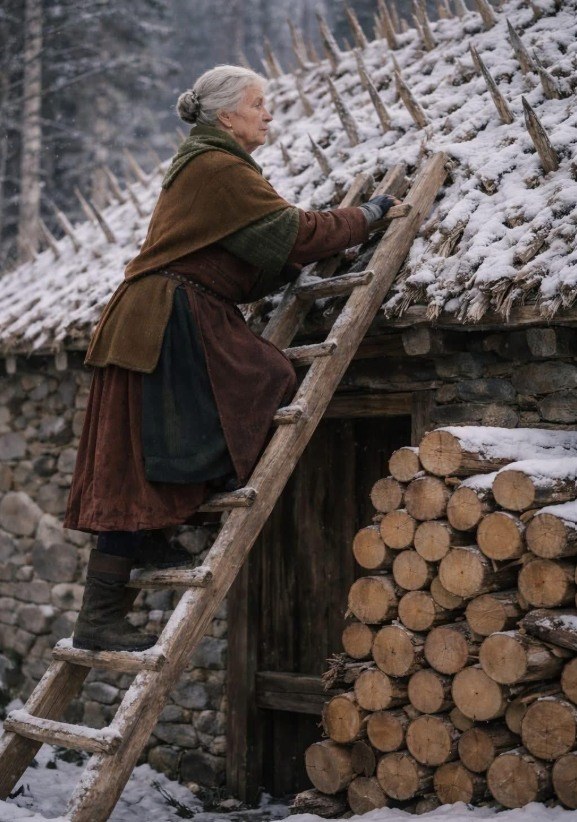
The warm golden light of the summer of 2026 usually brought comfort to the quiet valley village of Oakhaven. The air buzzed with cicadas, children splashed through irrigation ditches, and evenings carried the peaceful rhythm of small-town life. Yet amid that familiar calm, something strange began unfolding at the center of the village. Martha, an elderly widow whose weathered face reflected eighty years of mountain hardship and survival, started a ritual so unusual that people slowly began questioning whether grief had finally stolen her mind.
Martha had lived in the same small cottage for more than fifty years, most of them spent beside her husband Elias. Ever since his death the previous winter, she had withdrawn almost completely from public life. She rarely attended church gatherings anymore, seldom visited the market, and seemed to drift silently through the village like a shadow of herself. So when neighbors spotted her climbing onto her roof carrying heavy tools and bundles of sharpened wooden stakes, curiosity spread quickly through Oakhaven. At first, people assumed she was patching storm damage or repairing old shingles. But as the days passed, it became obvious that Martha was doing something entirely different — and deeply unsettling.
Every morning before sunrise, while the valley still rested beneath cool mist and quiet birdsong, Martha climbed her old ladder with careful determination. Piece by piece, she hammered sharpened wooden stakes directly into the beams and shingles of her roof. She wasn’t removing damaged material or reinforcing weak sections. She was deliberately transforming the roof itself. By the middle of July, her little cottage no longer resembled an ordinary home. Jagged rows of spikes covered the roofline completely, jutting toward the sky like the spines of some enormous prehistoric creature.
Naturally, the rumors began immediately.
At the bakery, the post office, and outside the church, villagers whispered about Martha’s strange behavior. Thomas, the local carpenter, shook his head every time he walked past her cottage. “She’s finally lost herself after Elias died,” he muttered to anyone willing to listen. “You don’t drive stakes through a roof unless you want rot and water damage.” Younger residents were even crueler. Teenagers filmed her from a distance and joked online about the “Witch of Oakhaven” building defenses against invisible enemies. Some believed she was trying to scare birds away. Others joked that she feared creatures falling from the sky.
Martha ignored all of it.
While the rest of the village mocked her quietly, she spent her afternoons in the small shed behind her cottage carefully carving new stakes from seasoned oak and ash branches. She examined every piece of wood with remarkable patience, testing its grain and strength before sharpening it into precise six-inch points. Each stake was coated in a homemade resin mixture designed to resist moisture and decay. Whenever anyone finally gathered enough courage to ask what exactly she thought she was doing, Martha gave the same cryptic answer every time:
“The wind remembers things. I’m only listening to what the old ones taught us.”
That sentence only convinced people further that grief had damaged her mind.
As summer faded into autumn, the spikes continued multiplying across her roof until nearly every inch was covered. From far away, the cottage looked dark and threatening compared to the neat homes surrounding it. Even the local constable eventually visited, pretending to check on her safety while secretly trying to determine whether she posed a danger to herself. Instead, he found Martha calm, intelligent, and completely aware of everything around her. Her kitchen was spotless. Her thoughts were clear. She discussed weather patterns, harvest seasons, and village life with perfect lucidity. But when he asked about the roof, she simply smiled politely and refused to apologize for it.
Then winter arrived.
The oldest residents in Oakhaven sensed something unusual in the air long before official forecasts noticed anything wrong. The atmosphere felt heavy, dense, unnatural. In late December, temperatures shifted violently as a rogue polar vortex collided with warm southern air, creating a massive storm system that no meteorologist had properly predicted. The sky darkened into bruised shades of purple and gray while the wind began screaming through the valley with an eerie frequency that rattled windows and bones alike.
By midnight, the storm known later as the Great Gale of Oakhaven had fully descended.
This was no ordinary winter storm. The wind moved like a living force, slamming sideways through the valley with the power of a freight train. Trees snapped in half like dry twigs. Barn doors exploded from hinges. Across the village, terrified families listened helplessly as debris smashed into rooftops and structures groaned under impossible pressure.
Most terrifying was what happened to the roofs themselves.
Modern homes are typically designed with smooth surfaces meant to shed rain and snow efficiently. But as the storm intensified beyond one hundred miles per hour, those same smooth surfaces became deadly weaknesses. The gale accelerated across rooftops like air passing over airplane wings, creating powerful suction that began ripping shingles away in enormous sections. Entire roofs started lifting under the pressure.
Thomas the carpenter watched helplessly from his basement as the roof he had proudly built himself peeled apart piece by piece before collapsing inward beneath the storm.
But while the rest of Oakhaven was being torn apart, Martha’s cottage behaved differently.
As the violent wind struck her roof, it failed to find the smooth surface needed to create aerodynamic lift. Instead, the thousands of wooden stakes disrupted and shattered the airflow. The spikes acted like primitive vortex generators, breaking the powerful current into smaller chaotic swirls that weakened each other before enough pressure could build. Rather than allowing the wind to grip and lift the roof, the stakes forced the air into turbulence, scattering the force harmlessly in every direction.
The storm that ripped apart the village simply could not gain control over Martha’s house.
While homes around her lost shingles, beams, and entire rooftops, her tiny cottage remained perfectly intact beneath its strange armor of wooden spikes.
When morning finally arrived, Oakhaven looked devastated. Roofs lay scattered across frozen yards. Barns had collapsed. Insulation and shattered wood covered the snow like wreckage after a war. Exhausted villagers stepped outside in disbelief, staring at the destruction surrounding them.
And then they saw Martha’s house.
Untouched.
Every stake remained exactly where she had placed it. Not a single shingle had lifted.
The same villagers who mocked her for months now gathered silently outside her gate, no longer laughing but staring in stunned awe. Martha stepped onto her porch wrapped in a heavy wool shawl, her expression carrying no triumph or smug satisfaction. Only sadness for the suffering around her.
Finally, she explained what Elias had taught her decades earlier.
Long ago, mountain villagers in the old country developed techniques for disrupting the “grip” of extreme windstorms. Before modern roofing existed, they understood through observation what modern fluid dynamics would later confirm scientifically: turbulent airflow weakens destructive lift forces. The stakes were not superstition. They were forgotten engineering disguised as folk wisdom — a survival technique passed down through generations of people who learned to respect the behavior of nature instead of fighting blindly against it.
Eventually the spikes were removed as the community rebuilt together. But the lesson they left behind remained far more important than the wood itself.
Martha was no longer viewed as the strange widow who had gone mad after losing her husband. She became something entirely different: the guardian of knowledge the modern world had dismissed too quickly. The villagers realized they had been focused only on appearances while Martha had been focused on understanding how the world truly worked beneath the surface.
In the end, her strange roof became more than protection from a storm. It became a reminder that wisdom does not always look polished, modern, or easy to understand. Sometimes the things that appear broken, outdated, or irrational are actually the very things holding everything together.
And sometimes survival belongs not to the loudest voices, but to the people humble enough to remember what others have forgotten.