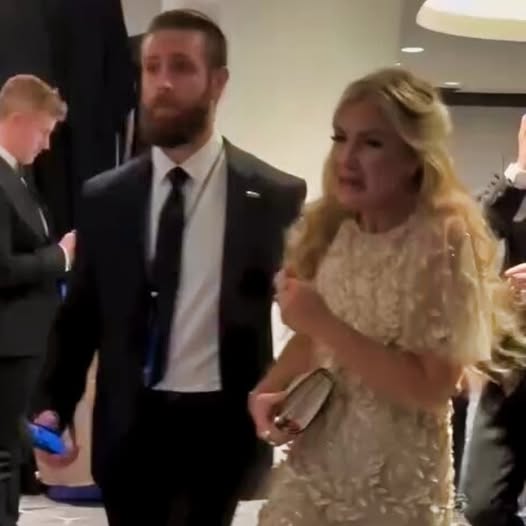
The White House Correspondents’ Dinner has long been treated as one of Washington’s rare nights of controlled laughter — an evening where political rivals exchange jokes beneath glittering chandeliers while journalists, celebrities, and government officials briefly pretend the nation’s divisions can be softened through humor. But on April 26, 2026, the atmosphere inside the Washington Hilton shifted from polished celebration to outright panic within seconds. What was supposed to be an elegant night of speeches and satire became a scene of confusion, screaming, and fear after reports of a security breach sent Secret Service agents flooding the ballroom with weapons drawn. And amid the chaos, one image emerged that seemed to capture the emotional exhaustion of the moment more powerfully than anything else: Erika Kirk, visibly shaken, tearful, and pleading only to leave.
Her four simple words — “I want to go” — spread rapidly across social media after bystanders captured footage of the evacuation. In another context, the phrase might have sounded ordinary. But in that moment, spoken by a woman already shaped by profound personal tragedy, it carried an entirely different emotional weight. To many viewers, the video no longer looked like political theater or viral spectacle. It looked like someone reaching the absolute edge of emotional endurance.
For Erika Kirk, the panic inside the ballroom did not exist in isolation. It collided directly with grief she has been carrying publicly ever since the assassination of her husband, conservative activist Charlie Kirk, in September 2025. Since his death, she has lived under an almost impossible combination of mourning, scrutiny, and responsibility. Overnight, she transformed from a relatively private spouse into a visible public figure tasked with preserving both a political movement and a family shattered by violence.
That transformation came with consequences few people fully see.
Public life after personal tragedy often demands emotional performances that are impossible to sustain forever. Erika was expected to appear resilient for supporters, composed for cameras, and determined for the organization she inherited leadership responsibilities within. But beneath that carefully maintained image remained a grieving widow and mother forced to navigate a reality where threats are no longer abstract concepts discussed on television. Violence already reached into her life once and took the person closest to her. After that, every raised voice, every security alert, every unexpected disruption carries a completely different psychological meaning.
So when the atmosphere inside the Correspondents’ Dinner collapsed into chaos, witnesses described Erika’s reaction not as political panic but as something deeply human.
The ballroom reportedly transformed almost instantly. Conversations stopped mid-sentence. Chairs overturned. Glass shattered across the floor while Secret Service agents rushed to secure President Donald Trump, the First Lady, and the Vice President after reports surfaced of a potential armed threat intercepted near security checkpoints. Guests dressed in tuxedos and gowns suddenly found themselves ducking beneath tables or being pushed urgently toward exits.
Inside that confusion, Erika Kirk appeared visibly overwhelmed.
The viral footage showed her moving quickly through crowded hallways surrounded by security personnel, her face streaked with tears while federal agents shouted instructions nearby. The elegance of the event disappeared entirely in those moments. No glamour remained. No performance. Only raw exhaustion and fear.
What struck many viewers most was how profoundly personal her reaction felt.
For people untouched directly by political violence, security breaches often remain temporary moments of adrenaline followed by relief once danger passes. But trauma changes the nervous system permanently. Once violence has shattered someone’s world personally, the body stops treating threats as hypothetical possibilities. Every alarm becomes emotionally connected to previous loss. Every moment of chaos threatens to reopen wounds that never fully healed in the first place.
That is what made Erika’s visible distress resonate beyond politics for many people watching.
Regardless of ideology or public opinion, the footage stripped away the emotional distance people often place between themselves and public figures. It became difficult to view her merely as a political symbol in that moment. Instead, viewers saw a woman whose life had already been permanently altered by violence suddenly thrust once again into an environment filled with screaming, armed agents, and fear.
And perhaps that is why the video spread so rapidly online.
Not because people were captivated by scandal, but because the footage exposed vulnerability rarely visible within modern political culture. Public figures are usually expected to remain composed no matter the circumstances. Emotion often gets interpreted as weakness, especially in highly polarized environments. Yet the image of Erika Kirk crying openly while asking simply to leave cut through those expectations entirely.
It reminded people that trauma does not disappear because cameras are present.
The investigation surrounding the security breach will likely continue generating debates about safety protocols, political rhetoric, and federal response failures. Questions about how close a potential threat came to such a heavily secured event will dominate headlines and political commentary. But emotionally, the night may ultimately be remembered less for procedural failures and more for that singular human moment captured in the hallway.
A woman already carrying unimaginable grief suddenly confronted by another reminder that safety can vanish instantly.
The tragedy of Charlie Kirk’s assassination in 2025 fundamentally altered the course of Erika’s life. Since then, she has attempted to carry both personal grief and public expectation simultaneously — a burden that becomes heavier every time fear re-enters the room. The events at the Correspondents’ Dinner appeared to force all those pressures violently to the surface at once.
Her plea — “I want to go” — sounded less like someone trying to escape a ballroom and more like someone exhausted by living beneath constant threat altogether.
And maybe that is the unsettling truth lingering underneath the entire incident.
Beyond politics, beyond headlines, beyond investigations and partisan reactions, the footage exposed the emotional cost of living inside a climate where violence feels perpetually close. It revealed how public figures can slowly become prisoners of fear while still being expected to smile beneath chandeliers and perform resilience for audiences watching from a distance.
As Washington continues dissecting what happened that night, the image that remains most haunting is not the flashing lights or armed agents.
It is the sight of a grieving woman in a glittering gown, tears running down her face, quietly breaking beneath a weight she has been carrying far longer than a single terrifying evening.