The natural world is filled with creatures powerful enough to command both fear and admiration, but few animals embody that combination more completely than the bear. Massive, intelligent, emotionally complex, and capable of remarkable problem-solving abilities, bears have long fascinated humans across cultures and generations. Scientists studying species like the American black bear have discovered levels of memory, awareness, and cognitive skill that challenge the outdated idea that wild animals operate only on instinct. Yet despite their intelligence and emotional depth, thousands of bears around the world have endured unimaginable suffering at human hands. Among the most heartbreaking examples was a brown bear named Caesar, whose life became both a horrifying symbol of cruelty and a powerful reminder of resilience, survival, and hope.
Before the world ever knew her name, Caesar existed inside conditions so brutal they are difficult to fully comprehend. She spent years trapped within the bear bile industry in China, an industry built around extracting bile from living bears for use in traditional medicine practices. In that system, animals are not treated as living beings capable of fear, pain, or emotion. They are treated as biological machinery — objects designed to be restrained, drained, and discarded once their bodies finally fail.
For Caesar, suffering was not occasional.
It was constant.
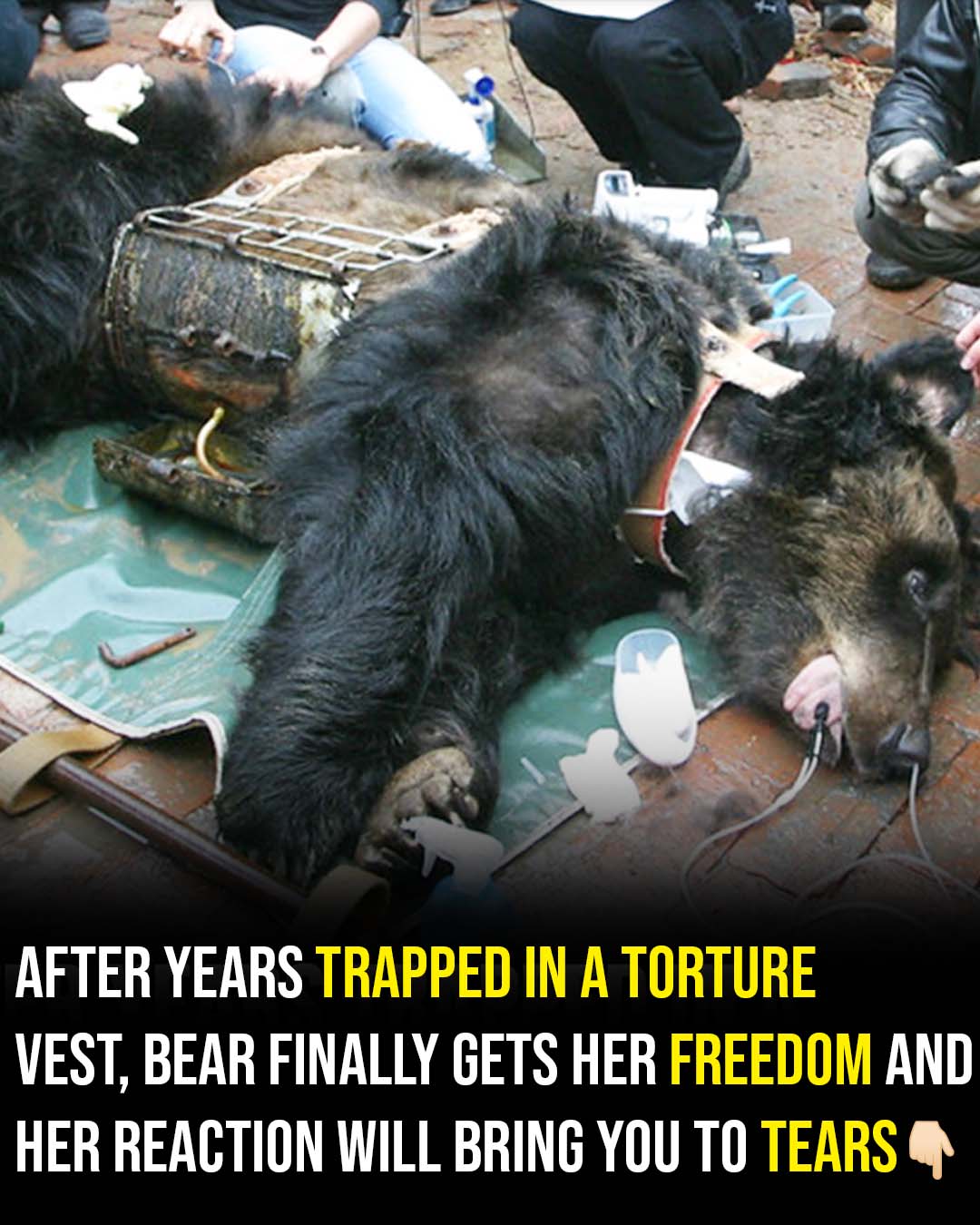
To maximize bile extraction, her captors forced her into a horrifying metal restraint device often referred to as a “crush vest” or “metal jacket.” The apparatus wrapped tightly around her body, pinning her movement almost completely while allowing continuous access to her gallbladder. The vest included a rigid breastplate that restricted her breathing and a sharp metal spike positioned near her neck to prevent resistance. If she tried turning her head or struggling against the device, she risked injuring herself further.
The cruelty was methodical.
Every part of the restraint system existed to remove dignity, freedom, and autonomy from a living creature.
Confined inside a cramped enclosure where she could barely move, Caesar endured years of physical agony. The extraction site on her body remained an open, infected wound that never fully healed because the harvesting process never truly stopped. But the damage extended far beyond flesh and bone. Bears are naturally curious, social, and active animals built to roam forests, climb, swim, forage, and explore vast territories. Depriving a creature like that of movement and stimulation for years creates psychological suffering almost impossible to measure fully.
And for a long time, it seemed Caesar would die there.
Forgotten.
Trapped inside metal.
Existing only as another silent victim of a profitable system.
Everything changed in 2004 when the animal welfare organization Animals Asia intervened. The group had spent years campaigning against bear bile farming and rescuing captive bears whenever negotiations and opportunities allowed. When rescuers first encountered Caesar, they were reportedly horrified even compared to the many terrible conditions they had already witnessed. Her “metal jacket” represented one of the most extreme forms of bile farm torture they had ever seen.
Securing her freedom was only the beginning.
Removing the vest itself marked the first real step toward restoring something Caesar had been denied for years: the ability to exist as a living creature instead of a machine for extraction.
When she arrived at the sanctuary in Chengdu operated by Animals Asia, her condition reflected both profound physical trauma and extraordinary survival. Her body carried scars, infections, weakness, and signs of prolonged suffering. Yet despite everything, there remained something astonishingly alive inside her spirit.
And slowly, over time, that spirit began re-emerging.
The transformation that followed became one of the most inspiring parts of Caesar’s story. With medical care, proper nutrition, safety, and freedom of movement, she gradually rediscovered what it meant to simply be a bear. Her dull and damaged coat thickened into healthy fur. The wounds along her body began healing. Muscles returned to limbs weakened by years of confinement. Eventually she grew into a massive, powerful bear weighing nearly 300 kilograms — a physical reminder of the strength hidden beneath years of abuse.
Her caretakers gave her the name Caesar, inspired by the Roman general, because she carried herself with a quiet dignity that seemed almost regal once she recovered.
For the first time in her life, Caesar experienced ordinary joys most wild animals take for granted.
She learned to swim freely in sanctuary pools.
She sprawled across warm grass under the sun.
She dug deep into cool earth during autumn afternoons.
She splashed water across her enormous body and shook herself dry in the sunlight while caretakers watched in awe.
To outsiders, these moments may sound simple. But for a creature once imprisoned inside metal for years, every movement became extraordinary. Every swim, every patch of grass, every quiet nap in the sun represented freedom reclaimed after unimaginable suffering.
The contrast between her old life and new one was almost unbearable to witness.
One version of Caesar existed trapped motionless in darkness while bile drained endlessly from her body.
The other rolled through grass, explored open spaces, and finally experienced peace.
But cruelty leaves scars even after rescue.
Although Caesar’s spirit recovered remarkably, years of abuse permanently damaged her internal health. Chronic infection, repeated invasive extraction procedures, and prolonged stress had already altered her body deeply on a cellular level. Sadly, this becomes a common reality for many rescued bile bears. Even after liberation, the long-term physiological consequences of captivity often remain fatal years later.
In late 2017, veterinarians discovered an aggressive tumor inside Caesar’s body.
Despite every effort made by the sanctuary staff, her health declined rapidly.
Shortly afterward, she passed away.
Her death devastated the people who spent years helping her heal, but it also reignited global attention toward the suffering of bears still trapped within the bile industry. Because although Caesar escaped, thousands of others remain imprisoned.
Estimates suggest roughly 10,000 bears are still held in bile farms across parts of China and Vietnam.
While the most extreme restraint devices like metal torture vests became increasingly condemned and restricted over time, many bears continue living inside tiny “crush cages” where movement remains nearly impossible and bile extraction continues through deeply inhumane methods.
That is why Caesar’s story matters far beyond one individual animal.
She became a symbol.
A living reminder of both the worst and best aspects of humanity.
The worst: the ability to normalize cruelty when profit becomes more important than compassion.
And the best: the capacity for empathy strong enough to fight against suffering and restore dignity to creatures who cannot defend themselves.
What makes Caesar’s story especially powerful is not simply that she survived, but that she remained capable of joy after everything done to her. Even after years of unimaginable pain, she still played, explored, rested peacefully in sunlight, and trusted the humans who finally chose kindness instead of exploitation.
That resilience feels almost miraculous.
Her life challenges people to reconsider how animals are viewed entirely. Bears are not unfeeling resources or tools designed for human convenience. They are emotionally complex living beings capable of fear, suffering, curiosity, memory, and comfort. Watching Caesar recover made that impossible to deny.
Though her life ended too soon, her thirteen years of freedom mattered profoundly.
They proved that rescue is never meaningless, even after terrible damage has already been done.
They proved healing is possible.
And they reminded the world that compassion can still reach creatures trapped in even the darkest conditions.
Today, Caesar’s legacy continues through every bear rescued from bile farms and every activist fighting to end the industry permanently. Her story remains both heartbreaking and deeply motivating because it forces people to confront an uncomfortable truth: silence allows cruelty to survive.
But awareness creates pressure.
Pressure creates change.
And change, eventually, creates freedom.
Caesar spent years trapped inside a metal vest designed to strip away her identity and reduce her existence to suffering.
Yet in the end, that is not how the world remembers her.
She is remembered instead as a survivor who reclaimed sunlight, water, movement, and dignity — a powerful bear who reminded humanity that even after the darkest cruelty, life still reaches instinctively toward freedom.