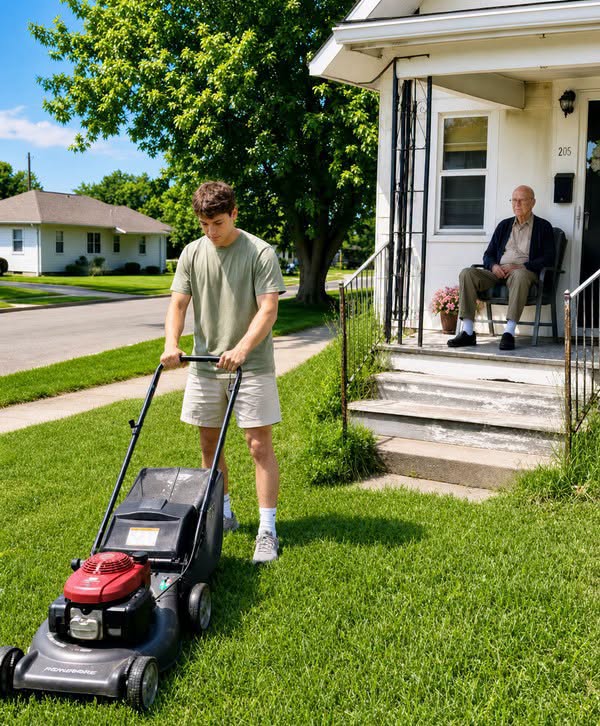
What started as a small act of kindness soon became a Saturday tradition. Week after week, Noah crossed the street with his mower and took care of Mr. Vance’s lawn. The simple routine continued for four years, becoming a familiar part of their lives. Noah never treated it as a burden or something that deserved special recognition. He simply understood that his neighbor needed help, and he was willing to offer it. Over time, those Saturday mornings became more than an opportunity to take care of the yard. They created a quiet connection between two people who might otherwise have remained distant neighbors.
Noah had been raised by a single mother, and his family did not have unlimited money to spare. Nevertheless, he never asked Mr. Vance for payment, nor did he expect gifts or public praise for what he was doing. He did not see the lawn care as a job that needed to be rewarded. For him, it was simply the right thing to do for someone who was having difficulty managing on his own. Sometimes, after Noah finished working, Mr. Vance would offer a small nod from the porch. That simple gesture was enough to make Noah feel that his efforts were appreciated.
When Noah’s mother eventually offered to pay him for the time he spent helping their neighbor, she wanted to make sure her son understood the value of his own work. But Noah explained his decision in a way that revealed how naturally he understood compassion. “He doesn’t need money. He needs help.” His words were simple, yet they expressed something meaningful about the difference between recognizing someone’s needs and expecting something in return for meeting them. Noah had noticed that Mr. Vance was struggling, and he believed that offering his time was more valuable than turning the situation into a financial arrangement.
For four years, the tradition continued without any expectation of a reward. Mr. Vance had something to look forward to each Saturday, and Noah continued showing up because he knew his presence made a difference. What the teenager may not have fully realized was just how important those visits had become to the older man. After losing his wife, Mr. Vance had been dealing with the quiet loneliness that can follow the loss of a lifelong companion. His days had become more difficult, and the absence of regular companionship had left him with fewer moments to anticipate.
Noah’s visits changed that in a small but meaningful way. The sound of the mower, the sight of the teenager crossing the street, and the familiar routine of watching the lawn being cut gave Mr. Vance a reason to look forward to the weekend. Noah did not need to deliver a long speech or solve every problem in his neighbor’s life. By showing up consistently, he offered something that money alone could not easily provide: companionship, reassurance, and the feeling that someone had noticed him.
After Mr. Vance passed away, Noah assumed that their Saturday tradition had come to an end. He had never expected anything from the relationship beyond the satisfaction of knowing he had helped someone who needed it. Then, following the funeral, Mr. Vance’s estate attorney contacted him with an unexpected message. The attorney had a handwritten letter from the late widower that explained how deeply Noah’s visits had affected his life. The letter revealed that those seemingly ordinary Saturday mornings had meant far more to Mr. Vance than the teenager had ever imagined.
In his letter, Mr. Vance described how loneliness had overshadowed his days after his wife’s death. The loss had left him struggling to find things to anticipate, and the quietness of his home often made each day feel longer. But Noah’s regular visits had brought a sense of routine and connection back into his life. Knowing that the teenager would likely arrive on Saturday gave him something to look forward to. What Noah considered a simple favor had become one of the most meaningful parts of the widower’s week.
The attorney also revealed that Mr. Vance had established a college fund for Noah and had left him the old lawn mower as a keepsake. The gifts were intended to recognize the kindness the teenager had shown over the years and to help support his future education. Mr. Vance’s children confirmed just how much the relationship had meant to their father. They explained that he often watched for Noah from the window, waiting to see him arrive and knowing that another Saturday of familiar companionship was about to begin.
When Noah learned about the college fund and the mower, he was overwhelmed. He had never helped Mr. Vance because he hoped to receive money, inherit anything, or be remembered in a will. The thought that his simple act of kindness had inspired such a generous gesture was difficult for him to process. At first, he resisted accepting the gift because he worried that doing so might somehow change the meaning of everything he had done.
His response reflected the same sincerity that had guided him from the beginning. “I didn’t do it for that.” Noah wanted it to be understood that his decision to help had never been motivated by the possibility of a reward. He had seen a neighbor in need and offered what he could. The college fund was a generous surprise, but it was not the reason he had spent four years taking care of the lawn.
Ultimately, the story of Noah and Mr. Vance is a reminder that even the smallest acts of kindness can have an enormous effect on another person’s life. A teenager with a lawn mower helped an elderly widower feel less alone, not through grand gestures or extraordinary sacrifices, but through consistency, attention, and genuine concern. Mr. Vance’s final gift acknowledged that impact, while the handwritten letter revealed the emotional value of the time they had shared.
Noah never set out to change his neighbor’s life. He simply kept showing up every Saturday because he believed that helping someone mattered more than receiving praise. In return, he discovered that his actions had created a lasting connection and helped preserve a memory that would follow him into adulthood. The money could support his education, and the old mower could remind him of the man he had helped, but the deeper lesson was already part of him: kindness is most meaningful when it is offered freely, without the expectation of receiving anything in return.