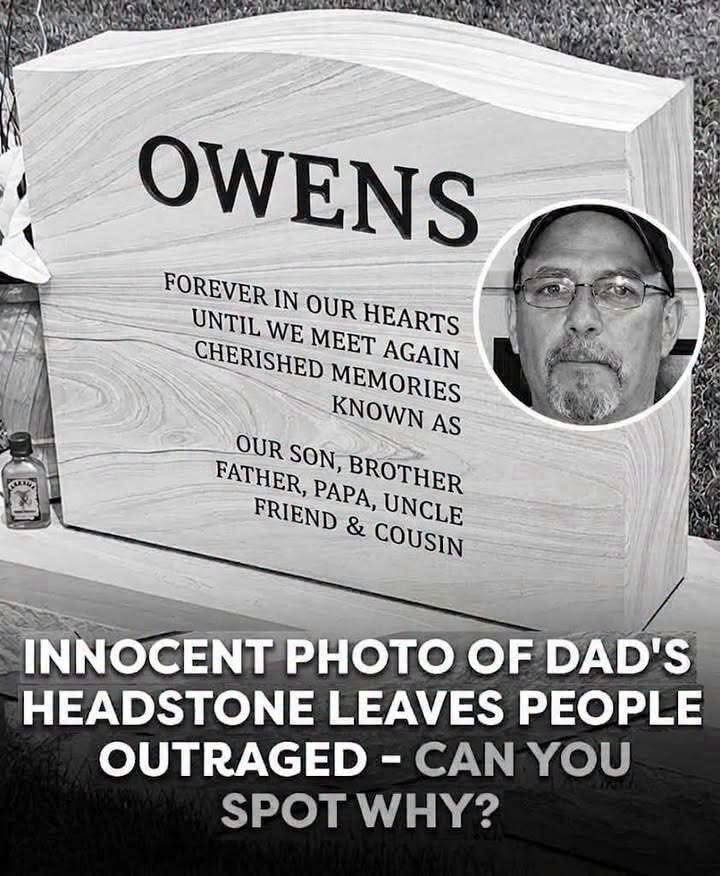
To the family, the inscription is not simply a provocative joke carved into a gravestone. It represents a personal connection to someone whose voice they can no longer hear and whose presence they can no longer feel in the ways they once did. The hidden message brings back memories of his humor and the moments that made him recognizable to those who knew him best. What outsiders might consider disrespectful, the family regards as an affectionate tribute to a loved one who had his own distinctive personality and way of expressing himself.
Their refusal to change the inscription is therefore about more than stubbornness or a desire to challenge authority. They believe that altering the wording would remove something deeply personal from the place where their father rests. Traditional memorial inscriptions often rely on solemn phrases, religious references, or expressions of love and remembrance. This inscription, however, reflects a different approach to mourning, one that preserves the deceased person’s individuality rather than presenting him through words that might feel unfamiliar to those who knew him intimately.
For the family, changing the inscription could feel like rewriting part of their father’s identity to satisfy people who never shared their experiences with him. They argue, in effect, that remembrance should leave room for personal expression, especially when the words are meaningful to those who are grieving. The acrostic allows them to preserve a private joke in a public memorial, creating a connection between the father’s personality and the memories his family continues to carry.
Cemetery trustees, however, approach the dispute from a different perspective. They are responsible for maintaining a shared place of mourning where people from different backgrounds, generations, and belief systems come to remember their loved ones. From their point of view, memorial inscriptions are not entirely private expressions because they remain visible to other visitors who may have very different expectations about what is appropriate in a cemetery. A phrase that one family considers humorous and affectionate may be viewed by another visitor as offensive or disrespectful to the solemn nature of the setting.
The trustees’ concerns also involve the rules governing the cemetery and the precedent that might be established by allowing the inscription to remain. If an exception is made in this case, they may have to consider how similar requests should be handled in the future. Their position is not necessarily that the family has no right to express its grief in a personal way, but that individual preferences must be considered alongside the standards intended to apply to everyone using the shared space.
As the disagreement continues, the situation has become increasingly difficult for both sides. The threat of removing the inscription has transformed what began as a personal memorial into a dispute involving rules, individual rights, and the limits of acceptable expression. With lawyers becoming involved, the family faces the possibility that a tribute they consider essential to their father’s memory could be altered against their wishes. Meanwhile, the cemetery trustees must decide how to balance compassion for a grieving family with their responsibility to maintain the standards of the grounds.
Neither perspective offers an easy resolution. The family wants to protect a tribute that reflects the person they loved, while the trustees want to preserve an environment in which all mourners can feel comfortable and respected. Both concerns arise from different understandings of what a memorial represents: one emphasizes personal memory and individuality, while the other emphasizes shared expectations and the responsibilities that come with a common space.
Ultimately, the dispute raises a difficult question about the nature of remembrance. Should a grieving family have broad freedom to commemorate a loved one according to his personality, humor, and private relationships, even when the result challenges conventional expectations? Or should the rules of a shared cemetery take priority when an inscription may offend visitors who have no connection to the deceased?
At its heart, the conflict is about more than a few controversial words carved into stone. It is about how people preserve the identities of those they have lost and how society accommodates deeply personal expressions of grief in public spaces. For the family, removing the acrostic would mean losing a meaningful part of their father’s memorial. For the trustees, allowing it to remain could raise questions about the standards that govern the cemetery. Until a resolution is reached, the inscription stands as a reminder that mourning is deeply personal, while the places where people mourn must also serve an entire community.