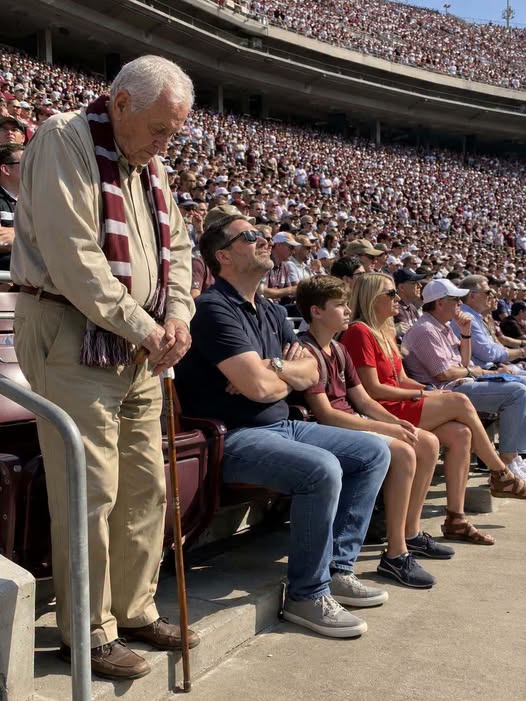
The stadium turned on a single sentence. A lifetime of devotion was mocked in front of seventy thousand witnesses, and for one suspended heartbeat, nobody seemed to know what to do. The crowd had come expecting a game, noise, rivalry, and the usual emotions that fill a stadium, but suddenly the atmosphere changed. An old man with a cane had been humiliated in front of everyone, and the words directed at him seemed to cut deeper than anyone expected. Then a boy stepped forward carrying a faded relic of courage, forcing a stranger to confront the weight of his own pettiness. What followed was not revenge, shouting, or another insult. It was something far more unexpected: a quiet act of courage that reminded an entire crowd that dignity can matter more than winning.
My grandfather never spoke about the insult again, at least not directly. Instead, whenever the memory came up, he talked about the boy. He talked about the way his hands had shaken and how frightened he had looked, yet he still stood there. In his hands was that faded blue armband, an old piece of family history that somehow became a bridge between generations. It was not valuable because of its material worth. It carried memories, stories, and the meaning of everything my grandfather had endured and loved. To the boy, holding it was a way of saying that his grandfather’s life and devotion were not something that could be mocked away with a careless sentence.
In my grandfather’s quiet retelling, the person who had delivered the insult was always a minor character. The man who had caused the humiliation might have been loud in that moment, but he gradually became almost irrelevant in the story. My grandfather did not remember the exact words as much as he remembered what happened afterward. He remembered the silence, the boy stepping forward, and the feeling that something had changed. The real center of the story was never the person who tried to make an old man feel small. It was the choice a frightened grandson made to stand beside someone he loved.
The boy could have remained silent. He could have pretended not to hear the insult or waited for an adult to intervene. He could have decided that getting involved would only make the situation worse. Instead, despite the fear visible in his trembling hands, he made a different choice. He stepped forward. There was no dramatic speech and no attempt to become a hero. He simply refused to allow his grandfather to stand alone in a moment of humiliation. Sometimes courage does not look like confidence. Sometimes it looks like being scared and moving anyway.
The reaction from the crowd made the moment even more powerful. What had begun with one cruel sentence suddenly became something much larger. People who had been focused on the match began turning toward the confrontation. Conversations stopped. Faces changed. The energy that had been directed toward the field was suddenly concentrated on what was happening among them. One person’s cruelty had created an uncomfortable silence, but the boy’s decision began breaking that silence apart.
For weeks afterward, Grandpa kept the match program on his bedside table. The ticket stub remained tucked carefully inside, as if the paper itself held the echo of that rising crowd. To anyone else, it was only an ordinary program and a piece of cardboard from a football match. To him, it had become a reminder of something much more important. It represented the day he had been reminded that his story mattered to someone else, and that the love between generations could be stronger than a stranger’s attempt to humiliate him.
Sometimes he would look at the program and ask me, almost as though he needed to make sure I remembered it correctly, “You saw it? How they stood up?” He was not talking about the players standing on the field or the crowd celebrating a goal. He was talking about the people who chose to stand emotionally and morally beside someone who had been hurt. They had not stood up for a legend, a trophy, or even a particular team. They had stood up for an old man with a cane and a boy carrying a memory.
What stayed with my grandfather was not the final score. He rarely mentioned who won or lost that day, and the details of the match itself eventually faded. The insult faded too. What remained was the image of people recognizing that something was wrong and refusing to simply watch. The stadium, a place usually built around competition and glory, briefly became something else. It became a place where ordinary people were reminded that how we treat one another can matter more than what happens on the field.
The boy never needed to become famous for what he did. His courage did not depend on being remembered by thousands of people or appearing in newspapers. In fact, the power of the moment came partly from how simple his decision was. He saw someone he loved being hurt, felt afraid, and chose to act anyway. That kind of courage rarely makes headlines, but it can stay with a person for an entire lifetime.
For my grandfather, the faded blue armband eventually became more than an old keepsake. It became a symbol of the moment when one generation protected another. It reminded him that memories are not only things we carry from the past; sometimes they are things we pass forward so that someone younger can understand what mattered to us. The boy carried that memory into the stadium, and in doing so, gave his grandfather a new memory to carry home.
In a place built for glory, what stayed with him was not the scoreline, the players, or the result. It was the proof that decency can still swell through a crowd like a chant. A single act of kindness can change the atmosphere of an entire room, stadium, or afternoon. The insult may have lasted only seconds, but the response lasted for years. And whenever my grandfather told the story, the lesson was always the same: sometimes the smallest person in the crowd can make the biggest choice, and sometimes simply standing beside someone who has been hurt is enough to change everything.