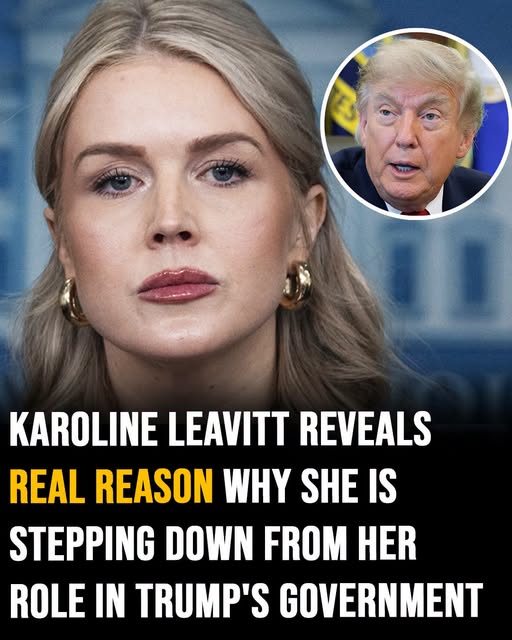
The news stunned Washington. Karoline Leavitt, the youngest person ever to serve as White House press secretary and one of Donald Trump’s most outspoken defenders, is preparing to walk away from the podium at the end of August. At 28, she reached one of the most visible communications jobs in American politics, standing behind the White House lectern during some of the administration’s most politically charged moments. Her departure immediately sparked speculation about what might have happened behind the scenes, with questions about political pressure, internal disagreements, or a possible scandal. But Leavitt has made clear that the decision is far more personal. After returning from maternity leave following the birth of her second child, she came to a difficult realization about the life she wanted to build outside the briefing room.
Leavitt’s departure is not being presented as a story of scandal or political defeat, but as the decision of a young mother choosing to redraw the boundaries of her life. She recently returned to work after welcoming her daughter, Viviana, in May, having already made history as the first White House press secretary to give birth while serving in the position. Her return meant stepping back into a job that demands constant attention, long hours, crisis management, rapid responses, and an almost permanent state of public scrutiny.
For Leavitt, the experience appears to have forced a painful reassessment. The West Wing is not a workplace that easily allows someone to switch off at the end of the day. A press secretary can be called upon to respond to breaking events at virtually any hour, prepare for briefings, defend presidential decisions, manage difficult questions, and remain ready whenever a political crisis suddenly erupts. The role requires being constantly available, and that reality can make the boundaries between professional life and family life extremely difficult to maintain.
Returning after maternity leave may have made that conflict even more visible. Leavitt had already demonstrated how committed she was to her career, famously returning to work quickly after the birth of her first child in 2024. But having a second baby appears to have changed the calculation. This time, the question was not whether she could continue doing the job. She had already proved that she could. The harder question was whether she wanted to continue paying the personal cost that came with doing it.
That distinction matters. Walking away from a powerful position does not necessarily mean someone is incapable of handling it. Sometimes it means they have reached a point where another responsibility has become more important. For Leavitt, motherhood appears to have become that priority. She has spoken about the difficulty of balancing the demands of her position with raising two young children, and her announcement described the decision as bittersweet.
Her choice is particularly striking because of how quickly she rose through the political world. Leavitt became a prominent Trump campaign spokesperson and later entered the administration as its press secretary in January 2025. Her age alone made her appointment historic, but her style also made her a highly visible figure. She became known for aggressively defending the president, confronting reporters, promoting the administration’s message, and embracing a media strategy that placed significant emphasis on conservative outlets and alternative platforms.
The job brought enormous attention, but it also came with an equally enormous level of scrutiny. Every statement could become a headline. Every confrontation could circulate online within minutes. Every mistake could be dissected by supporters and opponents alike. For someone still in her twenties, the intensity of that environment was extraordinary. Yet Leavitt repeatedly projected confidence and determination, presenting herself as someone prepared to withstand the political pressure surrounding the Trump White House.
That is why her decision to leave is likely to carry significance beyond the simple question of who will replace her. It demonstrates that even someone who has built her identity around political toughness can decide that another part of life deserves greater attention. The decision does not erase her political career or the positions she has fought for. Instead, it changes where she will exercise her influence.
Trump himself has publicly supported her decision and indicated that she will remain an important outside adviser. That means Leavitt is not disappearing from Republican politics or severing her relationship with the administration. Instead, she is moving away from the daily intensity of the briefing room while maintaining a political role from outside the formal structure of the White House. Trump has described her as a trusted adviser, suggesting that her influence will continue even after she leaves the podium.
For Leavitt, that may offer a different kind of balance. She can remain involved in politics, contribute to Trump’s agenda, and continue building her public career without having to live every day inside the relentless schedule of the West Wing. The arrangement could allow her to remain politically relevant while creating more room for her husband and her two young children.
Her decision also raises a broader question that many working parents face: Is it possible to give everything to a demanding career while also giving everything you want to give to your family? There is no universal answer. Some people manage the balance with extensive support systems, while others eventually decide that one part of their life needs to take priority. For Leavitt, the answer appears to have become clearer after the birth of her second child.
The image of her leaving the podium may therefore carry a meaning very different from the one Washington initially assumed. It is not necessarily an image of a young political star falling from power. It can also be understood as an image of someone who reached an extraordinary level of professional success and then decided that success alone was not enough. The podium gave her influence, visibility, and a place in history. But motherhood gave her something the podium could never provide.
Leavitt leaves the White House as a historic figure. She became the youngest press secretary in American history and one of the most recognizable voices of the Trump administration. She proved herself capable of surviving one of the most demanding communications positions in politics. But her most personal decision may ultimately be the one that defines this chapter of her life: recognizing that she did not have to remain in the brightest and most unforgiving room in Washington simply because she had earned the right to stand there.
Now, instead of spending every day beneath the White House lights, she will have more opportunities to experience the quieter moments that cannot be recreated later—the bedtime stories, the mornings with her children, the small hands reaching for hers, and the ordinary family moments that can disappear quickly while a career consumes every available hour. Her departure may be a sacrifice, but it is also a statement about what she believes matters most.
For a woman who spent so much of her career defending a president from behind a microphone, the decision to step away may be the most personal statement she has ever made. She is not abandoning ambition, and she is not disappearing from public life. She is simply choosing a different place from which to continue it. And for now, that place appears to be closer to home, closer to her children, and farther from the relentless lights of the White House podium.