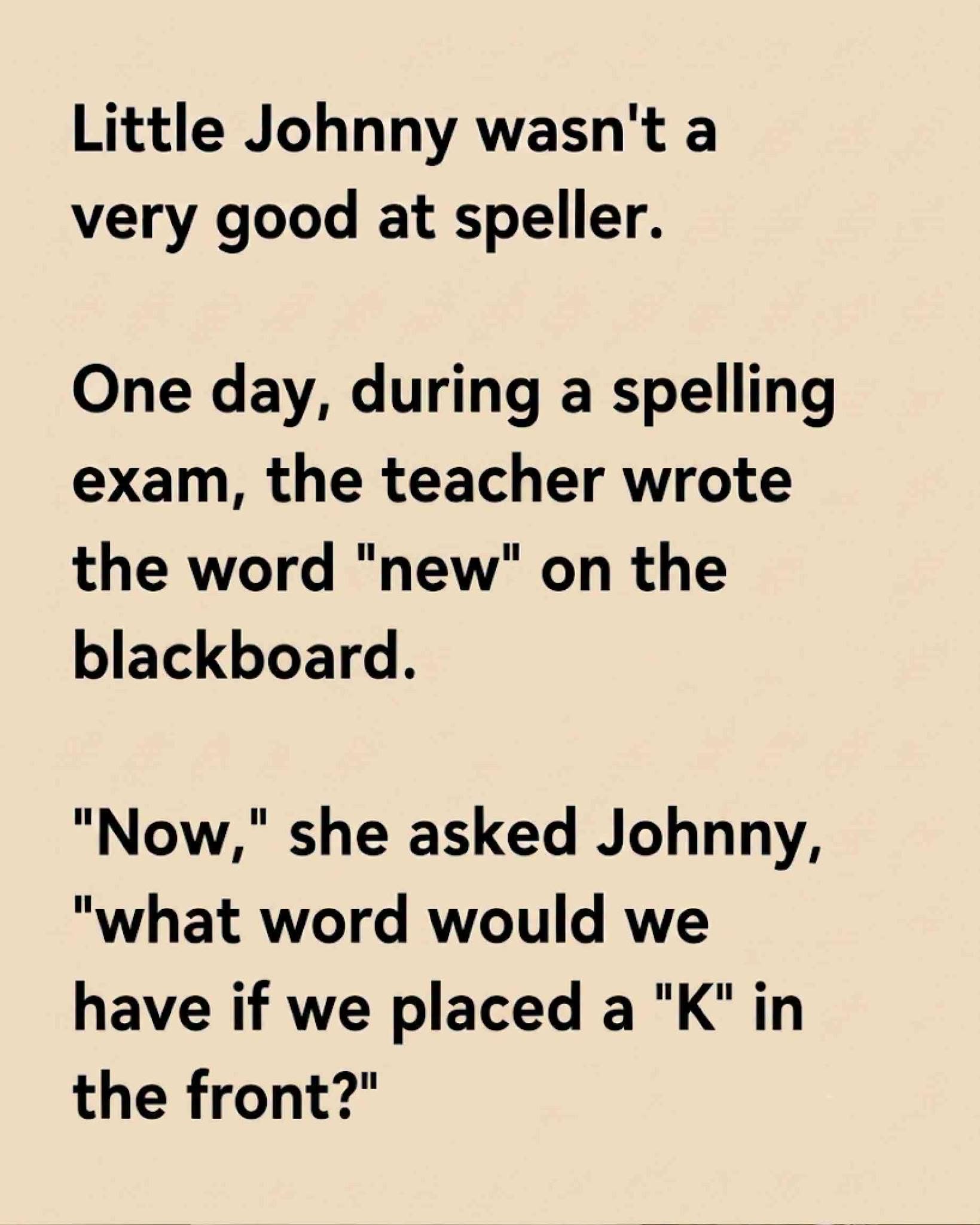
Little Johnny Wasn’t a Very Good Speller — But His Answer Left the Whole Class Laughing!
Little Johnny had a reputation at school for struggling with spelling. While some of his classmates could write long words without hesitation, Johnny often found himself scratching his head, trying to figure out which letters belonged where.
His teacher had tried everything to help him improve. She gave him extra exercises, encouraged him to read more books, and even organized spelling games to make learning easier.
Despite her efforts, Johnny always seemed to find a way to turn a simple spelling lesson into an unforgettable moment.
One morning, the teacher decided to test his knowledge in front of the entire class. What happened next left everyone laughing.
A Difficult Question for Little Johnny
The lesson began like any other. The students sat quietly at their desks while the teacher wrote several words on the blackboard.
After explaining the exercise, she turned toward Johnny.
“Johnny, let’s see how well you’ve prepared today,” she said. “Can you spell the word clock?”
Johnny stood up and thought carefully.
“C-L-O-C-K,” he answered proudly.
“Very good!” the teacher replied, pleasantly surprised.
Encouraged by his success, she decided to give him another word.
“Now, can you spell school?”
Johnny smiled confidently.
“S-C-H-O-O-L!”
The teacher nodded approvingly. For once, Johnny seemed to be doing exceptionally well.
But then she decided to make the challenge a little harder.
The Word That Changed Everything
“All right, Johnny,” the teacher continued. “Can you spell the word wrong?”
Johnny looked at the ceiling, rubbed his chin, and thought for several seconds.
Finally, he answered with complete confidence.
“W-R-O-N-G!”
The teacher smiled.
“Excellent, Johnny! That’s correct.”
Johnny looked puzzled.
“But teacher,” he protested, “how can it be correct if it’s wrong?”
For a moment, the classroom fell silent.
Then the students burst into laughter. Even the teacher struggled to maintain her serious expression.
Johnny, meanwhile, looked genuinely confused. He couldn’t understand why everyone was laughing when he had simply answered the question exactly as he understood it.
The teacher eventually explained that wrong was simply the word she had asked him to spell.
Johnny nodded thoughtfully.
“Oh, I see!” he said. “You should have told me you wanted me to spell the word, not make a mistake!”
That only made the laughter louder.
Why Little Johnny’s Jokes Remain So Popular
Stories about Little Johnny have entertained generations of readers because they combine innocent misunderstandings, clever wordplay, and unexpected punchlines.
The character is often portrayed as a mischievous schoolboy who interprets questions literally or finds a surprising way to answer them.
Although the stories are fictional jokes rather than reports of real classroom incidents, their humor often comes from familiar situations that parents, teachers, and students can recognize.
Spelling lessons, homework assignments, and classroom questions provide the perfect setting for these funny misunderstandings.
Sometimes, the humor lies not in Johnny getting an answer wrong, but in the unusual way he interprets what he has been asked.
A Lesson Nobody Expected
By the end of the lesson, Johnny still had plenty of spelling practice ahead of him. His teacher knew that improving his skills would take patience and regular effort.
But she also recognized that his curiosity and unexpected questions could make even an ordinary school day memorable.
After all, learning doesn’t always happen in a perfectly serious classroom. Sometimes, a funny mistake can make a lesson easier to remember than a page full of exercises.
And as Johnny returned to his seat, one thing was certain: his classmates would be talking about his answer for the rest of the day.
The moral of the story? Sometimes, the funniest answers come from taking a question a little too literally—and Little Johnny certainly knew how to keep everyone guessing!
Editorial note: This is a fictional, humorous school story inspired by the supplied title. The classroom and characters are illustrative.