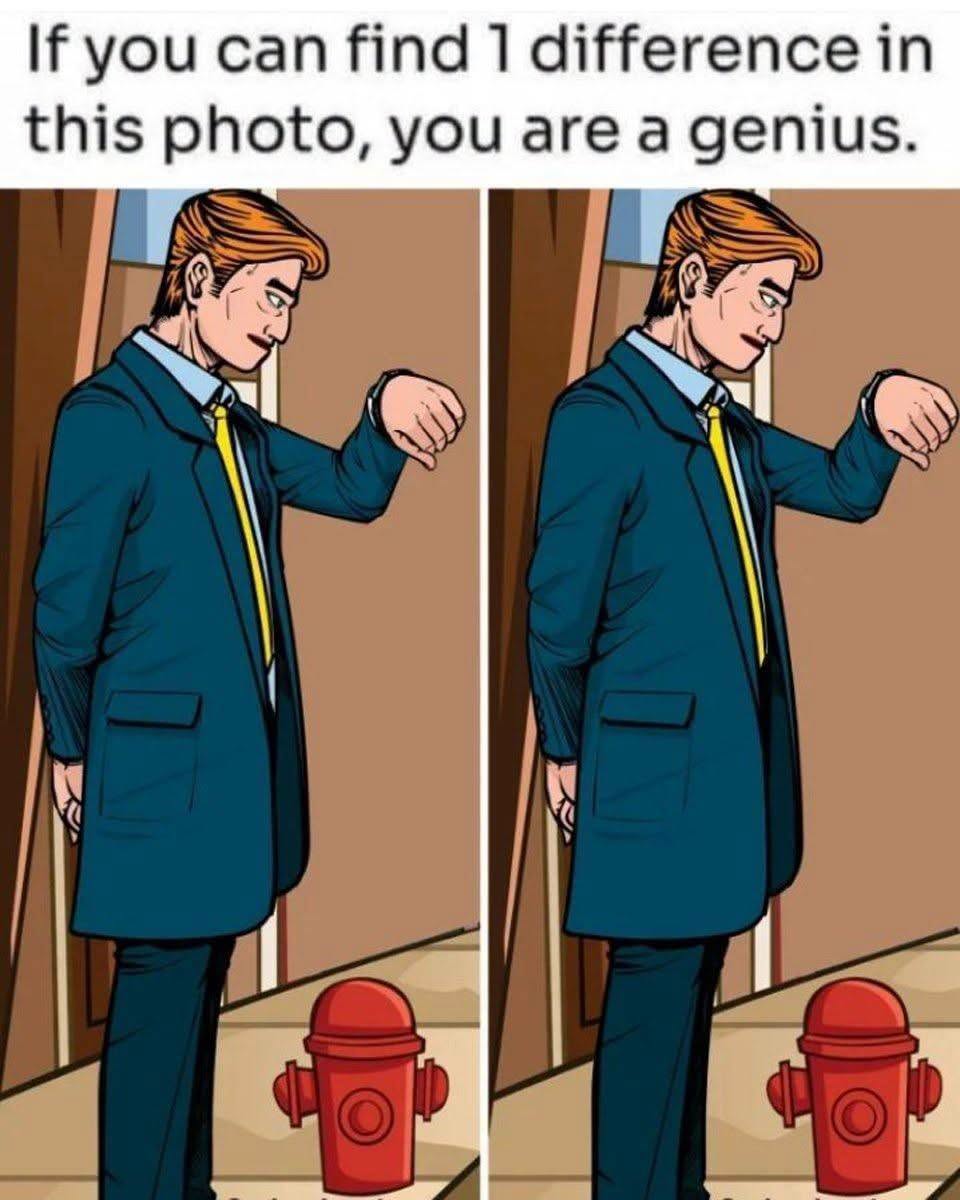
The challenge centers on a seemingly ordinary street scene, but hidden inside that simple picture is one small detail that separates the two versions.
At the center of the image stands a man on a sidewalk, casually glancing down at his watch. At first, there appears to be nothing unusual about the scene. He is dressed in a long blue coat over a light blue shirt, with a bright yellow tie adding a noticeable splash of color to an otherwise cool-toned outfit.
His reddish-brown hair provides another obvious feature for the eyes to register, while the red fire hydrant standing beside him adds another strong point of color.
Everything seems familiar.
Everything appears to match.
And that is exactly what makes the puzzle difficult.
The task sounds simple: look at the two versions of the picture and find the one difference.
But when two images are almost identical, the human eye has a natural tendency to focus on the overall scene instead of carefully checking every individual detail.
You may look at the man and immediately think, “They are exactly the same.”
You may notice the blue coat, the yellow tie, the watch, the hydrant, and the sidewalk without realizing that one tiny feature has been changed.
That is where the real challenge begins.
The puzzle is not necessarily testing how quickly you can look at a picture.
It is testing whether you can slow down enough to notice something your brain has already decided is familiar.
When an image looks almost identical to another image, your mind tends to fill in the details automatically.
You recognize the man’s face.
You recognize his clothing.
You recognize the hydrant.
You recognize the background.
Once your brain has established the general pattern, it becomes easier to overlook a small inconsistency.
That is why randomly scanning the picture may not be the best strategy.
Instead, try comparing matching sections systematically.
Start with the man’s head.
Look carefully at his reddish-brown hair.
Check its shape, direction, and outline.
Then move down to his face.
Examine the eyes, nose, mouth, and any small facial details that may have been altered.
Don’t simply ask whether the face “looks right.”
Ask whether every part of it matches.
Next, examine the area around his neck.
Look at the collar of the light blue shirt.
Then focus on the yellow tie.
Check its length, shape, position, and the way it sits against the shirt.
Bright colors can actually make certain details easier to notice, but they can also distract you from nearby changes.
After checking the upper body, move slowly toward the long blue coat.
Compare the edges.
Look at the sleeves.
Check the buttons, pockets, seams, and any visible folds.
Even something as small as a missing line or slightly different shape can be the answer.
Then move toward his hands.
Because the man is looking at his watch, the hands and wrist area deserve special attention.
Look at the position of his fingers.
Compare the watch itself.
Check the shape of the watch face and the surrounding details.
Sometimes these puzzles hide their differences in places people naturally overlook because the overall object seems obvious.
Once you have inspected the man, shift your attention to the red fire hydrant beside him.
Its bright color makes it easy to notice, but don’t assume that means it is identical in both images.
Compare its shape.
Look at its top.
Check the side openings, base, and any visible lines or small features.
Then examine the surrounding sidewalk and background.
A difference does not necessarily have to be located on the main character.
It could be somewhere behind him, where your eyes are less likely to concentrate.
That is one of the tricks these puzzles use so effectively.
They give you a central subject that immediately captures your attention and encourage you to spend most of your time looking there.
Meanwhile, the actual difference may be sitting somewhere just outside your main focus.
The ten-second limit makes the challenge even more difficult.
When a timer is running, people naturally become less methodical.
They start jumping from one object to another.
They scan instead of comparing.
They may notice something that looks slightly unusual but move on before determining whether it is actually different.
That pressure is part of the fun.
But there is no real reason to feel defeated if you do not find the answer within ten seconds.
The timer is there to create excitement, not to measure your intelligence.
Taking longer does not mean you have failed.
In fact, slowing down may give you a much better chance of finding the hidden detail.
A useful technique is to mentally divide the image into sections.
Think of it as a grid.
Compare the upper-left area of one image with the upper-left area of the other.
Then move across.
After that, compare the middle section.
Then the lower section.
This prevents your eyes from wandering randomly and makes it easier to identify small changes.
Another method is to focus on outlines.
Instead of looking at the objects as complete shapes, follow their edges.
The outline of the hair.
The edge of the coat.
The shape of the tie.
The contour of the hydrant.
The outline of the sidewalk.
When something has been added, removed, shortened, or reshaped, the outline can sometimes reveal it more quickly than the interior details.
You can also try covering one section at a time mentally or physically if the images are displayed side by side.
Look only at the head first.
Then only at the clothing.
Then only at the hands and watch.
Then the hydrant.
Then the background.
This reduces the amount of information your brain has to process at once.
The important thing is not to let the overall resemblance convince you that everything is identical.
The two images are supposed to look almost exactly the same.
That is the entire trick.
Your brain sees a familiar scene and quickly categorizes it.
Man.
Sidewalk.
Blue coat.
Yellow tie.
Fire hydrant.
Done.
But the puzzle asks a different question.
Not, “What is this picture?”
It asks, “What has changed?”
That requires a more deliberate kind of attention.
And that is why these simple-looking puzzles can be surprisingly difficult.
They reward patience more than speed.
They encourage you to look at familiar objects in an unfamiliar way.
The man may seem completely ordinary.
The coat may seem completely unchanged.
The watch may look exactly where it should be.
The hydrant may appear identical.
But somewhere in those details is one alteration waiting to be noticed.
The description provided here does not reveal exactly what that altered detail is, so no specific solution can be confirmed from the information alone.
That uncertainty is important.
It would be easy to guess that the difference is in the man’s hair, tie, watch, coat, or hydrant.
But a guess is not the same thing as identifying the actual change.
The real challenge is to compare the images themselves.
So, before looking for an answer, take another careful look.
Start at the top.
Move slowly downward.
Check the hair.
Check the face.
Check the collar.
Check the yellow tie.
Check the blue coat.
Check the hands.
Check the watch.
Then inspect the red fire hydrant.
Finally, scan the background.
Do not allow the ten-second countdown to make you careless.
If you spot the difference immediately, enjoy the victory.
If you don’t, keep going.
Sometimes the detail you are searching for is the one you have already looked at several times without truly seeing.
That is what makes a good spot-the-difference puzzle so satisfying.
When you finally notice the altered detail, it can feel almost impossible to believe that you missed it.
The image suddenly changes in your mind.
What looked identical becomes obviously different.
And that moment—that sudden realization—is the entire point of the game.
So take a breath, slow your eyes down, and compare rather than simply look.
The answer is hiding somewhere in plain sight.
The question is whether you can train your attention to see it.