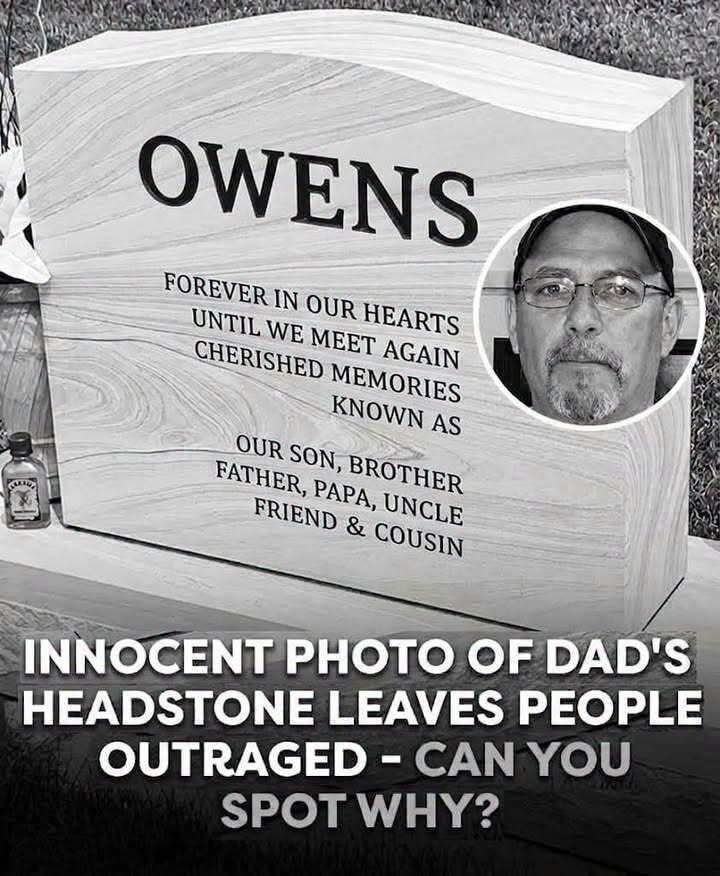
Steven Paul Owens’ headstone in Polk County, Iowa, was never intended to become the center of a public controversy.
To his family, it was something much more personal: a final message that captured the man they knew.
The engraved stone describes him with the familiar words people might expect to see on a memorial. He is remembered as a beloved father, grandfather, relative, and friend. On the surface, the inscription appears warm, respectful, and entirely appropriate for a cemetery.
But there is another message hidden within it.
The first letters of the engraved lines form a two-word profanity.
For strangers looking at the headstone, that discovery may seem shocking, disrespectful, or even inappropriate.
For Owens’ children, however, it means something completely different.
They say the phrase reflected their father’s personality and the way he interacted with people he loved.
It was not, in their telling, a message of hostility.
It was familiar.
It was humorous.
And it was part of the way Steven Owens expressed affection.
His daughter told CNN that provoking the response connected to the phrase had become something of a running joke among family members. It was the kind of private humor that develops over years, shaped by shared memories and countless conversations that outsiders could never fully understand.
That context changes the meaning of the inscription.
To someone who never knew Owens, the hidden words may appear crude simply because they are crude words.
To his family, they represent a recognizable part of him.
They remember a father and grandfather whose personality could not be reduced to formal descriptions.
They remember his humor.
His expressions.
The little habits that made him recognizable.
The phrases people heard so often that eventually they became part of the family’s vocabulary.
In that sense, the headstone was designed to do something that many traditional epitaphs cannot.
It was meant to sound like him.
A conventional memorial might describe someone as loving, devoted, generous, or deeply missed.
Those words can be sincere.
But they can also feel universal.
They could appear on thousands of headstones.
The Owens family wanted something more personal.
Something that could make someone who knew Steven smile.
Something that would remind them not only that he was loved, but of exactly how he made people feel while he was alive.
That is where the hidden acrostic became important.
The message was not necessarily intended for everyone walking through the cemetery.
It was, in many ways, a message for the people who knew how to read it.
The family could see the ordinary tribute.
Then they could notice the first letters.
And suddenly, the serious memorial contained a small piece of Steven’s personality.
A private joke had been transformed into a permanent part of his final resting place.
For his children, that may be precisely what made it meaningful.
A headstone is usually expected to communicate dignity.
But dignity does not necessarily require solemnity.
People grieve differently.
Some families choose religious passages.
Others use poems.
Some include favorite sayings.
Some add photographs.
Others choose humor because humor was central to the person’s identity.
The Owens family appears to have chosen something that reflected the way they remembered him rather than the way a stranger might expect a memorial to look.
Yet the cemetery is not a private living room.
That distinction is at the heart of the controversy.
The Camp Township Trustees, who oversee the cemetery, see the matter differently.
They argue that profanity has no place in a cemetery, even when the words are hidden within an otherwise respectful inscription.
From their perspective, the issue is not whether Owens’ family understood the joke.
It is whether a publicly visible memorial located in a shared cemetery should contain language that many people would consider offensive.
That creates a difficult question.
Who ultimately decides what is appropriate on a grave marker?
The family?
The cemetery?
The community?
Or some combination of all three?
For the Owens family, the answer seems obvious.
They believe the headstone belongs to Steven’s memory.
They knew the man.
They understood the joke.
They say no offense was intended.
And because the message reflects a part of his personality, they want the marker to remain exactly as it is.
For the trustees, however, intent is only part of the issue.
A cemetery is a shared public space.
People visit for many reasons.
They may come to mourn a spouse.
To visit a parent.
To bring flowers to a child.
To sit quietly beside someone they lost years ago.
They may also encounter other graves while doing so.
The trustees therefore have to consider standards that extend beyond a single family.
Their concern appears to be that allowing profanity on one headstone could weaken whatever standards the cemetery uses for inscriptions more broadly.
That is where a seemingly small memorial detail becomes a larger debate about public standards.
The disagreement is not simply about two words.
It is about who has the authority to determine how a person should be remembered in a shared space.
The family sees the inscription as an act of love.
The cemetery sees it as a potential violation of community standards.
Both positions come from different understandings of what a cemetery represents.
For the family, the cemetery is where Steven rests.
It is part of their private grief.
The stone is connected to decades of memories.
For the trustees, the cemetery is also a public environment governed by rules and expectations.
That difference in perspective can make compromise difficult.
The trustees have reportedly consulted lawyers about the possibility of removing the marker.
That possibility has understandably intensified the family’s concern.
Removing or changing the inscription would not feel like correcting a typo.
To them, it could mean erasing a part of Steven.
The hidden message is not random.
It is not graffiti.
It is not an anonymous insult.
It was deliberately created by the people who knew him best.
Changing it would therefore change the meaning of the memorial itself.
Imagine visiting a parent’s grave and seeing that a phrase you associated with them had been removed because someone else considered it inappropriate.
Even if the replacement wording were respectful, it might no longer feel like the person you came to remember.
That is the emotional weight behind the family’s position.
At the same time, people outside the family may reasonably feel uncomfortable with the inscription.
A cemetery is a place shared by many people, and not everyone will interpret profanity as harmless humor.
Someone encountering the hidden phrase without knowing Steven might see only the words themselves.
They would not have the memories.
They would not know the family joke.
They would not hear the phrase in his voice.
They would not understand the affection attached to it.
That is one of the strange limitations of memorials.
The people who knew someone best can understand a tiny detail instantly, while everyone else sees only an object.
The meaning of a headstone can therefore depend heavily on context.
And context is exactly what the family says the inscription contains.
They are not asking strangers to adopt their humor.
They are asking others to understand that their father’s memorial was written for the people who loved him.
The controversy also raises a broader question about how we expect people to behave when remembering the dead.
There is a long tradition of solemnity surrounding cemeteries.
Quiet voices.
Flowers.
Prayers.
Formal inscriptions.
Traditional symbols.
But grief does not always look solemn.
Sometimes people laugh at funerals.
Sometimes they tell embarrassing stories.
Sometimes the funniest memory becomes the one that keeps a person alive in conversation.
Sometimes a family remembers someone by repeating the exact joke that would have made them laugh.
That does not necessarily make the grief less serious.
It may be one of the ways people survive it.
For the Owens family, humor appears to be part of that process.
The hidden phrase gives them a way to remember Steven as a person rather than simply as someone who died.
That may be the most important point of the entire dispute.
A memorial is supposed to preserve memory.
But memory is rarely polished.
Real people are complicated.
They have serious sides and ridiculous sides.
They have formal moments and private jokes.
They have expressions that make sense only to the people closest to them.
A perfect memorial may therefore be less meaningful than an imperfect one that actually sounds like the person being remembered.
Steven Owens’ family appears to believe that this is what they created.
Not a vulgar monument.
A personal one.
A final inside joke.
A message that allows people who knew him to recognize him even after he was gone.
The trustees, however, have to consider the larger community.
That tension is unlikely to disappear simply because the family has good intentions.
Intent matters.
Context matters.
But shared standards matter too.
The difficult question is how those principles should be balanced.
Should a cemetery prioritize the family’s right to express an individual’s personality?
Should it enforce a uniform standard of decorum?
Can a memorial be both deeply personal and appropriate for a shared public space?
There may not be an answer that satisfies everyone.
And that may be why the dispute has attracted so much attention online.
People are naturally drawn to questions where personal freedom and community standards collide.
They also recognize something deeply human in the family’s argument.
Most people want the people they love to be remembered accurately.
Not generically.
Not through words chosen by strangers.
But as themselves.
For some families, that means a religious verse.
For others, a favorite song lyric.
For another, it might mean a simple joke that makes no sense to anyone else.
In Steven Owens’ case, the joke happens to be hidden inside the first letters of the inscription.
That small detail transforms the headstone from a conventional memorial into something much more intimate.
The debate may eventually be resolved through cemetery rules, legal advice, or an agreement between the family and the trustees.
But whatever happens to the physical stone, the story has already revealed something important about grief.
People do not necessarily remember their loved ones in the language of memorial plaques.
They remember voices.
Expressions.
Habits.
Jokes.
Arguments.
Laughter.
The strange little phrases that once seemed insignificant but later become priceless because they belong to someone who is gone.
For Steven’s family, those two hidden words apparently carry that kind of emotional weight.
They are not simply profanity.
They are part of a personality.
Part of a family language.
Part of the man they remember.
And perhaps that is why this controversy feels more complicated than a question of whether a cemetery marker contains inappropriate words.
At its center is a family saying, in effect, that this is how he was.
This is what made us laugh.
This is what reminds us of him.
Please let us remember him in our own way.
The trustees are saying something different.
This is a shared place.
There are boundaries.
And those boundaries have to mean something even when a family has a heartfelt reason for crossing them.
Between those two positions lies the uncomfortable space where personal memory meets public standards.
There may be no perfect solution.
But the controversy has already demonstrated why memorials matter.
They are not merely stones.
They are attempts to hold onto a person after that person can no longer speak for themselves.
Sometimes the most meaningful memorial is not the most polished one.
Sometimes it is the one that makes a grieving family smile.
And sometimes, beneath the formal words carved into stone, there is a private message that says more about the person than a hundred conventional adjectives ever could.