The smell of stale whiskey mixed with rain-soaked wool is the first thing that returns to me whenever I think about the day I lost Troy for the second time. I stood beside his open grave surrounded by quiet whispers and sympathetic glances from a town that had already decided our marriage was a tragedy. After thirty-six years together, I felt less like a widow and more like a ghost wandering through the wreckage of a life I no longer understood. Troy and I had built nearly four decades together from the foundations of childhood friendship, loyalty, and routines that once felt unshakable. Then suddenly, everything collapsed beneath the weight of secrets I thought I had already solved. At the time, I believed I understood exactly why our marriage ended. I thought the missing money and mysterious hotel receipts were proof of betrayal. But standing at his funeral while his drunken father stumbled toward me, I realized the truth was far more devastating than infidelity.
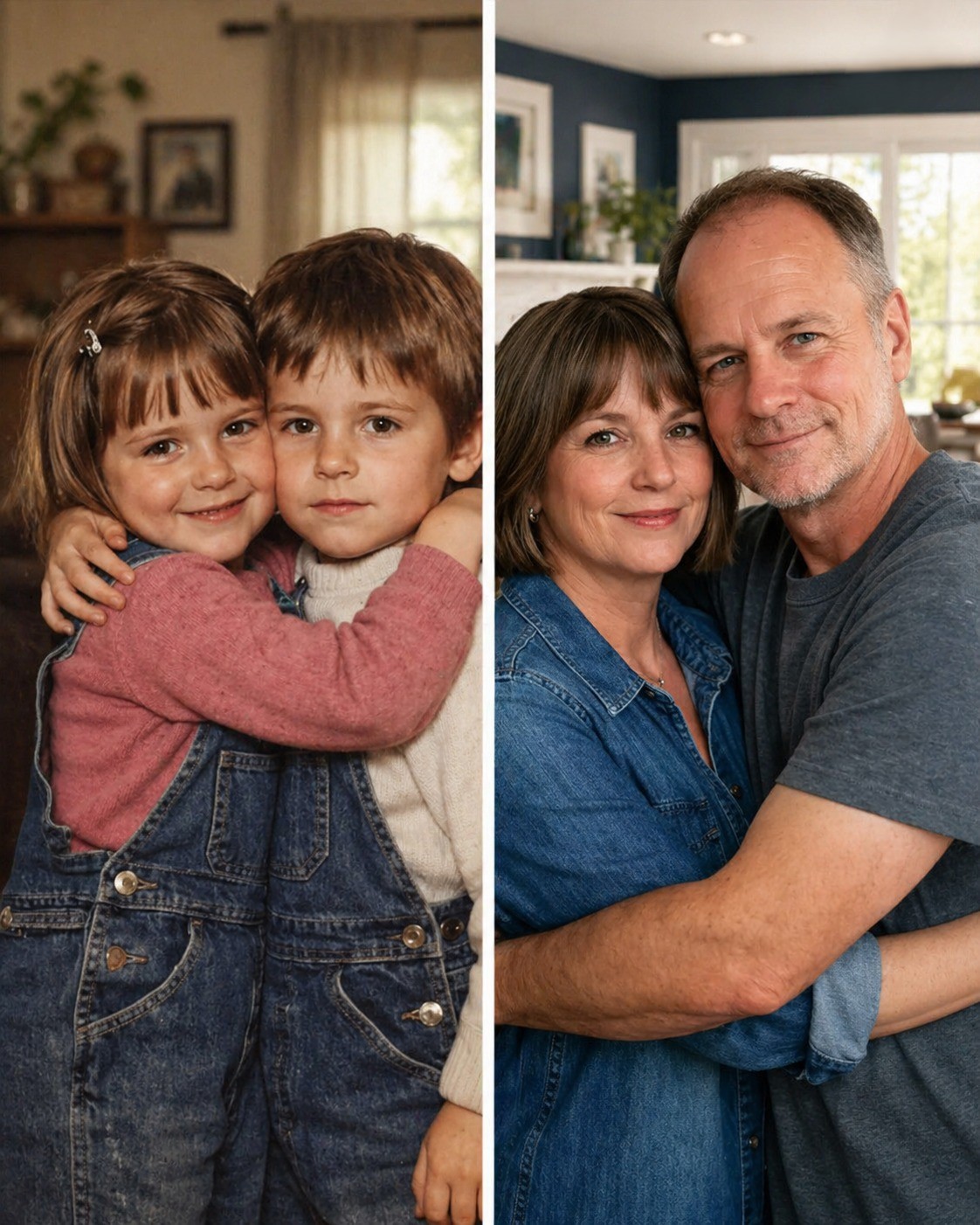
Troy and I had been inseparable practically since birth. Our families lived side by side, and by the age of five we were already moving through life together as naturally as breathing. Our relationship didn’t explode into existence through dramatic romance. Instead, it grew slowly over years of familiarity, trust, and shared dreams. By twenty we were married. Soon after came children, mortgages, routines, and all the ordinary milestones that quietly shape a life. We became one of those couples people assume will simply last forever because it’s impossible to picture them apart.
For a long time, I mistook predictability for safety.
We built our lives carefully. We worked hard, saved money, and planned for a future that always seemed guaranteed. But slowly, something changed. At first it appeared only in small financial inconsistencies. A few hundred dollars missing from our joint account here and there. Then larger amounts began disappearing. When I asked Troy about it, his answers became vague and strangely detached. He blamed bills, repairs, and miscellaneous expenses, but something in his eyes had changed. The man I once read effortlessly suddenly became unreadable.
Then I found the receipts.
Hidden inside his desk drawer was a stack of hotel records from Massachusetts — eleven separate visits to a place he had no reason to be. My stomach dropped immediately. When I called the hotel pretending to verify a reservation and the concierge casually recognized his name as a frequent guest, something inside me hardened permanently. It felt like confirmation of every terrible suspicion forming in my mind.
I confronted him directly.
I gave him every opportunity to explain.
Every opportunity to save us.
But Troy stood silently in our kitchen, refusing to tell me the truth.
That silence destroyed our marriage more completely than any confession could have.
I divorced him after thirty-six years together carrying the certainty that he had betrayed me with another woman. For two years afterward, I waited for some hidden part of his secret life to surface — a name, a photograph, a relationship, something concrete that would finally complete the story in my head. But nothing ever appeared. Troy lived quietly and alone. He saw the children occasionally, withdrew further into himself, and aged visibly within months.
Then came the phone call.
A sudden collapse.
A hospital room.
A death that arrived before I even understood he was truly sick.
The funeral felt surreal from the beginning. Less like mourning and more like standing trial in front of a town quietly dissecting our failed marriage. But the moment that changed everything happened when Troy’s father, Frank, cornered me near the flowers.
Frank had always been a quiet man, but grief and alcohol stripped away his restraint completely.
“You never understood what he gave up for you,” he muttered bitterly, his bloodshot eyes fixed on me.
At first I thought he was simply lashing out emotionally. But then he started talking about choices. Sacrifices. About a man who would rather lose his wife than force her to watch him slowly disappear. His words didn’t fit the version of Troy I had spent two years trying to hate.
Suddenly the entire narrative I built around our divorce began cracking apart.
Three days after the funeral, a courier arrived carrying a single letter.
The moment I saw Troy’s handwriting, my chest tightened.
Sitting alone in my quiet living room, I unfolded the pages and watched my entire understanding of the past two years collapse line by line.
Troy hadn’t been traveling to Massachusetts for another woman.
He had been traveling for medical treatment.
He had been diagnosed with a rare, aggressive illness requiring specialized care unavailable locally. The hotel stays, the disappearing money, the exhaustion, the secrecy — all of it connected instantly into a horrifying truth I never once considered.
He explained everything in the letter.
He hid the illness because he couldn’t bear watching our relationship transform from partnership into caregiving. After spending nearly four decades as my provider, protector, and equal, he became terrified of becoming someone dependent and fragile in my eyes. He secretly paid for treatments himself so insurance statements wouldn’t expose the diagnosis. He recovered alone in hotel rooms after painful procedures, then returned home pretending to still be healthy enough to preserve some illusion of normal life.
And while I believed he was cheating on me, he was quietly trying not to die.
The cruelest part was understanding why he chose silence.
Troy genuinely believed it would hurt me less to leave an unfaithful husband than to slowly lose a dying one.
So he sacrificed our marriage intentionally.
He allowed me to hate him because hatred seemed easier than grief.
The letter described it as a final act of love — deeply flawed, deeply lonely, and devastatingly misguided. He admitted that by hiding the truth, he betrayed our partnership in a completely different way. He denied me the right to stand beside him. He made the choice for both of us.
Reading those words felt unbearable.
The anger I carried for two years evaporated instantly, replaced by crushing regret so heavy it felt difficult to breathe. I replayed countless moments differently afterward. The nights I slept angrily in the guest room while he silently fought illness alone. The lawyer’s office where he signed divorce papers without resistance because he thought losing me was somehow protecting me. Every exhausted expression, every distant silence, every unexplained absence suddenly transformed from evidence of betrayal into signs of suffering I completely misunderstood.
He died alone because he was too proud to let me see him weak.
And I spent his final years believing he simply stopped loving me.
Now I often think about how tragedy sometimes disguises itself so convincingly that people destroy each other trying to survive it. Troy believed secrecy was mercy. He thought he was sparing me pain by carrying everything himself. But the truth is, he stole something from us far more valuable than comfort: time together.
I would have stayed.
I would have held his hand through every treatment.
I would have sat beside hospital beds and endured every terrifying diagnosis if it meant we faced it honestly together.
His illness would never have made him smaller in my eyes.
But he never gave me the chance.
Now I visit his grave carrying two different griefs at once. One for the husband I thought betrayed me. And another for the man who loved me so fiercely and so incorrectly that he destroyed himself trying to protect me from sorrow.
Sometimes I sit there talking to him aloud, saying all the things I wish he had allowed me to say while he was alive. I tell him I forgive him. I tell him he never needed to protect me from loving him fully. I tell him that weakness, sickness, and fear could never erase thirty-six years of shared life.
The house is still quiet now.
But the silence has changed.
It no longer feels haunted by imagined affairs or faceless women hidden inside hotel rooms. Instead, it holds the memory of a man who believed silence itself was an act of love.
And maybe that’s the cruelest lesson I’ve learned through all of this:
Love is not measured only by sacrifice.
Sometimes the greatest gift you can offer the person beside you is simply the truth — even when the truth is painful enough to break both your hearts.