It called my son’s name.
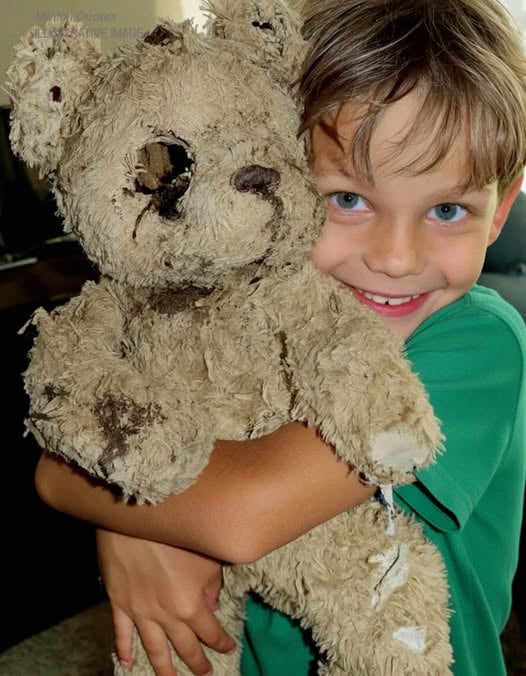
The voice came from inside the dirt-covered teddy bear he had just pulled from the ground beside the old forest trail we’d walked almost every evening since my wife died. At first, I honestly thought it was some broken electronic toy — the kind that randomly glitches after years buried in rain and mud. Maybe old batteries sparking one final time. Maybe grief playing tricks on my exhausted mind. But then the bear crackled again in that warped, rasping voice and whispered:
“Help…”
That was the moment I realized this had nothing to do with my grief at all.
My son froze beside me on the trail, still clutching the muddy bear against his jacket. The toy looked ancient. One button eye was missing, its fur stiff with dirt and moisture, the stitching along its stomach barely holding together anymore. It smelled like wet earth and leaves, like something buried and forgotten for years.
“Dad…” my son whispered nervously. “Did it just talk?”
I opened my mouth to reassure him, but before I could answer, the toy emitted another burst of static. Then, faintly:
“Ethan…”
My son’s name.
Every hair on my arms stood up instantly.
The woods around us suddenly felt too quiet. Even the wind seemed to disappear. I grabbed the bear carefully from my son’s hands, turning it over while trying to convince myself there had to be a rational explanation. Somewhere inside the stuffing, beneath layers of soaked fabric, I could feel something hard — an old voice box or recorder hidden deep in the toy.
Still, my stomach twisted with dread.
Because toys do not randomly know children’s names.
I shoved the bear into my backpack and told my son we were going home immediately. He kept glancing nervously over his shoulder the entire walk back while I tried desperately to stay calm for his sake. But inside my head, panic and logic were fighting viciously against each other.
My wife had died eight months earlier.
Since then, those evening walks through the woods became our ritual for surviving. Sometimes we barely spoke during them. Sometimes my son cried unexpectedly halfway down the path. Sometimes I did too, though I tried hiding it better than he did. The trail became the one place where silence between us didn’t feel uncomfortable.
And now something buried beside that path had spoken his name.
That night, I left the teddy bear sitting alone on the kitchen table.
I couldn’t bring myself to throw it away, but I didn’t want it near my son either. Every time I walked past the kitchen, its single remaining eye seemed to catch the hallway light differently, almost watching. I barely slept. Every creak in the house made my chest tighten. More than once I thought I heard faint static crackling downstairs.
At three in the morning, I finally gave in and examined the bear properly.
Carefully cutting open part of the stitching, I found a small recorder hidden inside the stuffing — old, damaged, but still partially functional. My hands shook while pressing the playback button.
Static filled the kitchen.
Then a child’s voice.
Scared. Crying.
“I want to go home…”
I stopped breathing completely.
The recording skipped violently before another adult voice appeared briefly in the background, too distorted to understand clearly. Then came silence. More static. Then the same weak whisper:
“Help…”
I sat there staring at the recorder while nausea rolled through my stomach.
This wasn’t a prank.
Someone had hidden this intentionally.
By morning, fear had hardened into responsibility. I could have thrown the bear away and convinced myself it was none of my business. But the thought felt unbearable now. Someone buried that toy carefully beside a trail families walked every day. Someone had left a child’s voice trapped inside it for years.
Ignoring it suddenly felt worse than being afraid of it.
So I drove straight to the police station.
The officer at the front desk looked mildly confused when I carried in a filthy teddy bear sealed inside a grocery bag. But his expression changed immediately once the recorder crackled to life on his desk.
They took the bear gently after that.
Not like garbage.
Like evidence.
Over the next several weeks, investigators contacted me repeatedly. They asked where exactly we found it, how deep it had been buried, whether the trail had changed over the years. Eventually one detective sat across from me quietly and explained the truth.
A young boy had disappeared nearly six years earlier.
His last known location was frighteningly close to our walking route.
The case had gone cold after months without evidence. But the teddy bear matched one visible in old family photographs released during the original search.
When they finally identified the voice recording fully, the child inside it was confirmed to be the missing boy.
I didn’t know how to respond after hearing that.
Relief and horror somehow existed together.
A few days later, the boy’s mother asked to meet me personally.
She arrived carrying a faded photograph with trembling hands. In the picture, a smiling little boy hugged the same teddy bear tightly against his chest. The fur had once been bright blue before years underground turned it gray-brown with mud.
She cried while thanking me.
Not because her pain disappeared — nothing could undo years of not knowing — but because uncertainty had finally ended. The bear we found gave investigators enough to reopen the case properly. For the first time in years, she felt closer to answers than silence.
And sitting there listening to her, I realized something painful and strange.
All those evening walks with my son were supposed to help us survive our own grief. I thought the trail only belonged to our sadness, our healing, our private struggle after losing my wife.
I never imagined that somewhere beside that same path, another family’s grief had been buried waiting desperately to be found.
Now sometimes, when my son and I walk there again, we stop briefly near the place where he uncovered the bear. Neither of us says much. We just stand quietly for a moment beneath the trees.
And every single time, I think about how close we came to walking past it forever.