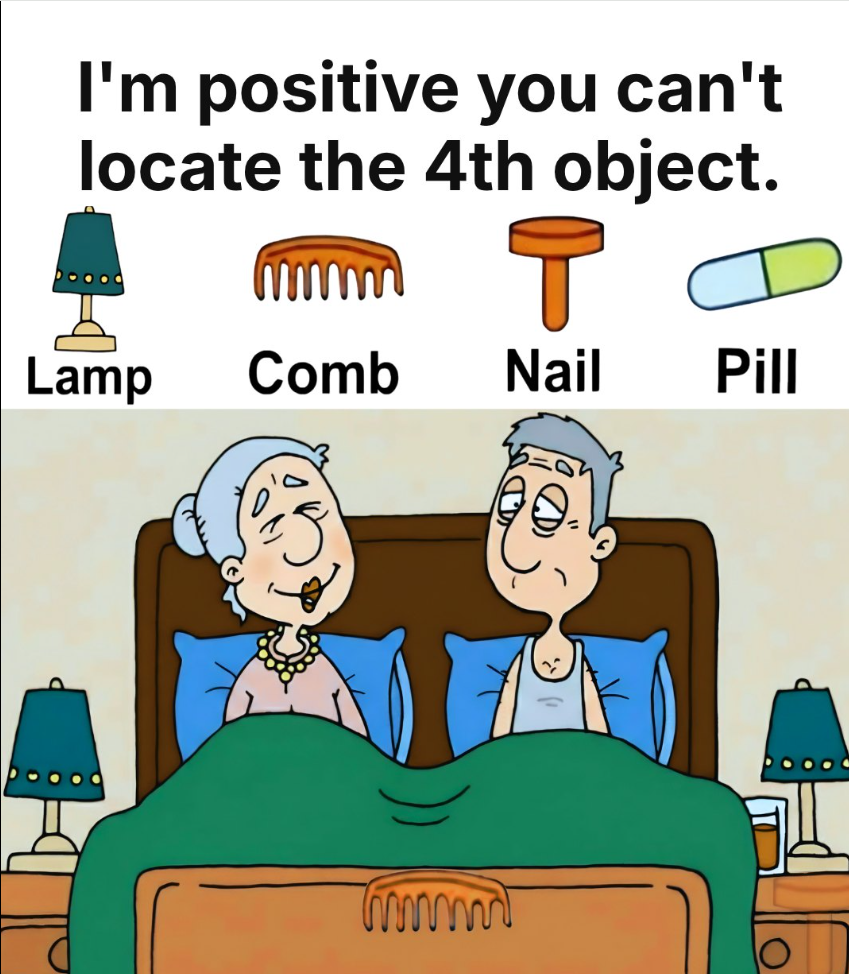
Most people are convinced they’ll spot everything instantly. They lean closer to the screen, narrow their eyes, and confidently point out one hidden object after another. At first it feels easy, almost laughably simple. The cozy bedroom scene seems harmless, familiar, predictable. But then something strange happens. One object refuses to appear. No matter how many times your eyes travel across the picture, your brain keeps skipping over it as if it doesn’t exist. Frustration slowly replaces confidence. You begin scanning every corner again and again, convinced the image must be tricking you somehow. Yet the real trick isn’t in the drawing — it’s happening inside your own mind.
What makes puzzles like this so fascinating is not merely the challenge of finding four hidden objects. It’s the unsettling realization of how easily human perception can be manipulated. The lamp almost jumps out immediately because your brain expects large, recognizable shapes. The comb takes longer, hidden among ordinary details your attention dismisses as background noise. The nail demands patience because it blends into the structure of the room itself. But the pill in the elderly woman’s mouth creates the deepest reaction of all. Most people stare directly at it several times without ever truly seeing it. That moment reveals something uncomfortable: our minds are not objective cameras recording reality exactly as it appears. Instead, they constantly edit, filter, simplify, and invent stories about what they think should be there.
Psychologists have studied this phenomenon for decades. The human brain is designed to save energy, so it relies heavily on patterns and expectations. Rather than processing every tiny detail equally, it quickly builds a rough interpretation of a scene and fills in missing information automatically. In everyday life, this shortcut helps us move through the world efficiently. But in visual puzzles, that same mental habit becomes our greatest weakness. We stop observing carefully and start assuming. Once the brain decides something is unimportant, it can effectively become invisible, even when it sits directly in front of us.
That’s why these puzzles stay in your thoughts long after you solve them. They expose the fragile relationship between sight and attention. You begin realizing how often this happens outside of games and riddles. Maybe you missed the exhaustion hidden behind someone’s smile. Maybe you overlooked a tiny detail during an important conversation. Maybe the answer to a problem was always present, but your mind filtered it out because it didn’t fit your expectations. Hidden-object puzzles quietly mirror real life in ways we rarely notice.
Each object in the scene becomes more than just part of a game. The lamp represents the obvious truths we recognize instantly. The comb symbolizes the details that only patience can uncover. The nail reflects the things hidden in plain sight, visible only when we shift perspective. And the pill — the object most people fail to notice — becomes a reminder that our minds often erase information that feels uncomfortable, unfamiliar, or unexpected. The puzzle stops being about eyesight and starts becoming a lesson about awareness itself.
Perhaps that’s the real reason people become obsessed with challenges like these. Solving them creates a brief but powerful moment where perception changes. Suddenly the invisible becomes obvious, and once you finally see the hidden object, you can’t imagine how you ever missed it. That experience is strangely emotional because it reminds us how limited our certainty truly is. We walk through life believing we see the full picture, yet our brains constantly rewrite reality without our permission.
So when you stare at that cozy bedroom scene one last time, the challenge is no longer just about finding missing objects. It’s about slowing down long enough to question your assumptions. It’s about resisting the brain’s urge to rush toward familiar conclusions. Because sometimes the smallest overlooked detail carries the biggest meaning. And sometimes the thing your mind refuses to see is exactly the thing you needed to notice most.