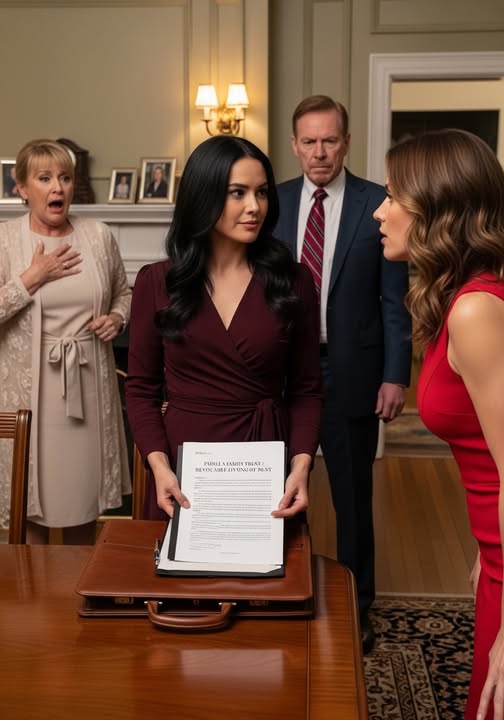
My sister told twenty-three relatives at Christmas dinner that I should disappear for a few days because “nobody would even notice.” She said it smiling into a wine glass, the same polished smile she always wore when she wanted to humiliate me in front of an audience. Most of my life, I responded the same way whenever Vanessa sharpened herself against me: I stayed polite, swallowed the insult, and made everyone else comfortable. But that night was different. Maybe because I was finally exhausted from being the family’s invisible daughter. Maybe because there was a heavy cream-colored envelope hidden inside my coat pocket by the front door. Whatever the reason, when I stood up and calmly said, “I accept your challenge,” nobody at that table understood I was walking out carrying the one thing capable of destroying the story they had spent decades telling about me.
Vanessa blinked when I answered her.
“What?” she laughed.
“I accept,” I repeated quietly. “I’ll step away. Let’s see whether anyone notices.”
The room froze around my mother’s dining table.
My father gave his usual weak response — “Vanessa, enough” — the kind of useless defense he offered whenever she crossed a line but he didn’t actually intend to stop her. My mother stared at her plate instead of at me. Vanessa sat there glowing in her white cashmere sweater, wine glass balanced elegantly in one hand, completely certain I would eventually shrink back into my usual role.
The spare daughter.
The practical one.
The one expected to quietly absorb everything.
But I didn’t shrink this time.
I stood up, crossed the hallway calmly, and slid my hand into my coat pocket. The envelope was still there. Thick. Heavy. Wax-sealed from a downtown law office I had never heard of before that week.
“Don’t be dramatic,” my mother snapped softly.
“I’m not,” I answered. “I’m taking Vanessa at her word.”
My father ordered me to sit down.
Vanessa laughed and told everyone I’d be back within the hour.
Then I walked out into the freezing December air anyway.
At my apartment, I opened the letter again for what must have been the twentieth time.
Six weeks earlier, my grandmother Elena had died quietly in hospice care. I loved her deeply, but even while grieving her, I never expected what the attorney’s letter revealed. According to the documents, my grandmother left me almost everything: the family house, a trust fund, investment accounts, and personal letters waiting for me at the law office.
But strangely, the money itself wasn’t what overwhelmed me most.
It was the feeling underneath it.
For the first time in my entire life, someone in my family had truly seen me.
The next morning, I sat across from the estate attorney, Margaret Chen, who carefully explained the part that changed everything permanently.
Ten years earlier, my grandmother tried establishing a university fund for me. She wanted to fully pay for any school I chose. She believed in me. She wanted me to dream bigger than survival and practicality.
My father stopped her.
He told her I didn’t need that kind of investment.
That I wasn’t the child worth prioritizing.
That the family’s future belonged to Vanessa.
Hearing those words physically hurt.
Because suddenly my entire life rearranged itself into painful clarity.
Vanessa, three years older than me, had always been the center of everything. When she wanted art school, my parents found $180,000 to make it happen. When she pursued marketing, they leveraged connections, introduced her to influential people, celebrated every accomplishment loudly.
Meanwhile, when I expressed interest in universities, I got practical lectures.
“Community college first.”
“Be realistic.”
“You don’t need expensive dreams.”
I became an accountant because stability felt safer than disappointment.
And for years, I believed the problem was me.
Not untalented exactly.
Just less worthy.
Less important.
Less chosen.
Then Margaret handed me my grandmother’s personal letter.
One sentence permanently lodged itself inside my chest:
“This money is not an inheritance. It is a correction.”
I cried in that office for years of my life all at once.
Because my grandmother understood something I never fully allowed myself to admit:
I was never lacking.
I was simply overlooked.
Deliberately.
Systematically.
Repeatedly.
For decades.
After leaving the attorney’s office, I turned off my phone completely.
When I finally checked it again days later, the messages told me everything about my family I needed to know.
My mother demanded an apology for “ruining Christmas.”
My father called my behavior unacceptable.
Vanessa pretended none of it meant what it clearly meant.
Then came the rumors.
According to Vanessa, I had some sort of emotional breakdown.
According to my parents, I was “not well” and “needed space.”
It was easier for them to portray me as unstable than admit I walked away intentionally.
That was the moment my hurt finally transformed into distance.
Cold, clean distance.
I called my cousin Daniel — one of the only relatives who had ever treated me fairly — and asked him for one favor.
“Invite me to the next family gathering,” I told him. “But don’t tell anyone I’m coming.”
Then I prepared carefully.
A deep burgundy dress.
A leather portfolio.
Inside it: my grandmother’s letters, legal documents, bank records, and decades of proof exposing exactly how my family operated.
When I walked back into my parents’ house six weeks later, twenty-three faces turned toward me simultaneously.
My mother went pale instantly.
My father stepped forward awkwardly.
“This isn’t the time,” he warned.
Vanessa pasted on a fake warm smile.
“Teresa! Are you okay? We’ve all been worried.”
I placed the leather portfolio directly onto the dining table.
“No,” I said calmly. “This time we do it here.”
Then I opened the clasp and removed the first document.
I looked directly at Vanessa.
“Since you wanted to know what happens when I step away,” I said quietly, “let’s find out what happens when I come back with proof.”
The room went completely silent.
I explained everything.
The inheritance.
The trust.
The house.
Then the education fund my father blocked.
The letters.
The evidence.
The years my grandmother tried repeatedly to support me while my father redirected every opportunity toward Vanessa instead.
“She tried five times,” I told them while holding up the documentation. “Five times to help me. And every single time Dad stopped her because Vanessa was apparently the only daughter worth investing in.”
My father immediately tried minimizing it.
“It was complicated—”
“No,” I interrupted. “It was simple. You chose her.”
I reminded them how I worked multiple jobs through community college while Vanessa graduated debt-free from art school. How every dream I had was labeled impractical while hers were treated as important investments. How I spent my entire life shrinking myself so Vanessa could comfortably remain the center of everything.
My mother attempted weak excuses.
“We thought we were doing what was best.”
“For who?” I asked quietly. “Because it certainly wasn’t best for me.”
Vanessa became defensive immediately.
“I didn’t know about any education fund.”
“No,” I answered. “But you benefited from every single decision they made.”
Then I pulled out my grandmother’s will.
Official.
Signed.
Notarized.
“She saw exactly what this family did,” I told them. “And she corrected it.”
Some relatives looked horrified.
Others avoided eye contact entirely.
My uncle finally asked my father directly whether it was true he blocked the education fund.
And for the first time in his life, my father had no convincing answer.
Because there wasn’t one.
I looked around the room slowly.
“You all watched this happen for thirty-two years,” I said. “You watched Vanessa receive everything while I was told to settle for whatever remained. And none of you questioned it because she was louder, prettier, more demanding. But loud doesn’t mean deserving. And quiet doesn’t mean less valuable.”
Vanessa stood up furiously.
“This is manipulative.”
“No,” I said calmly. “What’s manipulative is daring me to disappear, then telling everyone I’m unstable when I actually do it.”
Then I delivered the final truth.
My grandmother left me the family house.
And I was selling it.
Every dollar from the sale would fund scholarships for overlooked students in her name.
Because unlike the rest of my family, my grandmother believed in investing in people quietly dismissed by everyone else.
Then I picked up the portfolio and walked toward the door.
My father tried stopping me.
“Teresa, wait. Let’s talk.”
“We had thirty-two years to talk,” I answered without turning around. “You chose silence.”
So I chose distance.
Permanent distance.
One year later, my grandmother’s education fund exists officially. Students who remind me painfully of myself now receive opportunities nobody offered me. The family house is gone. I changed careers and now help people understand finances, independence, and self-worth professionally.
Some relatives apologized eventually.
Most didn’t.
Many still prefer Vanessa’s version of events because it protects them from admitting they enabled favoritism for decades.
But I no longer care.
Because my grandmother gave me something far more valuable than money.
She gave me proof that I was never the problem.
I was simply the daughter they underestimated.