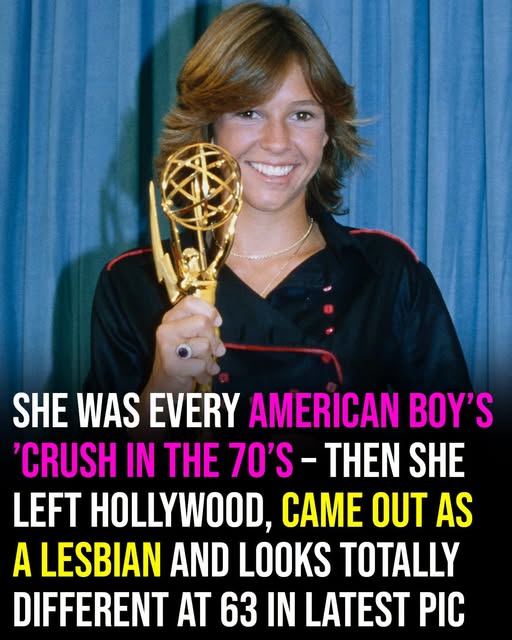
Fame nearly destroyed her. As a teenage star, Kristy McNichol lit up every screen she touched, becoming one of the most recognizable young actresses of her generation while privately struggling with pressures few people could see. To audiences, she was talented, charming, and seemingly destined for an extraordinary Hollywood career. Behind the cameras, however, she was dealing with studio pressure, a private personal life she could not openly share, and emotional struggles that had not yet been properly understood or diagnosed. The constant demand to perform, smile, and appear happy while falling apart inside eventually pushed her toward a breaking point. Then she stepped away from the spotlight, leaving fans wondering what had happened to the young star they had watched grow up. Years later, she would finally speak more openly about the experiences that had shaped her, including her mental-health struggles, her relationships, and the love that helped her find a different kind of life.
As a child star, Kristy McNichol carried the enormous weight of an entertainment industry that demanded perfection while giving young performers very little room to simply be young. Success brought attention, money, expectations, and opportunities, but it also meant living under constant observation. Every performance had to meet expectations, every appearance had to look effortless, and every personal detail risked becoming public. For someone still trying to understand herself, that environment could become overwhelming. The image audiences loved was carefully maintained, while the person behind it struggled to find a place where she could simply breathe without having to perform.
Publicly, Kristy was linked to Hollywood heartthrobs and expected to fit comfortably into the image the entertainment world had created for her. Privately, however, her romantic life was far more complicated. She fell in love with women at a time when openly discussing same-sex relationships could carry enormous professional and personal consequences, particularly for a young actress whose career depended heavily on public approval. Keeping such an important part of herself hidden created another layer of pressure. She was expected to present one version of herself to the world while privately experiencing feelings she could not safely express.
At the same time, another battle was developing inside her. Anxiety, insomnia, emotional instability, and periods when she struggled to cope became increasingly difficult to ignore. The sudden collapse she experienced while filming in France was not simply the behavior of a difficult or demanding celebrity, as some people might have assumed from the outside. It reflected a young woman whose mind and body were reaching a point of exhaustion. She was struggling with bipolar disorder before she fully understood what was happening to her, leaving her without the language or support she needed to make sense of the storm inside her.
For years, Hollywood had trained audiences to see stars as larger than life, almost as if they were immune to the problems affecting ordinary people. Kristy’s experience exposed the danger of that illusion. Behind the television appearances and glamorous photographs was someone dealing with real fear, exhaustion, emotional pain, and uncertainty. The public could see the successful actress, but it could not see the private battles taking place when the cameras stopped rolling. That separation between the public image and private reality eventually became impossible to maintain.
Walking away from acting in 2001 was therefore not simply a mysterious disappearance from Hollywood. It was an act of survival. At a time when many people might have expected her to continue chasing fame, she made the difficult decision to step away from the career that had defined so much of her childhood and young adulthood. The decision meant giving up a level of visibility and professional opportunity that many actors spend their entire lives trying to achieve. But for Kristy, the cost of staying may have become greater than the cost of leaving.
With Martie Allen by her side, Kristy was finally able to build the kind of quiet life she had been denied as a girl growing up in the public eye. Instead of constant cameras, interviews, schedules, and studio expectations, there was room for ordinary routines and private happiness. Tennis, yoga, travel, time with dogs, and the freedom to live without constantly wondering how the public would react became part of her new world. These things may sound simple compared with Hollywood success, but for someone who had spent years living under enormous pressure, simplicity itself could become a form of freedom.
Her relationship with Martie also represented something deeper than companionship. It became part of a life in which Kristy no longer had to separate herself into the person the public expected and the person she truly was. She could love openly within her private world and build a relationship based on honesty rather than secrecy. After years of having to protect parts of herself, that authenticity mattered more than another role, another award, or another appearance on a magazine cover.
When she came out publicly in 2012, she did not do so simply to reclaim attention or create another Hollywood headline. Instead, her decision was connected to the hope that her story might help young people who were frightened, confused, or struggling with their own identities. She knew what it felt like to believe that being different meant having to hide. By speaking openly, she offered reassurance to people who might have seen themselves in the younger Kristy—the frightened child or teenager who needed to know that life could eventually become better.
Her story also challenges the idea that leaving the spotlight means losing. Hollywood often measures success through visibility, awards, popularity, and career longevity. But Kristy’s life after acting suggests another definition of success. Sometimes success means recognizing that something is destroying you and having the courage to walk away. Sometimes it means choosing health, privacy, love, and peace over applause. And sometimes the bravest role a person can play is simply becoming honest about who they are when nobody is demanding a performance.
Kristy McNichol’s journey is therefore not simply the story of a star who disappeared. It is the story of someone who survived an environment that had become unbearable and eventually created a life on her own terms. The girl who once had to smile for cameras grew into a woman who no longer needed the approval of an audience to know her own worth. The pressure, secrecy, and emotional struggles did not disappear overnight, but with time, support, and honesty, they became part of a past she could understand rather than something she had to continue hiding.
Her legacy is not only the television shows, films, or performances that made her famous. It is also the courage to acknowledge what fame cost her and to choose something more meaningful in its place. Her life became a testament to the possibility of starting over after the world has already decided who it thinks you are. She chose peace over applause, truth over performance, and love over fear—and in doing so, she found something Hollywood could never guarantee: the freedom to finally live as herself.