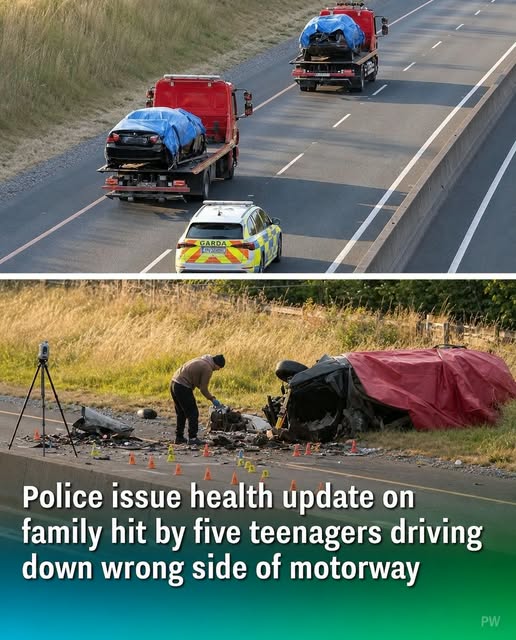
Blood on the motorway. Sirens in the darkness. Five teenagers gone in an instant, and a family of four torn apart because they happened to be in the wrong place at the wrong time. What began as an ordinary journey became a nightmare within seconds, leaving families grieving, survivors fighting to recover, and an entire community struggling to comprehend how quickly everything could change.
As tributes pour in and hashtags spread across social media, the numbers can begin to feel abstract. Five lives. Four survivors. One devastating collision. But behind every number is a person who had a bedroom, a favorite song, a group of friends, a family waiting for them, and plans for a future that suddenly disappeared.
For the families of those who died, there is no simple way to explain the emptiness left behind. Parents will never again hear the front door open and know their child has come home. Friends will never receive another message from the person whose name now appears in memorial posts. Bedrooms remain filled with belongings that suddenly carry a weight they never had before.
And alongside that grief is another kind of heartbreak.
A family of four was also caught in the collision. Their journey was supposed to be ordinary, but instead it ended with ambulances, operating theatres, intensive care, and injuries that may affect them for years. A seven-year-old child now faces a future changed by seconds of catastrophic recklessness.
The two stories now share the same stretch of motorway.
One family is mourning lives that cannot be restored.
The other is fighting to preserve the lives that remain.
Their suffering is painfully intertwined, but it came from entirely different circumstances. One group never volunteered to become part of a tragedy. They were simply traveling when another person’s actions placed them in unimaginable danger.
That distinction matters.
In the aftermath of a devastating collision, people often focus on the dramatic images—the flashing emergency lights, the wreckage, the road closed by police, the videos spreading across social media. The footage may be watched thousands or millions of times, but for the families involved, there is nothing temporary about what happened.
The viral moment ends.
Their reality does not.
Gardaí and emergency crews who responded to the scene will carry memories of those minutes long after the road is reopened. First responders may return home knowing they did everything they could while still remembering the faces, the sounds, and the devastation they encountered.
Doctors and nurses face another kind of battle.
They work in operating theatres and intensive care units trying to protect the futures that remain. Every procedure, every scan, every hour of monitoring represents another attempt to give survivors a chance to reclaim some part of the lives that existed before the crash.
For a child, recovery can become an entirely new journey.
A seven-year-old who should be thinking about school, friends, games, and ordinary childhood adventures may instead have to learn how to move through pain, rehabilitation, and uncertainty. Somewhere, a child may be learning to stand again, to walk again, and to trust a body that was suddenly injured because of a stranger’s reckless decision.
Those milestones may never trend online.
There may be no viral video when the first step is finally taken.
No hashtag when a parent hears their child laugh again.
No breaking-news alert when a survivor manages to return to something that once seemed effortless.
But those moments will matter more than the internet remembers.
Eventually, the headlines will disappear from people’s feeds. The hashtags will stop trending. Another story will replace this one, and the public conversation will move somewhere else.
The families cannot move on so easily.
They will continue carrying what happened into birthdays, holidays, anniversaries, school events, and ordinary evenings. A parent will remember the child who should have walked through the door. Another parent will watch a child struggle through rehabilitation and remember how different life looked before those few seconds.
That is the part of tragedy that statistics cannot capture.
The collision lasted only moments.
The consequences will last years.
For those who died, there is the unbearable finality of lives cut short. For those who survived, there is the long and uncertain work of rebuilding. And for everyone who loved them, there is the difficult task of learning how to live in a world that changed without asking permission.
Long after the viral clips disappear and the outrage fades, the people who never volunteered to be part of that tragedy will still be living with its cost.
The motorway will eventually reopen.
The damaged vehicles will be removed.
The sirens will fall silent.
But for the families left behind, that stretch of road will never simply be a road again.