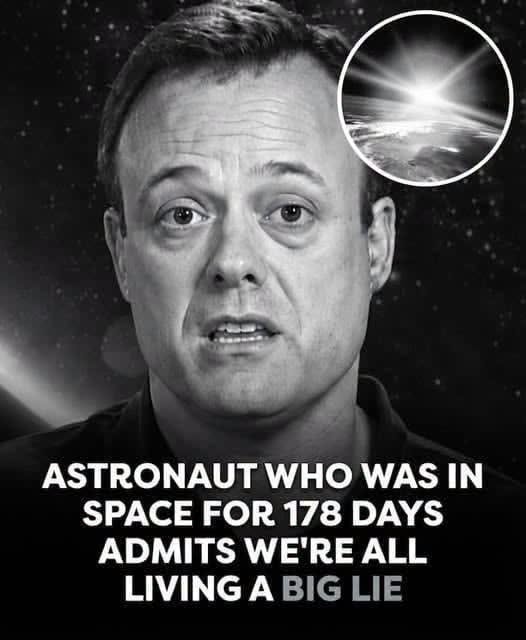
From space, Earth looks completely different. The borders that divide countries disappear, the enormous cities become tiny patches of light, and the conflicts that dominate headlines seem almost impossible to understand from hundreds of miles above the surface. What appears so large and important to people living on the ground becomes remarkably small when viewed from orbit. For astronaut Ron Garan, this experience was more than an extraordinary view of the planet. It changed the way he understood humanity, life, and the responsibility people share for protecting their home.
Garan spent 178 days aboard the International Space Station (ISS), orbiting Earth and observing the planet from a perspective that very few people will ever experience. During his mission, he had the opportunity to see oceans, continents, mountain ranges, deserts, and massive weather systems from above. But one particular detail stayed with him long after he returned to Earth: the atmosphere.
From space, Earth’s atmosphere does not look like an enormous protective structure. Instead, it appears as an incredibly thin layer surrounding the planet. This delicate blue line separates the world that supports life from the harsh emptiness of space. It contains the air people breathe, helps regulate temperatures, and protects living organisms from many harmful effects of the space environment.
Looking at that thin layer made Garan realize just how dependent every living thing is on a relatively small and fragile part of the planet. Everything humans have built, from enormous cities and advanced technologies to farms, roads, and entire civilizations, exists within this narrow protective environment.
The experience is closely connected to a phenomenon known as the **Overview Effect**. This term describes the profound shift in perspective that some astronauts experience when they see Earth from space. Instead of viewing the planet as a collection of separate countries and territories, they begin to see it as one interconnected world.
For astronauts, the experience can be difficult to describe. From orbit, there are no visible political borders separating nations. There are no lines dividing one population from another. The same oceans connect distant continents, the same atmosphere surrounds every country, and weather systems move across geographical boundaries without recognizing human divisions.
Garan became increasingly aware of how interconnected human life really is. A decision made in one part of the world can affect people thousands of miles away. Pollution does not remain within national borders, environmental changes influence communities across continents, and the health of ecosystems depends on conditions that extend far beyond individual countries.
On Earth, people often organize their lives around national identities, political disagreements, economic competition, and cultural differences. These things can feel enormous because they shape everyday experiences. But from space, the planet appears as a single living system, and the divisions people create seem almost invisible.
One of the most striking aspects of Garan’s observations was the contrast between humanity’s technological achievements and the vulnerability of the environment supporting them. Humans have developed spacecraft capable of traveling beyond Earth’s atmosphere, built extraordinary cities, and created technologies that connect billions of people. Yet all of these achievements depend on the continued health of the same planet.
The atmosphere is particularly important because it performs several essential functions. It provides the gases necessary for life, helps distribute heat around the planet, and contributes to the climate systems that support ecosystems. Without this protective environment, Earth would be an entirely different place, unable to sustain the extraordinary diversity of life that exists today.
The view from space also offers a different understanding of environmental problems. Deforestation, ocean pollution, melting glaciers, air contamination, and climate change are not isolated issues affecting only certain regions. They are connected challenges that can influence the entire planetary system.
For Garan, the lesson was not simply that Earth is beautiful. It was that people have a shared responsibility toward the place that makes their existence possible. Protecting the environment is not just about preserving landscapes or saving individual species. It is also about maintaining the conditions that allow human societies to survive and future generations to thrive.
After returning from space, Garan continued speaking about these ideas. Through interviews, public appearances, and his writing, he has encouraged people to reconsider how they understand the relationship between humanity and the planet. He has emphasized the importance of cooperation, long-term thinking, and recognizing that the world’s major challenges cannot be solved effectively when everyone acts only in their own immediate interests.
His perspective also raises an important question about priorities. People often spend enormous amounts of time competing with one another, arguing over boundaries, and pursuing short-term advantages. But the environmental systems that support life do not operate according to those divisions. The atmosphere, oceans, and natural ecosystems connect everyone, regardless of nationality, wealth, or location.
This does not mean that differences between countries and communities are unimportant. Different societies have different needs, histories, and challenges. However, recognizing our shared dependence on Earth can create a stronger reason to cooperate when dealing with problems that affect everyone.
The International Space Station itself provides an interesting example of what international cooperation can achieve. It represents decades of collaboration between different space agencies and countries, with astronauts and scientists working together on research that benefits people on Earth. Its existence demonstrates that even highly complex international projects can become possible when shared objectives bring people together.
Perhaps the most powerful part of Garan’s experience is the realization that people do not need to travel into space to understand the importance of protecting Earth. The photographs taken by astronauts, the scientific information collected aboard the ISS, and the experiences shared by those who have seen the planet from orbit offer everyone an opportunity to consider the bigger picture.
Earth may appear enormous when viewed from the ground, but from space, it becomes a small, remarkably beautiful world surrounded by darkness. Its oceans, forests, cities, and atmosphere form one interconnected system. There is no second planet waiting nearby with the same conditions, ecosystems, and resources that make life here possible.
Ron Garan returned from his 178-day mission with more than memories of an extraordinary journey. He returned with a perspective that challenged the way he thought about humanity and its future.
The most important discovery was not something hidden in space or waiting on another planet. It was something that had been surrounding every person all along.
The atmosphere may look like a thin blue line from orbit, but it represents an extraordinary protection that makes life possible. And perhaps the greatest lesson of seeing Earth from space is understanding that, despite all the differences people create between themselves, they share one home.
There are no borders visible from orbit, no separate atmospheres for individual nations, and no alternative planet that can replace this one. There is only one Earth, and its future is connected to the choices humanity makes today.