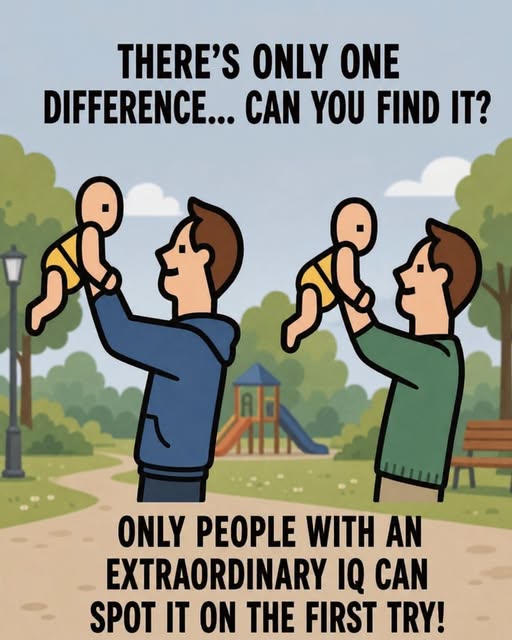
Some picture puzzles don’t just test your eyes. They expose your mind. You stare at two images, convinced they are identical, scanning every corner and every familiar shape. Then a tiny, stubborn detail refuses to line up, and suddenly you’re not so sure of what you see. That quiet doubt, that flicker of “How did I miss this?” is where the real story begins. The puzzle stops being a simple game and becomes a small lesson in how easily the human brain can convince us that we have seen something when we have only assumed it.
At first, everything looks obvious. The colors seem the same. The objects appear to be in the same places. The background feels familiar. Your eyes move quickly across both pictures, comparing them almost automatically, and your brain reaches a conclusion before you have consciously examined every detail. “Same.” Once that decision is made, your mind begins working to support it.
We like to believe we notice everything important, but our brains are ruthless editors. Faced with two nearly identical images, the mind searches for the overall pattern rather than carefully inspecting every individual element. It recognizes the larger scene and fills in the details that appear predictable. If a tree is supposed to have several branches, the brain does not necessarily count each one. If a window is supposed to contain a certain number of lines, the brain may simply register “window” and move on.
That efficiency is useful in everyday life. The brain cannot consciously analyze every object, sound, movement, and expression we encounter. There would be far too much information to process. Instead, it creates shortcuts. It identifies familiar patterns, makes predictions, and focuses attention on what seems most relevant.
But those same shortcuts are exactly what make visual puzzles so frustrating.
Your eyes can pass directly over the changed detail again and again while your brain confidently insists that nothing is wrong. You may even look directly at the answer without recognizing it because your mind has already decided what the image is supposed to contain.
This is why these puzzles can feel strangely personal. When you finally discover the difference, the first reaction is often disbelief. “How did I not see that?” You may stare at the same spot and wonder how something so obvious managed to remain invisible for so long.
The answer is that seeing is not simply a matter of light entering your eyes.
Your brain is involved in every step.
It interprets what your eyes receive and decides what deserves attention. It organizes information into patterns and uses previous experience to predict what should be there. When the visual information is almost identical, the brain has very little reason to expect something unusual. It therefore becomes easy for a tiny change to disappear into the larger picture.
Then, in a single moment, the illusion breaks.
You finally spot the missing stripe.
The shifted shadow.
The altered shape.
The extra object.
The detail that had been sitting there the entire time.
Nothing about the picture has actually changed. The image was always the same. What changed was your understanding of it.
And once you see the difference, it becomes almost impossible to unsee.
That sudden shift is what makes these puzzles so satisfying. The frustration disappears instantly and is replaced by a tiny feeling of triumph. You found it. The mystery is solved. The image suddenly makes sense.
But that small victory is about more than cleverness.
It is a reminder that perception is not as perfect as we like to imagine.
We can look directly at something and still fail to understand it. We can hear words and miss their meaning. We can spend time with someone and overlook the fact that something about them has changed. We can become so accustomed to a routine that we stop noticing the small details that once would have caught our attention immediately.
The puzzle simply makes that human limitation visible.
In everyday life, our brains are constantly filtering information. They have to be. Imagine trying to consciously process every sound in a crowded room, every movement on a busy street, every facial expression, every word, and every object within your field of vision. It would be overwhelming.
So the brain chooses.
It decides what matters.
It ignores what appears familiar.
It fills in gaps.
It predicts.
And most of the time, those shortcuts help us function.
The problem begins when something important is hidden inside the information our brain has decided is ordinary.
That is why the lesson of a picture puzzle can extend far beyond a screen. The changed detail may be harmless in a game, but real life is full of subtle signals that can be just as easy to overlook.
A friend who suddenly becomes quieter.
A family member who stops calling.
A coworker whose behavior changes slightly.
A child who seems distracted instead of energetic.
A partner whose tone sounds different.
A problem that begins as something small and gradually becomes impossible to ignore.
None of these signals necessarily means something is wrong. But they remind us that important changes do not always arrive dramatically. Sometimes they are tiny enough to be dismissed.
The human mind loves certainty. Once it recognizes a familiar pattern, it wants to keep that pattern intact. It does not naturally enjoy constantly questioning everything it sees. That would be exhausting.
Picture puzzles exploit exactly this tendency.
They create an environment in which your brain expects sameness while secretly introducing difference. The challenge is not merely seeing the picture. It is overcoming your brain’s assumption that you already know what you are looking at.
That is why slowing down can make such a difference.
Instead of looking at the entire image at once, you begin breaking it into sections. You compare one area at a time. You look at shapes, edges, shadows, colors, patterns, and positions. You stop trusting the first conclusion your brain gives you.
And suddenly, the difference appears.
The same principle can be useful outside puzzles. Sometimes we need to slow down before deciding that everything is fine, that we already understand someone, or that a situation is exactly what it appears to be.
Curiosity can interrupt automatic thinking.
So can patience.
So can the simple decision to look again.
That second look is often where the important information lives.
The beauty of these puzzles is that the consequences of missing something are completely harmless. If you fail to notice the difference, nothing serious happens. You simply try again, perhaps become frustrated, and eventually find the answer.
But the experience gives you a safe way to observe your own perception in action.
You can literally watch your brain make an assumption.
You can feel the confidence of being wrong.
And then you can experience the moment when new information forces that assumption to change.
That is a powerful little lesson.
It reminds us that being confident does not necessarily mean being correct. Sometimes the thing we are most certain about is the thing we have not examined closely enough.
And when the difference finally becomes visible, the puzzle leaves you with one simple realization: the world did not suddenly become clearer.
You simply started looking differently.
Maybe that is why these seemingly simple games remain so addictive. They turn an ordinary visual task into a challenge against our own assumptions. They make us question what we think we see and encourage us to search beyond the obvious.
In puzzles, the cost of overlooking a tiny detail is trivial.
In life, the consequences can be much greater.
We may miss quiet signals, subtle emotions, changes in behavior, opportunities, warnings, or truths that have been sitting in plain view. Not because we do not care, but because our minds are designed to simplify the world.
The lesson is not that we should distrust everything we see.
It is that sometimes we should look twice.
Slow down.
Question the obvious.
And remember that something can be directly in front of us without being fully understood.
Because sometimes the most important difference is not hidden in the picture at all.
It is hidden in the way we are looking at it.