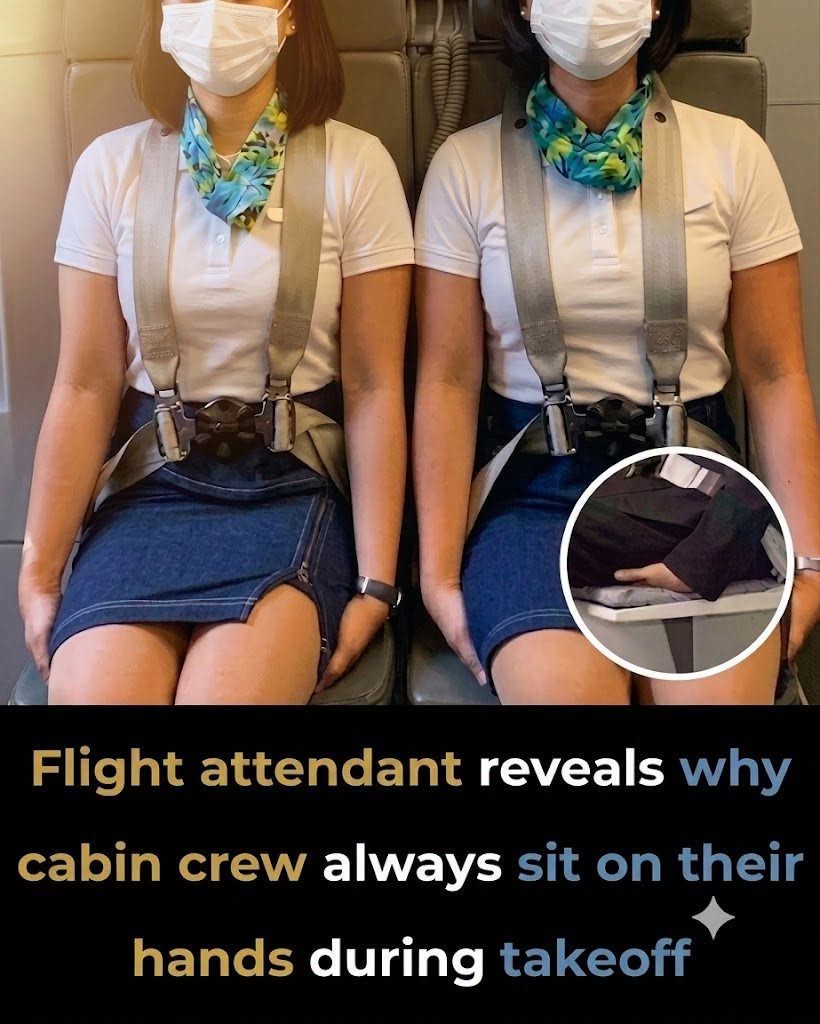
Why You May See Cabin Crew Sitting With Their Hands Tucked Under Their Thighs
If you’ve ever watched flight attendants during takeoff or landing, you may have noticed something unusual: some crew members sit upright with their hands tucked beneath their thighs.
At first glance, the position may seem uncomfortable or even unnecessary. But it has a practical explanation related to aviation safety, body positioning, and emergency preparedness.
The key is that cabin crew are not simply sitting back and relaxing. They are preparing for one of the most important phases of a flight.
Here’s what this position means and why it matters.
1. The Position Is Part of a Safety Routine
Takeoff and landing are critical phases of flight when cabin crew must be ready to respond quickly if something unexpected happens.
During these periods, flight attendants typically perform safety checks, secure the cabin, confirm that passengers are seated with their seat belts fastened, and prepare themselves according to their airline’s procedures.
When seated at their designated crew stations, they may adopt a specific posture known as a brace position or a variation of a safety posture.
Depending on the airline and aircraft, this can include sitting upright, keeping the feet and legs positioned as instructed, and placing the hands beneath the thighs or in another prescribed position.
The exact posture is not universal. Cabin crew follow the procedures established for their aircraft and airline.
2. Why Put Their Hands Under Their Thighs?
There are several practical reasons this position may be used.
- To keep the hands in a prescribed position: Tucking the hands beneath the thighs can help crew members maintain a consistent posture during takeoff and landing.
- To reduce unnecessary movement: Keeping the arms close to the body can help prevent the hands from moving freely during turbulence or a sudden deceleration.
- To prepare for an impact: A prescribed brace position is intended to help occupants maintain a safer body posture if an emergency landing or impact occurs.
- To maintain readiness: Remaining seated and properly positioned allows cabin crew to follow safety procedures during critical flight phases.
However, the position should not be interpreted as a guarantee against injury. Its purpose is to follow a safety procedure, not to eliminate every risk.
3. What Is the Brace Position?
A brace position is a body posture designed to be used when instructed or when required by an applicable emergency procedure.
Its purpose is generally to help reduce uncontrolled body movement and the risk of certain impact injuries.
The exact position depends on the aircraft, seat configuration, available space, and operator procedures.
For cabin crew, the prescribed position may differ from the one passengers are instructed to use because crew seats and their surroundings are different.
That is why a flight attendant’s posture may look unusual compared with the way passengers sit.
4. Why Is This Important During Takeoff and Landing?
Takeoff and landing require special attention because unexpected events can occur during these phases.
Although serious aviation accidents are rare, cabin crew must be prepared to respond without delay.
Before takeoff and landing, they generally complete tasks such as:
- Checking that the cabin is secure.
- Ensuring passengers follow safety instructions.
- Confirming that relevant equipment and exits are ready according to procedures.
- Taking their assigned seats and adopting the required safety posture.
Once seated, crew members may have limited time to react if an emergency occurs.
A standardized posture helps them follow established procedures rather than improvising in a stressful situation.
5. Does This Mean Flight Attendants Expect a Crash?
Absolutely not.
Seeing cabin crew sitting with their hands beneath their thighs does not mean they expect an accident.
Aviation safety relies on preparation, checklists, training, and consistent procedures. The same way pilots perform routine checks before every flight, cabin crew prepare for unusual situations even when they fully expect a normal journey.
Most takeoffs and landings are uneventful.
The purpose of safety procedures is to ensure that crew members know what to do if circumstances change unexpectedly.
6. Do All Airlines Use This Exact Hand Position?
No.
This is an important distinction because viral posts sometimes describe the practice as though every flight attendant worldwide follows precisely the same technique.
In reality, safety procedures vary according to the airline, aircraft type, crew-seat design, and applicable aviation requirements.
Some crew members may place their hands beneath their thighs, while others may be instructed to position their hands on their legs or adopt another specific posture.
Without knowing the airline and aircraft involved, it is not possible to say that one hand position is universally required.
7. What Should Passengers Do During Takeoff and Landing?
Passengers should follow the safety instructions given by the cabin crew and the information provided on their aircraft.
In general:
- Keep your seat belt fastened while seated.
- Return your seat to the required upright position.
- Stow tray tables and loose items as instructed.
- Follow the crew’s directions during turbulence or an emergency.
- Pay attention to the safety briefing, particularly the location of nearby exits.
The crew’s procedures and passenger instructions may differ, so passengers should not automatically copy a flight attendant’s exact posture.
The Bottom Line
When flight attendants sit with their hands tucked beneath their thighs, they may be following a prescribed safety posture used during takeoff and landing.
The position can help them maintain the required body posture and prepare for a possible impact, but the precise technique varies between airlines and aircraft.
It is a reminder that cabin crew have an important safety role beyond serving food and helping passengers. Their training includes preparing the cabin, following emergency procedures, and remaining ready to respond when needed.
The next time you notice a flight attendant sitting upright with their hands tucked beneath their thighs, remember that what looks like an unusual sitting position may be part of a carefully designed safety routine.
Editorial note: This article provides general aviation-safety information. The exact posture and its purpose should be confirmed against the relevant airline’s procedures; the hand position is not universal.