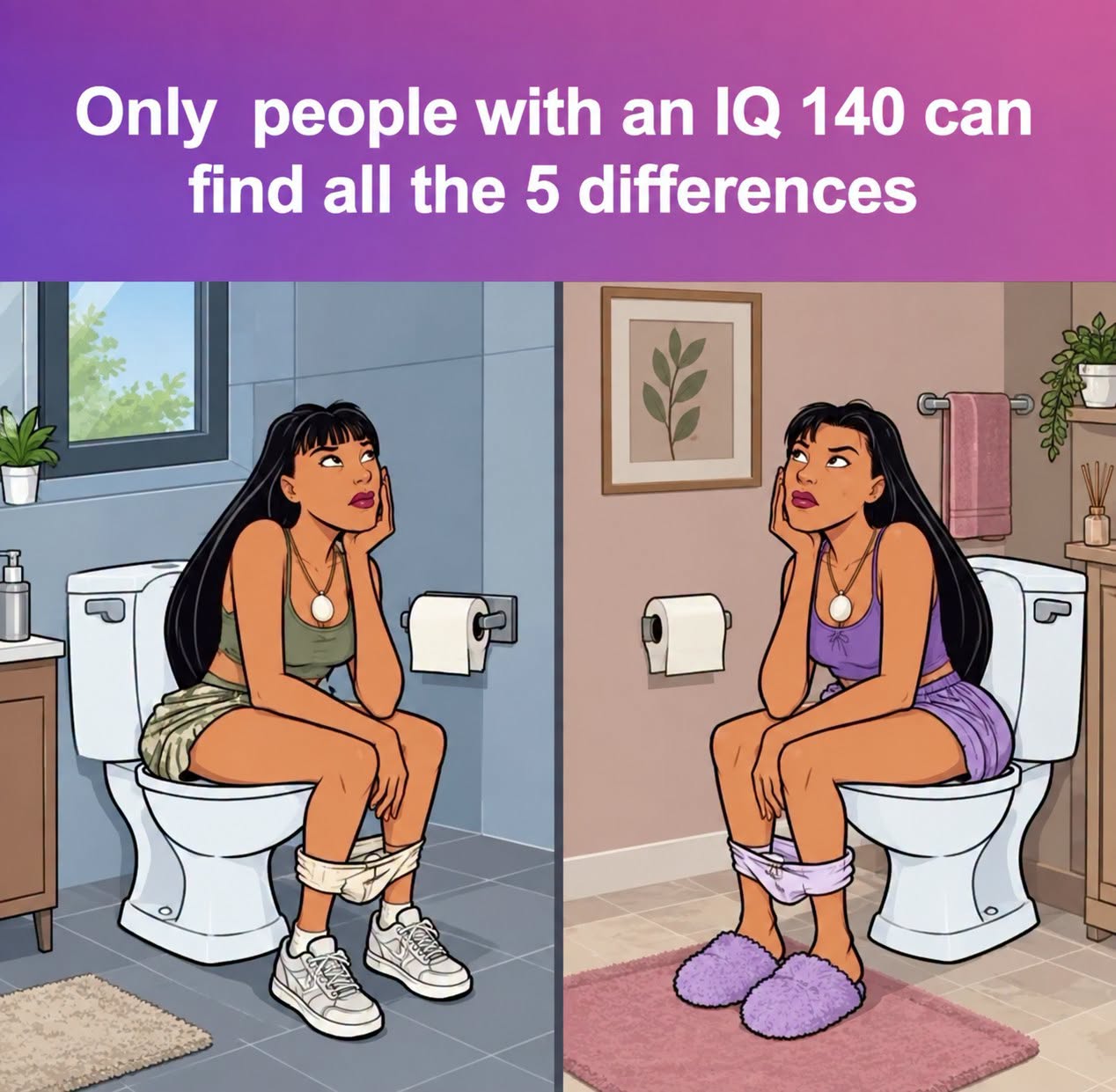
Spot-the-difference games are often presented as simple tests of observation, but they are not reliable measures of whether someone has an IQ of 140—or any particular level of intelligence. Their real challenge lies in visual attention, concentration, patience, and the ability to notice small changes inside two images that are intentionally designed to look almost identical.
Part of the appeal comes from the feeling that the answer is right there in front of you.
You can see both pictures clearly. Nothing is hidden behind a complicated code or an obscure mathematical formula. Yet somehow, one tiny detail refuses to reveal itself. A button may be missing. A shadow may point in a slightly different direction. One object may have moved by a few pixels. A color may be just a little warmer or darker than it should be.
And that is exactly what makes these puzzles so frustrating.
The brain is naturally good at recognizing the overall meaning of a scene. When you look at a picture of a room, a street, a garden, or a group of people, your mind quickly identifies what the scene represents. You may immediately understand what you are looking at without consciously examining every individual object.
That efficiency is useful in everyday life, but it can work against you in a spot-the-difference puzzle.
Your brain may register two images as essentially the same because the overall composition is unchanged. The furniture is still there. The people are still standing in roughly the same positions. The background still looks familiar. The colors appear consistent.
Meanwhile, one tiny detail is different.
Your eyes may technically pass over it, but your attention does not necessarily stop there.
This is one reason a missing button can be harder to notice than an entirely new object. A large change attracts attention automatically. A tiny change has to compete with everything else in the image for your limited attention.
The same thing happens with altered shadows, small changes in facial features, slightly different patterns, or objects that have shifted position. If the difference does not immediately disrupt the overall picture, your brain can effectively decide that there is nothing important to investigate.
That does not mean you are unintelligent.
It means your visual system is doing what it normally does: prioritizing the bigger picture.
Fatigue can make the challenge even harder. When you are tired, your ability to sustain attention can decline, and details that might normally stand out can become surprisingly difficult to find. After staring at two similar images for several minutes, everything can begin to blend together.
Distractions can have the same effect.
If your phone is buzzing, someone is talking nearby, or you are constantly switching between tasks, your attention is divided. Even a person with excellent observational skills can struggle when their concentration is repeatedly interrupted.
The size of the screen also matters.
A difference that is relatively easy to see on a large monitor may become much harder to identify on a small phone screen. Fine details can become compressed, colors can appear less distinct, and tiny changes may be difficult to compare accurately.
That is why missing a difference should never be treated as a verdict on your intelligence.
You can be highly intelligent and still miss an obvious visual detail.
You can also find every difference without having an unusually high IQ.
The two abilities simply are not the same thing.
Spot-the-difference puzzles primarily reward careful observation and sustained attention. They may also reward familiarity with common puzzle patterns. Once you have solved enough of these challenges, you may begin to anticipate where designers like to hide differences.
For example, you may start checking hands, buttons, windows, shadows, signs, patterns, reflections, and small objects near the edges of the picture. You may also learn that puzzle creators often make changes that are visually subtle but logically meaningful.
That experience can make you faster.
But becoming faster at solving a particular type of puzzle does not automatically mean your general intelligence has increased.
If you want to improve your performance, one of the most useful strategies is to slow down.
That sounds counterintuitive because many puzzles encourage people to race against a timer. But rushing can make your eyes jump randomly between different parts of the image. You may repeatedly look at the same areas while completely ignoring others.
Instead, try comparing the pictures systematically.
Start at one section and work across the image. Compare matching areas rather than constantly jumping from one side to another. Examine objects individually and ask yourself whether their shape, position, color, size, or pattern is exactly the same.
Look at the edges of objects.
Check corners.
Compare shadows.
Look at repeated patterns.
Examine small details on clothing, buildings, furniture, signs, and other objects.
You can also divide the picture mentally into sections and inspect each section before moving to the next. This creates a more organized search and reduces the chance that your attention will wander.
Another useful strategy is to change the scale of the image.
If you are looking at a digital puzzle, enlarging the image can make small differences easier to see. This is particularly useful when the difference involves a tiny line, color variation, or small object.
However, magnification can also make comparison more difficult if you lose sight of the overall image. The goal is not to stare at every pixel indefinitely. It is to give yourself a clearer view when a particular area seems suspicious.
If everything begins looking identical, take a break.
This is one of the simplest strategies and one of the most overlooked. After staring at two nearly identical pictures for a long time, your brain can become accustomed to the visual information. Continuing to stare may not make you better at finding the answer.
Look away for a moment.
Blink.
Stretch.
Get a glass of water.
Then return to the puzzle.
Sometimes the missing difference becomes obvious almost immediately.
Another useful approach is to stop assuming that the difference must be somewhere visually dramatic. Puzzle designers often know that people naturally look toward the center of an image or focus on the most interesting object.
That means peripheral areas can be worth checking carefully.
A small object near the edge may have changed. A background detail may be missing. A pattern that appears decorative may contain the actual answer.
The trick is not necessarily to look harder.
It is to look differently.
There is also a psychological element to these puzzles. Once you find several differences, you may become convinced that the remaining answer must be extremely difficult. That expectation can make you overlook something simple.
Sometimes the final difference is sitting in a place you already examined several times.
Your eyes saw it.
Your brain simply did not register it as important.
This is why frustration can become part of the challenge. You know there is another answer somewhere, and that knowledge creates pressure. You begin questioning yourself: How could I possibly have missed something this obvious?
But that reaction is exactly why it is important not to turn a game into a judgment about yourself.
A missed difference is a missed difference.
It is not evidence that you are unintelligent, inattentive in every area of life, or somehow less capable than someone who found it faster.
People have different strengths. Some may be excellent at visual puzzles. Others may be better at language, mathematics, memory, creativity, problem-solving, communication, or understanding complex ideas.
Human ability is far too broad to be reduced to whether someone notices a missing button in a picture.
That is especially important when these puzzles are accompanied by dramatic claims about IQ.
A puzzle may say that only people with an exceptionally high IQ can find the answer in a certain number of seconds. Such claims are generally part of the entertainment rather than a scientifically meaningful assessment of intelligence.
The challenge can still be fun.
It can still be genuinely difficult.
And it can still provide a satisfying feeling when you finally discover the missing detail.
But there is no reason to attach your self-worth to the result.
In fact, the best way to approach these puzzles may be to remove the pressure completely.
Treat the challenge as a game.
Enjoy the moment when your brain finally notices what your eyes had been missing. Laugh when the answer turns out to be in the most obvious place. Challenge a friend or family member and see who finds it first.
Use it as a short mental break rather than an examination of your abilities.
If you find all the differences quickly, enjoy the victory.
If you cannot find them, take a break and try again.
If someone else sees the answer before you, that does not make them smarter.
It simply means that, in that particular moment, their attention landed on the right detail first.
And that distinction matters.
Visual attention can fluctuate from one moment to another. Sleep, stress, distractions, screen size, motivation, familiarity, and even the way an image is designed can influence performance.
None of those factors provides a complete picture of intelligence.
So the next time a spot-the-difference puzzle challenges you, resist the temptation to turn it into an IQ test.
Slow down.
Compare matching sections.
Inspect objects individually.
Check edges, colors, shadows, patterns, and positions.
Use a larger screen when possible.
Take a break if your eyes become tired.
And most importantly, remember what you are actually doing.
You are playing a puzzle.
You are not proving your worth.
The satisfaction comes from the moment when a hidden detail suddenly becomes visible—the tiny change that was there all along, waiting for you to notice it.
That moment is the fun.
The number of seconds it took you is not a measure of who you are.