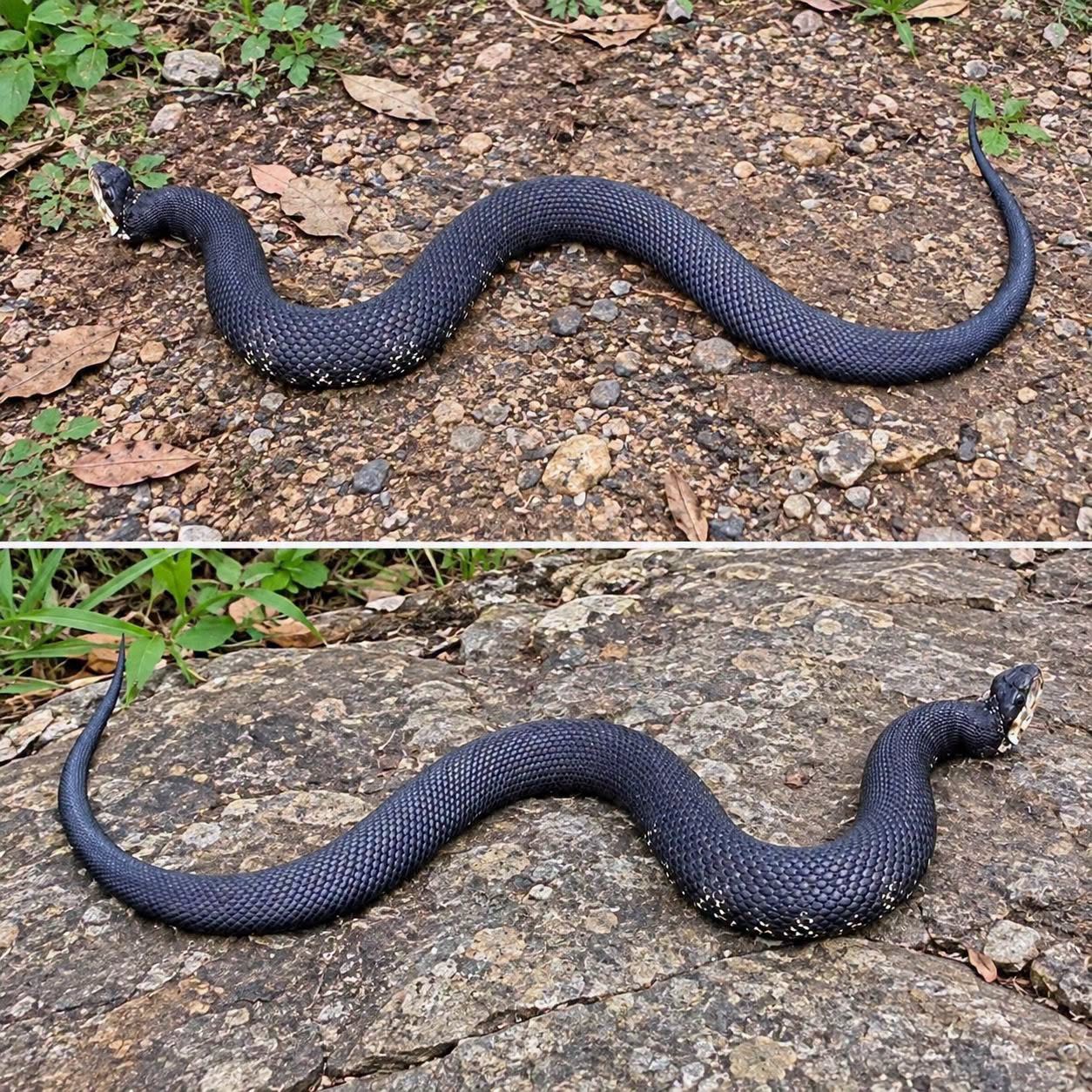
A snake’s flickering tongue can look mysterious, and to someone who is uncomfortable around snakes, it may even appear threatening. But the constant movement is not a warning display or an attempt to intimidate people. It is one of the ways a snake gathers information about the world around it.
The tongue acts almost like a chemical sampling tool.
When a snake flicks its tongue into the air, it can collect tiny chemical particles from its surroundings. Those particles are then delivered to a specialized sensory structure known as the Jacobson’s organ, or vomeronasal organ, located in the roof of the snake’s mouth.
This system gives snakes an extraordinarily useful way to interpret their environment.
A snake does not rely on vision alone to understand what is nearby. Chemical information can help it detect potential prey, recognize other animals, follow scent trails, and gather clues about its surroundings. In practical terms, the tongue is helping the snake “sample” the environment.
That is why tongue flicking is such a characteristic snake behavior.
It is not necessarily a sign that the animal is angry.
It is not proof that the snake is preparing to attack.
And it certainly does not mean that a snake is responding to a household scent in the way people sometimes imagine.
The sophistication of a snake’s chemical senses has contributed to a large number of popular claims about how to repel them. You may hear that vinegar, sulfur, cinnamon oil, ammonia, or other strong-smelling substances will create an invisible barrier that snakes refuse to cross.
The idea sounds logical at first.
If snakes are highly sensitive to chemical information, perhaps an overwhelming smell would make them stay away.
But the reality is much less certain.
Evidence supporting many scent-based home remedies is limited or inconsistent, and a powerful smell should not be treated as a reliable snake-proof barrier. A substance that smells extremely strong to a person does not automatically produce a predictable behavioral response in every snake.
Different species can respond differently, environmental conditions can change how odors disperse, and a snake that is motivated by food, shelter, temperature, or another environmental factor may not behave according to a simple “strong smell equals avoidance” rule.
In other words, putting a bottle of vinegar or another strongly scented substance around the property does not guarantee that a snake will stay away.
That is important because relying on an unproven scent remedy can create a false sense of security.
If someone believes an odor has created a protective boundary, they may pay less attention to the conditions that actually attract snakes to an area.
A more dependable strategy is to make the surroundings less appealing in the first place.
Snakes often enter areas because the environment provides something useful to them. That might include food, shelter, water, hiding places, or favorable temperatures. Removing those opportunities can make a property less attractive without depending on a supposedly magical smell.
Start with the yard.
Keeping grass and vegetation trimmed can reduce the amount of dense cover available for snakes and the animals they may hunt. A heavily overgrown yard can provide numerous hiding places, making it easier for wildlife to move around unnoticed.
That does not mean every blade of grass needs to be perfectly maintained.
The goal is simply to reduce unnecessary clutter and dense hiding areas, particularly close to buildings, walkways, play areas, and other places where people spend time.
Debris is another factor worth considering.
Stacks of boards, piles of leaves, discarded materials, rocks, and other clutter can create sheltered spaces where small animals and reptiles can hide. Removing unnecessary debris can make the area less attractive and easier to monitor.
Woodpiles deserve particular attention.
Firewood stored directly beside a home can create protected spaces underneath and between the pieces. It can also attract rodents and other small animals that may become prey for snakes.
Moving woodpiles farther away from the house can therefore address more than one potential problem at the same time.
The same principle applies to animal feed.
If pet food, livestock feed, birdseed, or other food sources are left accessible, they can attract rodents. Once rodents become established, predators that feed on them may have a reason to visit the same area.
A snake does not necessarily need to be attracted to your house itself.
It may simply be attracted to the food chain developing around it.
That is why rodent control can be an important part of reducing unwanted snake encounters.
If mice or rats are finding easy access to food, shelter, or nesting areas around a property, addressing those conditions can make the environment less attractive to snakes that hunt them.
This does not mean that eliminating every rodent will guarantee that no snake ever appears.
Wild animals do not follow perfect rules.
But reducing available food sources can remove one of the reasons a snake might repeatedly visit.
Physical exclusion is another useful strategy.
Inspect the outside of the house for accessible gaps around foundations, doors, vents, utility openings, and other areas where wildlife could potentially enter. Sealing practical entry points can reduce opportunities for snakes and other animals to get indoors.
This is especially useful because a snake does not need a large opening to create concern. Some species can move through surprisingly small spaces, particularly when following prey or seeking shelter.
The goal should be to reduce accessible openings rather than assuming that a single strong scent will create a protective boundary.
Prevention is usually less stressful than confrontation.
If a snake is discovered outside, the safest response is generally to give it space.
Do not attempt to grab it.
Do not corner it.
Do not try to provoke it to determine whether it is dangerous.
And do not encourage children or pets to approach it.
A snake that feels threatened may respond defensively, particularly if it believes it has no escape route. A person trying to handle an unfamiliar snake also risks misidentifying the species and misunderstanding its behavior.
Distance is often the simplest form of protection.
Children should be kept away from the animal, and pets should also be prevented from approaching it. Dogs and cats may be curious and may attempt to investigate a snake, potentially creating a dangerous encounter for both the animal and the pet.
If the snake is in an area where it can safely move away, allowing it an escape route may be the best immediate option.
If it is inside a home, trapped in a confined space, or located somewhere that creates a genuine safety concern, contacting a qualified local wildlife professional can be a much better choice than attempting to remove it yourself.
Professionals can identify the animal, assess the situation, and determine the appropriate method of removal.
This is particularly important when people cannot confidently identify the species.
A common mistake is assuming that a snake’s appearance or behavior provides an easy answer about whether it is dangerous. Identification can be surprisingly difficult, especially for someone who is frightened and seeing the animal only briefly.
The safest approach is therefore to avoid unnecessary contact.
There is also a broader lesson in the way snakes use their tongues.
Their behavior can seem strange because humans experience the world primarily through our own senses. We tend to interpret animals through familiar human signals. A person might associate repeated movement with agitation or aggression, but that interpretation does not necessarily apply to a snake.
The tongue flick is primarily about gathering information.
The snake is effectively checking what is around it.
Where is potential food?
Has another animal passed nearby?
What chemical traces are present?
Is the surrounding environment changing?
These are the kinds of questions its sensory system helps answer.
Understanding that behavior can make encounters feel less mysterious.
It can also reduce the temptation to rely on myths.
Because snakes have such an unusual sensory system, it is easy to assume that any sufficiently powerful odor must repel them. But animal behavior is rarely that simple.
A smell that seems overwhelming to a human may not create a dependable barrier. Even if a snake temporarily avoids a particular area, that does not establish that the substance is a reliable long-term repellent.
Environmental conditions can change.
The smell can dissipate.
The snake can encounter another route.
And if food or shelter is available, the animal’s motivation may outweigh whatever effect the odor has.
That is why practical habitat management generally makes more sense than depending on scent-based solutions.
Trim vegetation.
Remove unnecessary debris.
Store wood carefully and away from the house.
Keep food sources secure.
Address rodent problems.
Inspect possible entry points.
And maintain the property in a way that reduces places where wildlife can hide close to people.
None of these steps can guarantee that a snake will never appear.
Wild animals can travel, and even a carefully maintained property can occasionally attract wildlife.
The goal is not to create an impossible wall between humans and nature.
The goal is to reduce unnecessary encounters and make the property less attractive to animals seeking food or shelter.
That distinction is important.
A snake in the yard is not automatically a sign that something has gone terribly wrong. In many environments, snakes are simply part of the local ecosystem. They may feed on rodents and other animals and play a natural role in controlling populations.
The safest response is therefore not necessarily to panic at the sight of one.
Instead, create distance, keep people and pets away, and determine whether professional assistance is necessary.
The more familiar people become with normal snake behavior, the easier it can be to respond calmly.
A flickering tongue is not an invitation to approach.
It is not a threat display.
It is a sensory tool.
And understanding that small detail helps explain why snake behavior can be so different from what people expect.
At the same time, that sophisticated sensory system should not be used to justify every snake-repellent claim found online.
There is a big difference between knowing that snakes detect chemical information and proving that a particular household substance will reliably keep them away.
One fact does not automatically establish the other.
That is where practical prevention becomes more valuable than promises.
If you want fewer snakes around your home, focus on the conditions that make the area attractive rather than searching for a magic smell that supposedly creates an invisible barrier.
Reduce food.
Reduce shelter.
Reduce clutter.
Reduce easy access.
And respond cautiously when wildlife does appear.
Those steps may not be as exciting as a miracle repellent, but they are far more grounded in how animals actually interact with their environment.
Ultimately, the goal should not be to live in fear of every snake that appears.
It should be to create a safer space for people and pets while respecting the fact that wildlife exists around us.
A bottle of strong-smelling liquid may offer reassurance, but reassurance and proven protection are not the same thing.
Real prevention comes from understanding why animals visit, reducing the resources they find around the property, and knowing how to respond when one does appear.
The snake’s flickering tongue is a remarkable example of how specialized nature can be.
It helps the animal gather information from an environment that humans experience very differently.
And once you understand what that tongue is actually doing, the mystery becomes a little less frightening.
The most dependable protection is not a scent.
It is preparation, prevention, distance, and good judgment.