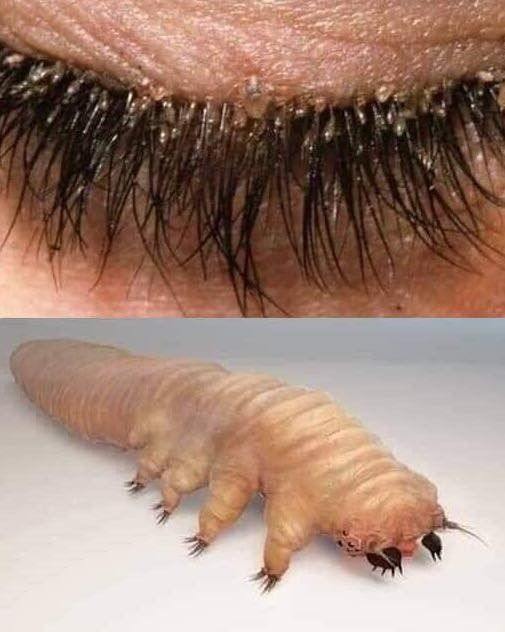
Most people have no idea tiny organisms are already living on their faces right now.
Not because their skin is dirty.
Not because something is terribly wrong.
Simply because the human body naturally hosts microscopic life most people never notice.
Among the most common are tiny mites called Demodex — nearly invisible organisms that live inside hair follicles and oil glands, especially around the eyelashes and eyelids.
For many people, they cause absolutely no problems at all.
They quietly exist on the skin without symptoms, feeding on oils and dead skin cells while remaining completely unnoticed for years.
But when their numbers grow out of balance, things can change surprisingly fast.
Suddenly the eyes begin burning.
The eyelids feel irritated and swollen.
Lashes become crusty near the roots.
A strange crawling or gritty sensation appears that no amount of rubbing seems to relieve.
Some people even begin losing eyelashes without understanding why.
And because the symptoms resemble allergies, dry eye syndrome, irritation, or simple exhaustion, many never realize microscopic mites may be contributing to the problem.
The condition most commonly associated with this imbalance is called blepharitis — chronic inflammation of the eyelids.
Blepharitis itself can have multiple causes, including bacteria, skin conditions, clogged oil glands, or Demodex overgrowth. But eye specialists increasingly recognize that excessive mite populations can significantly worsen irritation for certain people.
The frustrating part is how subtle the symptoms often begin.
At first, it may feel like ordinary dry eyes.
Slight itching.
Mild redness.
Occasional irritation after waking up.
But over time, the discomfort can become constant.
Burning.
Swelling.
Watery eyes.
Sensitivity to light.
Crusting around the eyelashes.
A gritty sensation like sand trapped beneath the eyelids.
And because people naturally touch or rub irritated eyes repeatedly, inflammation can worsen even further.
Demodex mites tend to become more common with age, partly because oil gland changes and immune system shifts create environments where the mites multiply more easily. People with certain skin conditions like rosacea may also experience higher Demodex populations.
Poor eyelid hygiene, heavy makeup buildup, sleeping in eye makeup, or weakened immune function can also contribute to imbalance.
Still, it is important not to panic.
Hearing the word “mites” immediately sounds alarming, but Demodex organisms are extremely common. Most adults have them to some degree, and their presence alone does not mean someone is infected, contagious, or unclean.
The real issue arises when the balance changes enough to trigger inflammation and irritation.
Because symptoms overlap heavily with allergies and dry eye disease, many people spend months treating the wrong problem first. They switch eye drops repeatedly, blame seasonal allergies, or assume stress and screen time are entirely responsible.
Often, the actual diagnosis only happens after an eye doctor closely examines the eyelashes under magnification.
Tiny debris around lash follicles can become one clue.
Inflammation patterns provide another.
Once identified, treatment is usually straightforward and focused heavily on eyelid hygiene.
Daily cleansing becomes extremely important.
Gentle, fragrance-free eyelid cleansers or specially designed lid wipes help remove oil buildup, debris, bacteria, and excess mites from the lash area. Warm compresses may also help loosen clogged oils and soothe irritated glands.
Consistency matters far more than harshness.
Aggressive scrubbing or strong products can actually worsen inflammation around such delicate skin.
In more persistent cases, eye specialists may recommend targeted therapies designed specifically for Demodex-related blepharitis or prescribe medications to reduce inflammation and restore healthier eyelid balance.
Good hygiene habits also help reduce recurrence:
Cleaning makeup brushes regularly.
Removing eye makeup fully before sleep.
Avoiding expired cosmetics.
Washing pillowcases frequently.
Keeping hands away from irritated eyes whenever possible.
And perhaps most importantly, seeking professional evaluation instead of self-diagnosing severe or persistent symptoms online.
Because while Demodex-related irritation is usually manageable, similar symptoms can also overlap with other eye conditions requiring different treatment.
The deeper reason stories like this capture people’s attention so intensely is psychological as much as medical.
There is something deeply unsettling about realizing invisible organisms exist on the human body without our awareness.
It challenges the illusion that we fully control or completely understand ourselves physically.
But in reality, the human body has always been an ecosystem — complex, interconnected, and constantly interacting with microscopic life in ways most people never think about.
Most of the time, that balance works quietly without problems.
And when issues do appear, they are usually treatable with proper care, hygiene, and medical guidance.
So while the idea of invisible eyelid mites sounds terrifying at first, the reality is far less dramatic than fear makes it seem.
Often, the biggest danger is not the mites themselves.
It is ignoring persistent eye symptoms for too long while assuming they will simply disappear on their own.