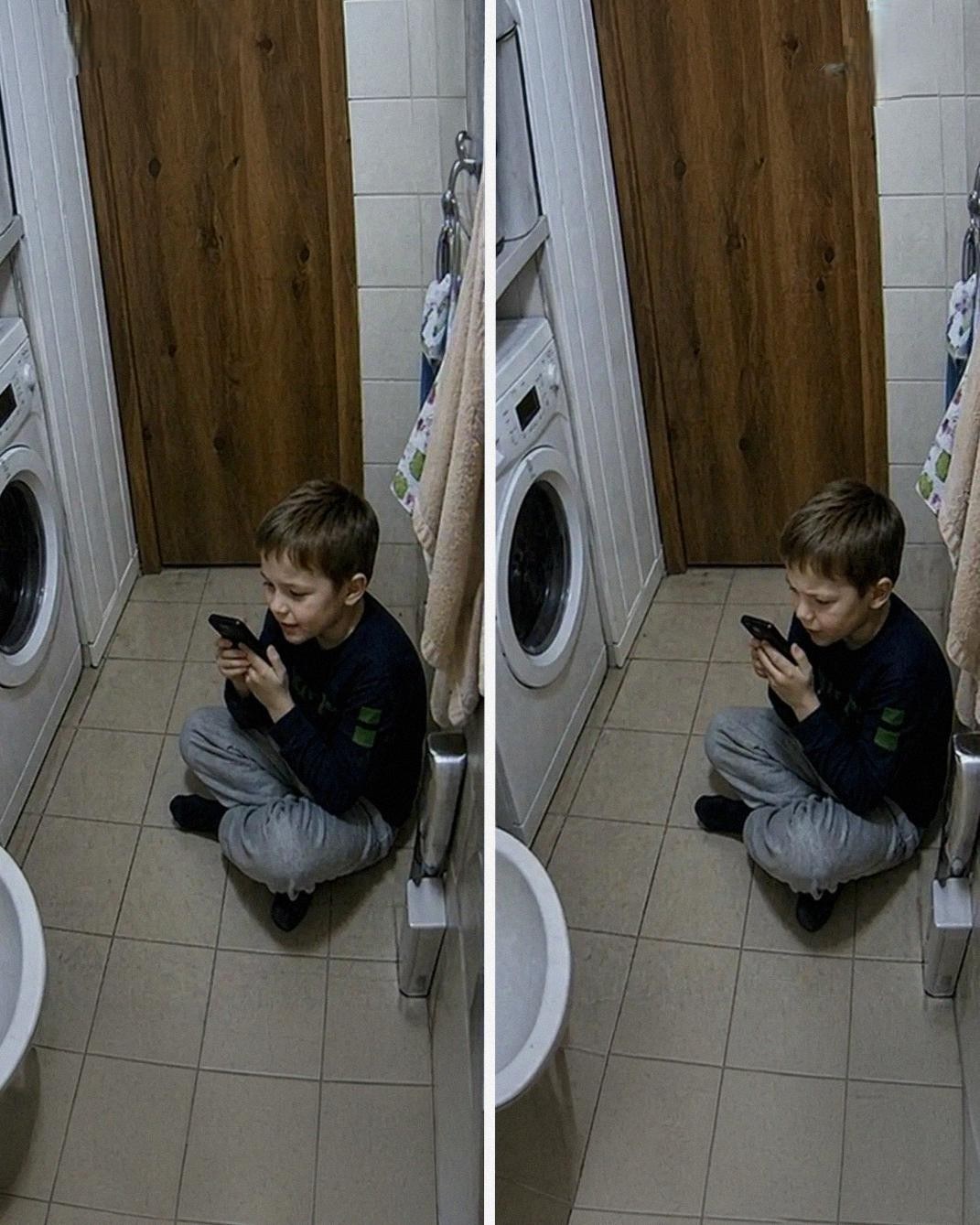
The quiet stillness of my office shattered just after noon when my phone rang with a call that instantly changed the way I understood safety, motherhood, and fear. The voice on the other end belonged to my six-year-old son, Jonathan, but it barely sounded like him. His words arrived in frightened whispers so thin and shaky they almost disappeared beneath the static. I could hear him trying not to cry while he told me he was hiding upstairs in the bathroom. Then came the sentence that made my blood turn cold.
“Mommy,” he whispered desperately, “the woman in the living room says she’s my real mom.”
For a second, my body stopped functioning entirely.
I didn’t think logically. I didn’t close my laptop properly, explain anything to coworkers, or even grab my purse correctly. I simply ran. My husband, Leo, had taken the day off specifically to spend time with Jonathan while I worked. Between his constant travel schedule and our hectic routines, father-son days were rare and important. But as I raced toward the parking garage calling Leo over and over again without an answer, every possible nightmare flooded my mind at once.
Why wasn’t he answering?
Who was this woman?
How did she get into my house?
Every red light on the drive home felt unbearable. My imagination spiraled into darker and darker places. I wondered whether Leo had hidden an entire life from me. Whether some secret from his past had suddenly arrived at our front door claiming ownership over our child. I tried forcing myself toward rational explanations — confusion, misunderstanding, maybe some bizarre accident — but the terror in Jonathan’s voice refused to let me believe this was harmless.
When I finally pulled into the driveway, I barely remembered turning off the engine before running toward the house.
The silence inside terrified me immediately.
No television.
No conversation.
No movement.
Just stillness.
I screamed Jonathan’s name so loudly my throat hurt. Seconds later I heard the upstairs bathroom door swing open followed by frantic footsteps pounding down the stairs. Jonathan threw himself into my arms sobbing uncontrollably, clutching me with desperate force while I wrapped my body around his instinctively like a shield.
Then I looked toward the living room.
A woman sat on the floor beside the coffee table looking like she had been dragged through a storm. Her clothes were soaked with rain and smeared with mud. Wet hair clung chaotically to her face while her hands trembled in her lap. But what unsettled me most wasn’t her appearance.
It was the way she looked at Jonathan.
Not aggressively.
Not violently.
But with heartbreaking intensity.
The expression on her face carried recognition so deep and desperate it made the hairs rise on my arms instantly.
Leo stood nearby looking completely broken. His posture carried the helpless exhaustion of someone who realized too late how badly things had spiraled. The moment he saw me, relief crossed his face, but it only fueled my rage further.
“What is going on?” I screamed.
Before Leo could answer, the woman slowly lifted her head.
“My name is Reese,” she said hoarsely, staring at Jonathan with tears already filling her eyes. “That’s my little boy. That’s my son.”
Something primal exploded out of me.
I pulled Jonathan behind me while demanding answers from Leo, whose explanation somehow sounded both unbelievable and horrifyingly real at the same time.
Earlier that day, he and Jonathan had stopped at a store for snacks. Outside, during heavy rain, Leo noticed Reese wandering dangerously close to traffic while clutching a doll wrapped in blankets as though it were a real infant. A passing car splashed muddy water across her, and according to Leo, she looked terrified, disoriented, and completely lost. She kept repeating that she needed to find her son.
Out of pity — and terrible judgment — Leo decided not to leave her alone in that condition.
So he brought her into our car.
And then into our home.
I could barely process what he was saying. Every protective instinct inside me screamed at once. He had brought a mentally unstable stranger directly into our house while our child was there. Leo insisted he only wanted to help her temporarily while contacting authorities or finding family. But then came the detail that shattered me completely: he left her alone with Jonathan for “just a minute” while grabbing dry clothes upstairs.
That single minute changed everything.
According to Jonathan, Reese knelt beside him, held his hand gently, and told him she had finally found him after searching for so long. Terrified, he ran upstairs and locked himself in the bathroom before calling me.
Meanwhile Reese remained trapped entirely inside her delusion. She cried openly while reaching toward Jonathan, insisting repeatedly that he belonged with her. Every movement she made sent fresh panic through me. I was seconds away from dialing emergency services when a loud knock shook the front door.
A police officer stepped inside.
The second he saw Reese, his entire expression collapsed into exhausted heartbreak.
Not fear.
Not suspicion.
Recognition.
He approached her slowly with the careful tenderness of someone handling a wound too deep for sudden movement. Calling her softly by name, he guided her toward the ambulance waiting outside. Then he explained everything.
Reese had wandered away from her mother hours earlier, and police had been searching for her all afternoon. Witnesses photographed Leo’s license plate after seeing him help her into the car, which eventually led officers to our address.
Once they left, silence swallowed the house again.
Jonathan kept asking whether the woman really believed she was his mother. I held him tightly while explaining that sometimes people become very sick inside their minds and start believing things that feel real to them even when they aren’t true.
But the fear lingered long after sunset.
That night, Jonathan slept between Leo and me while all three of us lay awake staring into darkness.
The next morning, however, something inside me still needed answers. Fear had slowly transformed into curiosity mixed with anger and confusion. So Leo and I drove to the hospital where Reese had been taken.
There we found Officer Kyle sitting exhausted in the waiting area, no longer looking like an authority figure but simply a man carrying years of sadness.
And finally, he told us the full truth.
Five years earlier, Reese lost her baby during childbirth.
The trauma shattered something inside her permanently.
Most days she functioned normally enough, but certain triggers could pull her into devastating psychological episodes where grief overpowered reality itself. Seeing Jonathan — a little boy almost exactly the age her child would have been — caused her mind to collapse into a version of life where her son had survived.
She wasn’t dangerous in the way I originally imagined.
She was broken.
Painfully, catastrophically broken.
Kyle described her not as a predator, but as someone trapped endlessly between memory and hallucination, forever searching for a child who never got the chance to breathe.
Eventually he allowed us to see her briefly.
Without the rain, mud, and chaos, Reese looked startlingly fragile sitting beneath the sterile hospital lights. The moment she recognized us, shame flooded across her face immediately. She remembered enough of the previous day to understand what she had done and how badly she frightened Jonathan.
Through tears, she apologized repeatedly.
She explained that during those moments, the reality inside her mind feels more convincing than the real world around her. For a brief period, she truly believed Jonathan belonged to her.
And suddenly my fear transformed into something far more complicated.
Empathy.
Not forgiveness for the danger.
Not approval of Leo’s reckless decision.
But grief for a woman trapped forever inside the worst moment of her life.
I reached across carefully and touched her hand.
On the drive home afterward, the tension between Leo and me remained heavy, but my anger had softened into reflection instead of fury. When we picked Jonathan up from school and he asked once more about “the lady,” I answered as honestly as I could for a six-year-old child.
“She was a mommy who got very lost after something sad happened to her,” I told him quietly.
That night I stood in Jonathan’s doorway long after he fell asleep.
Watching him breathe peacefully beneath his blankets, I realized motherhood is far more fragile and terrifying than I had ever fully understood before. It isn’t defined only by biology, routines, or happy family photographs. Sometimes motherhood reveals itself most clearly in moments of crisis — in the instinct to answer the phone immediately, race home without hesitation, and become safety itself for someone smaller than you.
And maybe that’s what stayed with me most after everything.
Not just the fear.
Not even the danger.
But the realization that while some mothers spend their lives desperately searching for children they lost, others are given the unimaginable privilege of hearing a frightened voice whisper “Mommy” into the phone — and still being able to come running home.