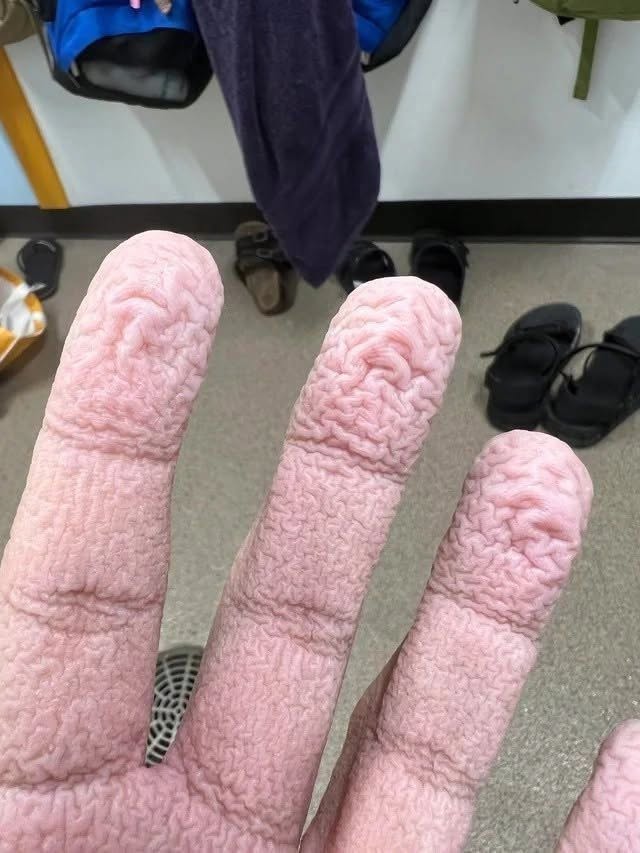
Your fingers wrinkle in the bath, and most of the time you don’t think twice about it. You look down, see those familiar little ridges running across your fingertips, maybe joke about having “old hands,” and continue with your day. Within a short time after drying off, everything usually returns to normal. But what if those creases start appearing much faster than they used to? What if they remain long after your hands are dry—or appear when your skin hasn’t touched water at all? A change that seems insignificant could sometimes be your body’s way of telling you to pay closer attention. Behind those tiny ridges are nerves, blood vessels, sweat glands, and the protective barrier of your skin, all working together in ways you rarely notice until something changes.
The wrinkling that happens after spending time in a bath, swimming pool, or shower is generally completely normal. For years, people assumed fingertips wrinkled simply because the outer layer of skin absorbed water and expanded. But research has shown that the nervous system plays an important role in the process.
When your hands or feet remain in water, your nervous system triggers tiny blood vessels beneath the skin to constrict. As those vessels narrow, the volume beneath the skin decreases slightly, creating the characteristic ridges and valleys across your fingertips. It is an active biological response rather than simply skin swelling randomly from moisture.
Scientists have suggested that these wrinkles may even provide an evolutionary advantage by improving grip in wet environments. Like the grooves on a tire helping move water away from the surface, wrinkled fingertips may make handling wet objects easier. Whether you’re holding something slippery or walking barefoot on a wet surface, those temporary ridges may provide a subtle advantage.
Under ordinary circumstances, there is little reason for concern. Your fingers wrinkle after being submerged for several minutes, you dry your hands, circulation returns to normal, and the skin gradually smooths again. The entire process is temporary, painless, and harmless.
But the situation becomes more interesting when that familiar pattern changes. Some people notice their palms beginning to wrinkle after only brief contact with water. Others develop unusually pronounced white or swollen-looking areas across the palms. In certain cases, the wrinkling may remain much longer than expected after the skin has dried.
One uncommon condition associated with this pattern is aquagenic wrinkling of the palms. People with this condition may develop exaggerated wrinkling, whitish bumps, swelling, or discomfort shortly after their hands are exposed to water. The changes can appear dramatically faster than ordinary water-induced wrinkling.
Aquagenic wrinkling has been associated with changes involving salt transport in the skin and is known to occur more frequently in people with cystic fibrosis or those who carry certain CFTR gene variants. However, experiencing unusually fast wrinkling does not automatically mean someone has cystic fibrosis. There are multiple possible explanations, and medical evaluation is necessary before drawing conclusions.
The nervous system can also influence how fingers wrinkle. Because the normal response depends partly on nerve signals controlling blood vessels, certain types of nerve damage or dysfunction may alter the usual pattern. Changes in circulation, sweating, hydration, skin condition, or electrolyte balance may also affect how the hands look and feel.
Sometimes the explanation is much simpler. Frequent handwashing, strong soaps, cleaning chemicals, cold weather, occupational exposure, or repeated use of alcohol-based products can damage the skin barrier. When that protective barrier becomes dry and irritated, fingertips may develop fine lines, cracking, peeling, or a wrinkled appearance that has little to do with the normal response to water.
That is why context matters. Wrinkled fingers by themselves are rarely enough to identify a medical condition. What matters more is whether the pattern has changed suddenly, whether it happens without water exposure, how long it lasts, and whether other symptoms appear alongside it.
Pain, burning, tingling, numbness, significant discoloration, swelling, cracking, or heavy peeling deserve more attention, particularly when they persist or worsen. Fingers that repeatedly become unusually pale, blue, or intensely red may also point toward circulation changes that should be discussed with a healthcare professional.
Protecting the skin can help when irritation is contributing to the problem. Gentle cleansers may be less disruptive than harsh soaps, while regular moisturizing can help restore the skin barrier. Wearing appropriate gloves when washing dishes, cleaning, or working with irritating chemicals can reduce repeated exposure.
At the same time, skincare shouldn’t become a way of covering up persistent symptoms without understanding them. If your hands suddenly begin behaving very differently, especially without an obvious explanation, it may be worth showing them to a clinician or dermatologist. A professional can examine the skin, review other symptoms, medications, and medical history, and decide whether further investigation is necessary.
For most people, wrinkled fingertips after a long bath will remain exactly what they have always been: a harmless and fascinating example of the nervous system quietly doing its job. There is no reason to become frightened every time your fingers develop temporary creases after swimming or showering.
But your hands can sometimes reveal subtle changes happening elsewhere in the body. The important thing is not to panic over every wrinkle but to recognize when something has clearly departed from your normal pattern.
So the next time you climb out of the bath and see those familiar ridges, there is probably nothing to worry about. Watch them fade as your hands dry and appreciate the surprisingly sophisticated biology behind something so ordinary. But if the wrinkles begin appearing almost instantly, refuse to disappear, develop without water, or arrive alongside pain, numbness, discoloration, or significant skin changes, don’t simply ignore them. Protecting your hands with gentle care is wise—but paying attention when they begin telling you something new may be wiser still.