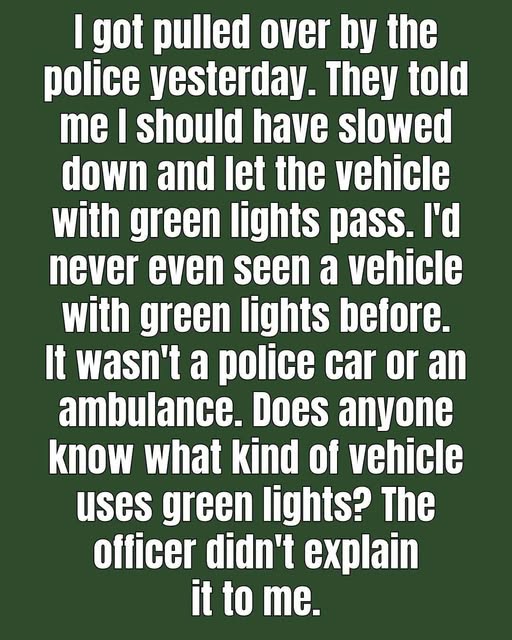
The sudden flash of green slices through traffic, catches your eye, and makes your brain stall for a second. That’s not the familiar red and blue of a police vehicle. It isn’t the flashing red of a fire truck, and it doesn’t immediately look like an ambulance rushing toward an emergency. So what exactly are those strange green lights doing on the road? Is it some new trend? A prank? A customized vehicle? Or could there be something far more serious happening behind that windshield? Drivers may see unusual emergency-style lights and barely give them a second thought, never realizing that depending on local laws, the vehicle could be connected to someone responding to an emergency or providing an important service.
Green warning lights can have very different meanings depending on where you live. In some jurisdictions, they may be associated with volunteer firefighters, emergency medical personnel, medical transport, command vehicles, or other authorized services. In others, green lights can have an entirely different legal meaning. Unlike the more universally recognized colors used by police cars, ambulances, and fire engines, green lights are not interpreted the same way everywhere.
That uncertainty is exactly why they can be confusing. A driver may notice a green light approaching from behind and wonder whether they are legally required to move aside. Another person might assume the light is simply decorative. But in places where green lights identify authorized responders or medical-related vehicles, the person behind the wheel may be trying to reach someone who needs assistance.
Some vehicles connected with medical transportation perform a quieter but still important role. They may transport elderly passengers, people with disabilities, or patients who require regular medical appointments and cannot easily travel independently. Their journeys may not look dramatic from the outside, but getting someone safely and reliably to care can matter enormously.
Imagine a dialysis patient who depends on scheduled treatments several times each week. There may be no screaming siren and no dramatic race through an intersection, yet missing or significantly delaying essential treatment can create serious problems. Other passengers may be undergoing cancer treatment, rehabilitation, specialist appointments, or care for chronic medical conditions.
Volunteer emergency responders can present another situation entirely. In some areas, volunteers use green lights on personal vehicles to identify themselves while responding to calls. The vehicle may look completely ordinary except for that flashing light, which can make it easy for other motorists to misunderstand what they are seeing.
That does not automatically mean every vehicle displaying green lights has the same traffic privileges as an ambulance or police car. The rules vary considerably by jurisdiction. In some places, a green light may simply request courtesy from other drivers rather than legally require them to pull over. Elsewhere, specific authorized vehicles may receive different privileges.
This is why understanding local traffic law matters. Color alone does not tell the entire story. A green light that has one meaning in one state, province, or country could mean something completely different after crossing a border. Drivers should never assume that unusual warning lights grant a vehicle unlimited authority to ignore normal traffic rules.
The lights are also generally regulated rather than being ordinary decorations that anyone can install and use however they wish. Many jurisdictions restrict certain flashing colors to specific categories of vehicles or authorized personnel. Improperly displaying lights reserved for emergency or official use can potentially lead to traffic penalties, fines, or other consequences depending on local law.
Those restrictions exist for a reason. Emergency-style lights depend on public recognition and trust. If anyone could imitate official warning signals whenever they wanted to move through traffic faster, drivers would eventually stop taking those signals seriously. That confusion could become dangerous when an actual responder genuinely needs cooperation.
For motorists, the safest response is usually awareness rather than panic. If you notice an authorized vehicle approaching, remain predictable, pay attention to surrounding traffic, and follow the rules that apply where you are driving. Do not suddenly slam on the brakes, make an unsafe maneuver, or create another hazard simply because you see an unfamiliar flashing light.
When local rules call for yielding, providing space can make a meaningful difference. Even when a particular light is only requesting courtesy, safely allowing an authorized responder to pass may help someone reach an emergency scene or important destination sooner. A few seconds that mean almost nothing to your own journey can sometimes matter much more to someone else’s.
And behind those lights there may be a story you will never know. It could involve a volunteer responding to an emergency, a medical professional trying to reach someone who needs help, or another authorized service performing a necessary task. What looks like an unusual green flash through your windshield may represent an important responsibility unfolding quietly in the middle of ordinary traffic.
There is also something deeply human about recognizing that not every urgent situation arrives with a screaming siren. Some forms of care happen quietly. Some emergencies are answered by volunteers driving their own vehicles. Some essential journeys look completely ordinary to everyone except the person whose well-being depends on reaching the destination.
So the next time a strange green light appears in your mirror, don’t automatically dismiss it as decoration or assume you know exactly what it means. Stay alert, understand the laws where you live, and respond safely and predictably. If the vehicle is authorized and local rules or conditions call for giving it space, doing so may cost you only a few moments.
Sometimes courtesy on the road is more than good manners. It can become part of a much larger chain of people helping someone they may never meet. By easing off the gas, remaining calm, and allowing an authorized vehicle through when appropriate, you may be giving a stranger a better chance at reaching care, receiving help, finding comfort—or simply getting a little more of the time that matters so much.