He thought it was just another harmless joke. One sarcastic remark, one cheap laugh at her expense, and the evening would move on as though nothing had happened. Everyone around the table chuckled politely while she forced a smile, pretending his words hadn’t landed exactly where he intended. But she heard every single syllable. She noticed the laughter, the satisfied grin on his face, and the way he expected the moment to disappear as quickly as it arrived. What he didn’t realize was that humiliation has a remarkable memory. She said nothing that night, choosing silence over argument, and quietly let him believe he’d gotten away with it. The following morning, however, as he reached for his favorite pair of boxers, the bedroom suddenly filled with a dramatic white cloud that left him coughing, confused, and completely unprepared for what came next.
The previous evening had started like dozens before it. Friends gathered for dinner, stories were exchanged, and playful teasing filled the room. He had always considered himself the funniest person in the group, someone who believed every occasion needed a joke. Most of the time his comments were harmless enough, but every now and then they crossed a line. Instead of making everyone laugh together, they singled someone out. More often than not, that someone was her.
She had grown used to brushing those moments aside. Correcting him in front of others usually led to more jokes, while arguing afterward often ended with him insisting she was “too sensitive.” Over time, she stopped defending herself and simply endured the comments, hoping one day he would realize how much they stung. But beneath her calm exterior, each careless remark quietly accumulated, leaving behind wounds he never bothered to notice.
That night’s joke had been different.
Without thinking, he made a comment about her appearance that immediately drew uncomfortable laughter from everyone at the table. A few people looked away, clearly embarrassed. Others laughed simply because they didn’t know what else to do. She smiled politely, finished her meal, and continued the evening as though nothing had happened. Inside, however, she made a decision. She wasn’t going to argue. She wasn’t going to cry. And she certainly wasn’t going to spend another evening explaining why kindness mattered.
Instead, she waited.
The next morning unfolded exactly as she expected.
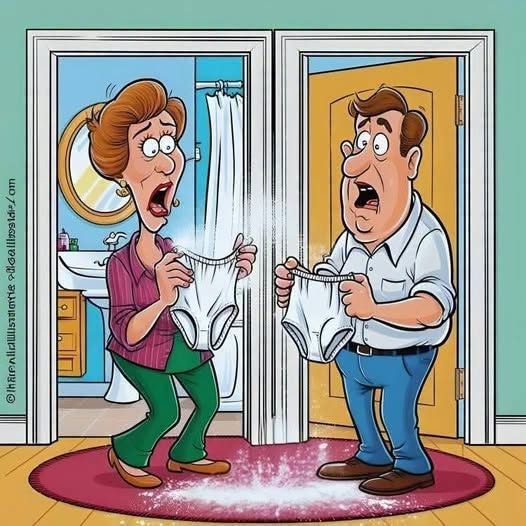
Still half asleep, he wandered toward the dresser, grabbed his underwear, and slipped them on without a second thought. Seconds later, the room erupted into a thick white cloud that exploded in every direction. Powder covered the floor, floated through the sunlight, and settled across the bedroom furniture. Startled, he jumped backward, coughing as he tried to understand what had just happened.
“What on earth is this?” he shouted.
Holding the boxers at arm’s length as though they had somehow betrayed him, he stared in complete disbelief. His confidence from the previous night had vanished, replaced by total confusion. He called her name, demanding an explanation while trying unsuccessfully to shake the powder from the fabric.
She walked into the room without rushing.
For a moment she simply stood there, taking in the sight before her. The man who had laughed so confidently the night before now looked completely bewildered, standing in the middle of a cloud of white dust while clutching his powdered underwear like evidence in a courtroom.
“Why is there talcum powder in my underwear?” he asked, hoping there was some perfectly innocent explanation.
She looked at him calmly.
“That’s not talcum powder,” she replied with remarkable composure.
He frowned.
“It’s Miracle-Gro.”
The silence that followed seemed to last forever.
His expression shifted from confusion to realization in a matter of seconds. He looked from the boxers back to her, slowly understanding that this wasn’t about gardening products at all. It was about the joke he’d made, the embarrassment he’d caused, and the lesson she had chosen to deliver without raising her voice.
A bright red blush spread across his face.
Not because of the powder.
Because, for the first time, he found himself on the receiving end of the kind of public humiliation he had always treated as entertainment.
She didn’t yell.
She didn’t insult him.
She didn’t remind him of every previous joke at her expense.
She simply let the moment speak for itself.
After a long pause, he finally began laughing—first at the absurdity of the situation, then at himself. It wasn’t the loud, boastful laughter from the night before. It was quieter, humbler, and carried with it the realization that humor loses its charm when it’s built on someone else’s discomfort.
Later that day, he apologized sincerely. Not because he had been embarrassed by a cloud of powder, but because he finally understood how easily words can leave lasting marks. He admitted he had mistaken teasing for affection and never considered how often his jokes came at her expense.
From that point forward, something between them quietly changed. Their conversations became more thoughtful, their humor more balanced, and the playful teasing that remained was shared rather than one-sided. He still loved making people laugh, but he became far more careful about who paid the price for the punchline.
Looking back, neither of them remembered the powder as the most important part of the story. What lasted was the lesson hidden beneath the prank. Respect isn’t measured by grand romantic gestures or expensive gifts. Sometimes it’s revealed in the small everyday choices—knowing when to laugh, knowing when to stop, and understanding that the funniest joke is never the one that leaves someone else feeling small.
And every time he reached into the dresser after that morning, he couldn’t help smiling just a little, remembering the day one perfectly timed prank taught him a lesson that no argument ever could.