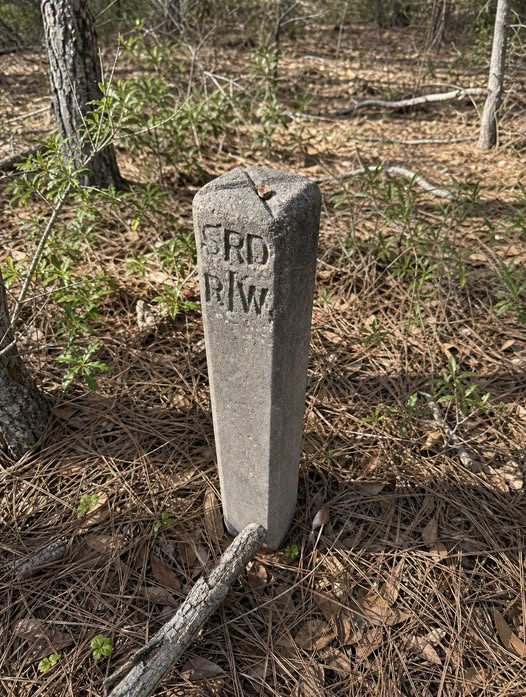
That plain concrete post was never meant to be beautiful.
It was never designed to attract attention, become a landmark, or make anyone stop and wonder about the past. It was built for a practical purpose, planted in the ground and left behind to do a very ordinary job.
Yet there it stands.
Knee-high in the weeds.
Weathered by rain, sun, snow, and decades of changing seasons, holding a secret line between the past and the present.
At first glance, you think it’s nothing.
Just an old piece of concrete surrounded by grass.
Something left behind because nobody bothered to remove it.
But then you look closer.
And you realize it may be the last witness to a vanished road, a lost routine, and an entire community’s forgotten daily life.
Imagine walking along an old railroad bed or following a faint trail through the woods when you suddenly notice it.
A small, lonely concrete post.
Maybe it is stamped with “R/W” or “SRD.”
The letters may be worn down. Moss may cover part of the surface. Weeds may have grown around its base. There may be no road anywhere nearby, no signs pointing toward a destination, and no obvious reason for the marker to be standing there.
But that little post is quietly telling you something.
A road once lived here.
The pavement may be gone.
The vehicles are gone.
The houses that once stood nearby may be gone too.
But the boundary remained.
Long after the pavement crumbled, signs rusted away, vegetation reclaimed the shoulders, and local memory began to fade, the right-of-way marker continued doing the job it was placed there to do.
It marked the legal edge of a road.
A road that may no longer exist in any practical sense, but whose history is still written into the land.
And once you recognize one, the landscape begins to change.
Suddenly, the strange features around you don’t look quite so random.
That shallow depression in the grass?
Maybe it was part of the old roadbed.
That slight rise through the trees?
Perhaps it was the raised edge of a route built decades ago.
Those tiny pieces of gravel mixed into the soil?
They may be remnants of a surface that once carried bicycles, wagons, cars, delivery trucks, school buses, and people heading to work.
What looked like an ordinary patch of woods begins to resemble a map.
The land starts revealing a pattern.
A route begins to emerge.
And with it comes an uncomfortable realization: people once passed through here every day.
They may have driven this road without giving it a second thought.
A farmer may have used it to reach a field.
A child may have walked along its edge on the way to school.
Neighbors may have waved at one another from passing cars.
Someone may have stopped at a roadside mailbox.
Someone may have taken this same route every morning for twenty years.
To them, it wasn’t history.
It was simply the road.
That is what makes these forgotten markers so powerful.
They preserve the ordinary.
We often imagine history as something enormous and dramatic. We think of courthouses, battlefields, factories, iron bridges, historic homes, monuments, and famous buildings.
But communities are not built only from landmarks.
They are built from routines.
People going to work.
Children walking home.
Neighbors visiting each other.
Trucks carrying supplies.
Families traveling into town.
Those everyday movements create the invisible structure of a community.
And when the road disappears, much of that structure disappears with it.
The concrete marker may be one of the few physical reminders that the routine ever existed.
It doesn’t tell you who drove there.
It doesn’t tell you where they were going.
It doesn’t tell you what happened along the road.
It simply remains.
A quiet piece of evidence.
Sometimes the most fascinating historical discoveries are the ones nobody intended to preserve.
An abandoned road may vanish beneath trees.
A bridge may collapse.
A railroad may be removed.
A neighborhood may disappear.
But something as simple as a concrete stake can survive long enough to whisper that the landscape was once different.
That is why encountering one can feel strangely intimate.
You are not looking at a monument built to celebrate history.
You are looking at something that was never supposed to become history at all.
It was practical.
Unremarkable.
Ordinary.
And precisely because of that, it can tell us something museums sometimes cannot.
It shows us how people actually moved through the world.
Where they traveled.
What connected one place to another.
How a community once functioned before new roads, new neighborhoods, and new development changed the landscape.
Standing beside that little marker, you can almost imagine the road returning.
For a moment, the weeds become shoulders.
The trees become distant houses.
The quiet woods become the sound of engines, footsteps, bicycles, and conversations.
Then the image disappears.
All that remains is the concrete post.
Still standing.
Still marking a boundary.
Still quietly doing the job it was given decades ago.
Maybe nobody remembers who placed it there.
Maybe nobody alive remembers the road exactly as it was.
But the marker remembers in the only way an object can.
By remaining.
And that may be the deepest lesson hidden in something so ordinary.
History does not always announce itself.
Sometimes it is buried under grass.
Sometimes it is hidden beneath a trail.
Sometimes it survives as a faded abbreviation stamped into concrete.
You just have to know what you’re looking at.
Because once you recognize that lonely little post, the landscape is never quite the same again.
You realize that the woods around you may not be empty at all.
They may be full of vanished routes, forgotten routines, and traces of lives that once seemed completely ordinary.
And that concrete stake, weathered and half-forgotten, is quietly insisting on one simple truth:
What was once ordinary was also important.
And sometimes, the smallest witnesses are the ones that remember the longest.