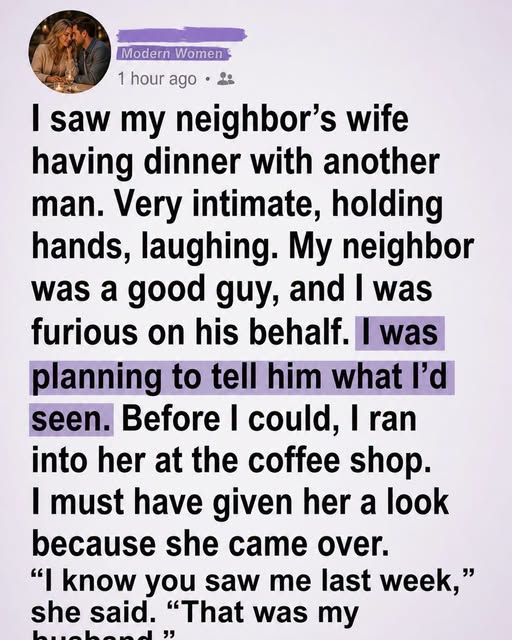
I was so sure I was right.
One dimly lit restaurant. One held hand. One quiet conversation between two people who seemed far too comfortable with each other.
And suddenly, I was convinced I had uncovered a betrayal.
My heart raced with righteous purpose. I wasn’t thinking about whether I could be wrong. I wasn’t considering what I didn’t know. In my mind, the pieces already fit together perfectly.
I was ready to “protect” a friend.
I was ready to expose a secret I had only imagined.
The strange thing about certainty is how convincing it can feel before you have the facts.
I walked into that restaurant believing I was simply having dinner, but I walked out believing I had discovered the truth about someone else’s life. I replayed the scene in my head over and over—the way Sarah sat across from the stranger, the way their hands met across the table, the familiarity in their expressions.
To me, it looked obvious.
Too obvious.
I took those tiny details and built an entire story around them.
The hand became intimacy.
The quiet conversation became secrecy.
The stranger became a lover.
And before I had even asked a single question, I had already decided what had happened.
I didn’t realize that I wasn’t observing a story.
I was writing one.
My own mind had taken a few seconds of someone else’s life and filled in everything I couldn’t see. I had created motives, conversations, history, and betrayal from a scene that contained none of those answers.
Yet the more I thought about it, the more convinced I became.
That is the danger of assumptions.
They rarely arrive announcing themselves as assumptions.
They arrive disguised as certainty.
I began thinking about what I should do. Should I tell Sarah that I knew? Should I warn Mark? Should I confront her before she had a chance to lie?
I imagined myself as the loyal friend who would have the courage to say what everyone else was afraid to say.
But underneath all that righteous certainty was something much less noble.
I wanted my interpretation to be true.
Because once we become emotionally invested in a conclusion, admitting that we might be wrong can feel almost impossible.
Days later, one sentence shattered everything I thought I knew.
There had been no affair.
No secret romance.
No betrayal.
The dinner had a completely different purpose.
And suddenly, every detail I had treated as evidence became meaningless.
The hand across the table meant something entirely different.
The familiarity meant something entirely different.
Even the quietness I had interpreted as secrecy had another explanation.
I felt embarrassed at first.
Then ashamed.
Then something much worse came over me.
Fear.
Because I realized how close I had come to acting on something that wasn’t true.
I had been preparing to inject suspicion into a relationship without understanding what was actually happening.
And then I learned the part of the story that made my mistake even more painful.
Sarah was facing a diagnosis.
Mark was beside her.
That dinner had been part of something deeply personal, something neither of them owed the outside world an explanation for. They were dealing with a reality far heavier than anything I had imagined while sitting across the room and watching them for a few minutes.
When I saw them face the diagnosis together, something inside me changed.
I watched Mark support Sarah through uncertainty, and I couldn’t stop thinking about how easily I had almost added another layer of pain to their lives.
They already had enough to carry.
They were already trying to understand what came next.
They already had difficult conversations ahead of them.
And I had nearly brought them a completely unnecessary heartbreak because I thought I knew what I had seen.
That realization stayed with me.
It made me question how often people do exactly what I had done without ever realizing it.
We see a photograph.
A conversation.
A person leaving a building.
Someone sitting beside someone else.
A message without context.
And our minds immediately begin constructing the missing pieces.
We turn glimpses into narratives.
Then narratives into conclusions.
And eventually, conclusions into judgments.
The problem is that we rarely see the whole picture.
We see one moment.
One expression.
One sentence.
One table in a restaurant.
But a human life is made of millions of moments that happen outside our view.
There may be grief we don’t know about.
There may be fear.
There may be family circumstances.
There may be a diagnosis.
There may be an apology.
There may be a friendship.
There may be something completely ordinary that looks extraordinary when viewed from the wrong angle.
Sarah’s story taught me that certainty isn’t always wisdom.
Sometimes certainty is simply the absence of information disguised as confidence.
Since that night, I’ve tried to treat every “obvious” conclusion as a question instead of a verdict.
If something looks suspicious, I remind myself that looking suspicious isn’t the same as being suspicious.
If I don’t understand someone’s behavior, I try to remember that I don’t have access to everything that happened before or after the moment I witnessed.
And if I feel that sudden rush of certainty—the feeling that I have finally figured someone out—I try to pause.
Because that feeling is exactly when I should be most careful.
The hardest lesson wasn’t that I had been wrong.
It was realizing how easily my wrong assumption could have hurt people I cared about.
I had wanted to be the person who protected a friend.
Instead, I almost became another source of pain.
There is humility in admitting that we don’t know.
There is kindness in waiting.
And sometimes, there is love in refusing to turn incomplete information into a judgment.
I still think about that restaurant sometimes.
The dim lighting.
The quiet conversation.
The hand across the table.
The scene that once seemed to tell me everything.
Now, when I remember it, I see something completely different.
I see how little I actually knew.
And I remember that behind every glimpse we get of someone else’s life, there is always a story unfolding just beyond our view.
Sometimes we don’t need to investigate it.
Sometimes we don’t need to expose anything.
Sometimes we simply need to wait long enough for the truth to reveal itself.
Because what looks like betrayal from across the room may actually be love.
What looks like secrecy may be pain.
And what looks like an obvious conclusion may be nothing more than a story we wrote because we didn’t yet know the rest.
I learned that the hard way.
And I hope I never forget it.