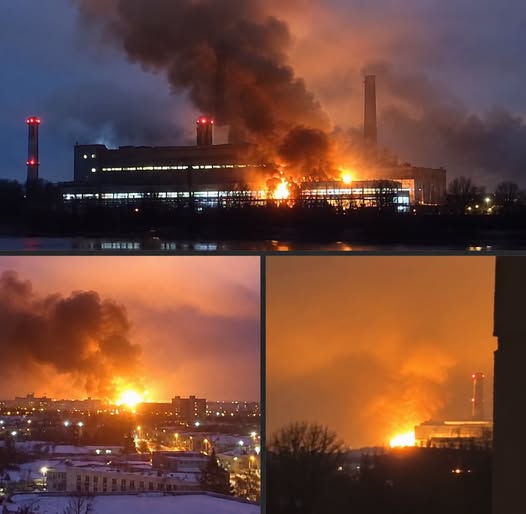
When that sudden **“global alert”** hijacks your screen, it can feel as though the world has tilted beneath your feet. Your heart jumps before your brain has time to process what you’re seeing. For a few seconds, every frightening possibility seems to arrive at once. Is something happening? Is there a threat nobody has explained yet? Should you be worried? In an age filled with war headlines, economic uncertainty, political tension, and constant breaking-news notifications, even a single alarming word can send the imagination racing toward the worst-case scenario.
And when that word is **“precautionary,”** it can sound like code for something much more serious. People see the alert, take a screenshot, send it to family members, and within minutes the original message can be buried beneath speculation. One person says it must be connected to a military situation. Another claims they heard something is about to happen. Someone else posts an unverified explanation with a dramatic headline. Suddenly, a simple warning has become the center of a story nobody can actually confirm.
But a **“precautionary” global alert is rarely a prophecy of disaster.** In most cases, it is better understood as a seatbelt rather than a collision. Civil defense tests, temporary airspace advisories, regional tensions, severe-weather preparations, infrastructure warnings, or disaster-preparedness drills can all lead to alerts designed to make people more aware and ready to respond if circumstances change.
The message is generally much simpler than the fear surrounding it: **“Pay attention. Stay informed. Be prepared if necessary.”** It does not automatically mean, **“Something terrible is happening right now.”**
That distinction matters.
A precautionary warning exists because authorities would rather people have information before they need it than after. Preparing for a possibility is not the same thing as predicting that possibility will happen. Emergency systems are built around that principle. They are supposed to function before a crisis becomes unavoidable, which means some warnings will naturally arrive when the situation is still uncertain, developing, or completely routine.
What has changed dramatically is not necessarily the existence of alerts themselves, but the environment in which those alerts appear.
People now receive breaking notifications while scrolling through social media, watching videos, checking messages, working, driving, eating dinner, or lying in bed. A serious-looking notification can appear between ordinary posts and instantly command attention. Before someone has even opened the full alert, their phone may already be buzzing with messages from friends asking, **“Did you see this?”**
Then the speculation begins.
A screenshot travels from one group chat to another. Someone crops out the less dramatic portion of the message. Another person adds a frightening caption. A third person claims that a relative, coworker, or unnamed “source” knows what is really happening. Within minutes, people may be reacting not to the original alert, but to several distorted versions of it.
That is where the real danger can begin.
**Fear spreads faster than context.**
A short notification may contain important details explaining exactly what the warning means, who is affected, how long it applies, and what people should do. But those details are often ignored once the emotional reaction takes over. The words people remember are the ones that sound frightening. The surrounding explanation disappears.
A precaution becomes a prediction.
A possibility becomes a certainty.
A warning becomes a rumor.
And a rumor becomes something that feels like fact simply because thousands of people are repeating it.
Social media can accelerate that process even further. Platforms reward content that grabs attention, and panic is exceptionally good at doing that. A calm explanation saying, “Officials are advising people to remain aware while they assess a developing situation,” rarely spreads as quickly as a post declaring, **“Something HUGE is happening—prepare now!”**
The more dramatic version gets shared. The calmer explanation gets overlooked. Soon, people are frightened by a story that may have little connection to the original notification.
That is why the most grounded response is also the least dramatic.
**Stop. Read the alert completely.**
Look at who issued it. Read the date, time, location, duration, and instructions. Determine whether it is an actual emergency warning, a test, an advisory, or a preparedness message. Then check official government, civil-defense, emergency-management, or other authoritative channels for additional information.
If there are clear instructions, follow them.
If there are no instructions requiring immediate action, resist the urge to invent them.
And perhaps most importantly, be cautious with anonymous claims. A post saying **“I know someone who works inside”** is not automatically evidence. A blurry screenshot is not automatically proof. A dramatic video circulating without context is not automatically confirmation of anything.
None of this means global tensions should be ignored. The world can be unpredictable, and governments maintain alert systems precisely because circumstances can change quickly. People should remain informed and take legitimate warnings seriously.
But being informed is different from being frightened.
The healthiest response to an unexpected alert is not to dismiss it and not to panic over it. It is to **understand it.** Give the official message a chance to speak before allowing thousands of strangers online to speak for it.
Because sometimes the most frightening thing about an alert is not what it actually says.
It is what our imagination adds to it.
A single precautionary notification is usually not a countdown clock. It is a reminder that systems are watching, authorities are communicating, and ordinary people may need to stay aware. The best response is calm attention: **read, verify, prepare if instructed, and wait for facts.**
Global tension may be real. Uncertainty may be real. But one precautionary alert, by itself, is almost always a reason to **stay informed—not a reason to assume catastrophe is already on the way.**