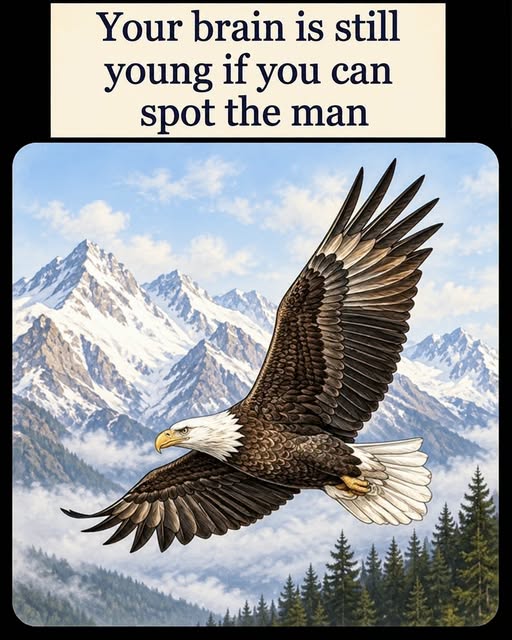
The eagle looks obvious. **Almost too obvious.** Its wings slice dramatically across the sky, its body dominates the center of the scene, and the mountains rise behind it like a familiar backdrop. Your brain takes one quick glance and confidently decides that it already understands the picture. You see the eagle. You see the mountains. You see the sky. Case closed.
Except it isn’t.
Somewhere among those ridges, shadows, cracks, and jagged lines, a man is hiding in plain sight. He isn’t moving. He isn’t outlined in bright colors. There is no arrow pointing toward him. He has been carefully blended into the natural shapes of the landscape, waiting for someone to stop seeing the image as a single obvious scene and start looking at it differently.
You stare harder.
You scan the mountains from one side to the other.
And somehow, **you see less.**
That is what makes the illusion so frustrating. The harder you try to force yourself to find the hidden figure, the more your eyes seem to bounce past him. Your brain keeps returning to the eagle because it has already decided that the eagle is the subject. Everything else becomes scenery.
Then, suddenly, you catch something.
A strange curve.
A shadow that seems just a little too deliberate.
A line that could be the edge of a shoulder.
You hesitate.
You look again.
And for a split second, the mountains no longer look like mountains.
The moment you finally spot him can feel almost surreal. You wonder how you could have stared at the same image for so long without noticing something that now seems completely obvious. Once the man’s outline becomes visible, it can become nearly impossible to **unsee** him.
What makes this image so unsettling is not simply the hidden man. It is the quiet way the picture exposes how easily our perception can be guided without us realizing it.
Your brain wants to organize everything it sees. It searches for the most obvious subject, assigns importance to it, and quickly builds a story around the scene. The eagle becomes the main object. The mountains become the background. The sky becomes empty space. Once those roles are established, your attention naturally follows the pattern your mind has created.
And that is exactly what allows the man to disappear.
He is not actually invisible.
He is simply **not being interpreted as a person.**
His body has been constructed from the same visual language as the landscape around him. A contour becomes a rock formation. A dark patch becomes a shadow. A bend in the mountain becomes nothing more than another irregular ridge. Individual pieces that might reveal the figure are dismissed because your brain has already decided what they belong to.
It is almost like your mind is solving a puzzle before you have realized there is a puzzle at all.
That is why simply staring harder often doesn’t work.
Instead, you have to change the way you look.
Step back from the image.
Soften your focus.
Stop searching for an entire human figure.
Look for **fragments**.
Maybe one line resembles a shoulder. Maybe a darker section could be a jaw. Perhaps the shape of a ridge seems strangely symmetrical. Instead of asking, *“Where is the man?”*, ask, *“Could that shape be part of something else?”*
That tiny shift in strategy can completely change the picture.
The landscape begins to rearrange itself.
A rock becomes an arm.
A shadow becomes part of a face.
A ridge becomes a torso.
Shapes that seemed random suddenly connect, and the hidden figure begins to emerge from the scenery as though he had been waiting for your brain to give him permission to exist.
And the strangest part is that **the picture never changed.**
Not a single pixel moved.
The eagle remained exactly where it was. The mountains stayed in the same position. The shadows remained the same. The hidden man was there from the beginning.
What changed was you.
The illusion reveals something surprisingly powerful about human vision: seeing is not simply a matter of light entering your eyes. Your brain is constantly interpreting, filtering, prioritizing, and predicting what those signals mean.
Sometimes that helps us navigate the world quickly.
Sometimes it causes us to miss what is directly in front of us.
The eagle captures your attention because it is obvious. The man escapes it because he requires interpretation. And once your mind becomes committed to the first explanation of what you are seeing, alternative explanations become surprisingly difficult to notice.
That is why these images can feel almost magical.
They remind us that **looking and seeing are not always the same thing.**
You can stare directly at something and still fail to recognize it. You can examine every part of a scene and somehow overlook the one detail that matters most. Then, once someone—or your own brain—finally reveals the hidden pattern, the entire image transforms.
Nothing was added.
Nothing was removed.
You simply became willing to notice what you had previously dismissed.
And perhaps that is the most fascinating trick of all: sometimes the thing hiding in plain sight was never really hidden.
**Your mind was simply looking somewhere else.**