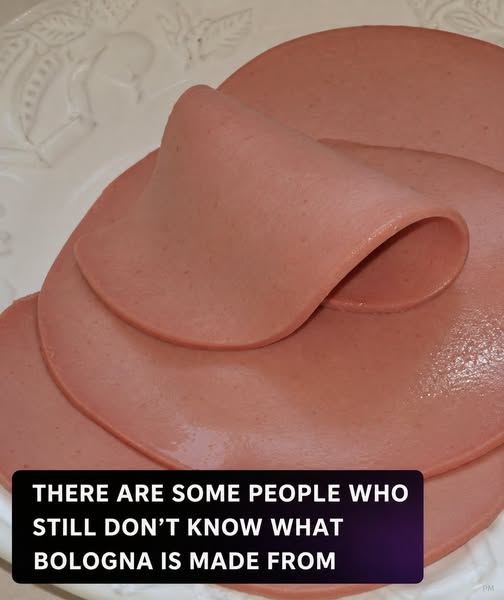
Bologna has been mocked, misunderstood, and turned into a punchline for generations. People joke about “mystery meat,” repeat horror stories about what might be hiding inside those pale pink slices, and then quietly stack them between two pieces of bread anyway. For many families, bologna is simply a cheap and familiar lunch. But the real story behind it is stranger, older, and far more deliberate than most people imagine.
The food Americans know as bologna traces its roots back to Italy, particularly the city of Bologna and its famous mortadella. Traditional mortadella is a very different experience from the uniform slices found in American supermarkets. It is a carefully prepared sausage traditionally made from finely ground pork, with visible cubes of cured pork fat and, in many versions, seasonings and pistachios.
The American version gradually evolved into something much simpler.
Instead of showcasing large pieces of fat and recognizable ingredients, manufacturers created a smooth, consistent texture that could be sliced easily and produced on a massive scale. The result was the soft, pale-pink lunch meat that became a staple of American refrigerators.
The process is surprisingly deliberate.
Depending on the product, the meat may come from beef, pork, chicken, turkey, or a combination of meats. The ingredients are finely ground and blended into a uniform mixture. Fat, seasonings, water, and other permitted ingredients may be incorporated to create the characteristic texture. The mixture is then emulsified, cooked, and sometimes smoked before being chilled and sliced.
That smooth texture is not evidence of some mysterious ingredient.
It is the result of processing.
Everything is designed to create consistency. Every slice should look nearly identical. Every bite should have a familiar texture. Every package should behave predictably on the supermarket shelf.
That predictability is one of the reasons bologna became so successful.
It was inexpensive.
It was convenient.
It could feed an entire family without requiring much preparation.
And children generally found its mild flavor easy to enjoy.
In many American households, bologna became associated with school lunches, quick sandwiches, weekend snacks, and parents trying to prepare something filling without spending much money. It was never necessarily meant to be luxurious. Its purpose was practicality.
That practicality also explains why its flavor is so mild.
Bologna is not usually designed to challenge the palate. It doesn’t need to have the complexity of an artisan sausage. Its appeal comes from familiarity. It is soft, salty, mildly savory, and predictable.
That blandness is not necessarily a flaw.
It is part of the design.
A food intended for mass consumption needs to appeal to a broad audience. The same mild flavor that might seem boring to an adult can make it attractive to a child. The same soft texture that might seem overly processed to one person makes it easy to chew and convenient for a quick sandwich.
Then there are the myths.
For decades, bologna has been surrounded by stories about mysterious scraps and unidentifiable meat. Some of those stories have become so common that people repeat them as though they were established facts.
The reality is considerably less dramatic.
Food regulations in the United States establish requirements governing meat products and what manufacturers can use and label. Bologna is a regulated processed meat, not a free-for-all where manufacturers can secretly put anything they want into a package and call it lunch meat.
That does not mean every bologna product is identical.
Different brands use different recipes, ingredients, meat combinations, seasonings, and processing methods. Some versions are cheaper and more heavily processed, while others are marketed as premium products with simpler ingredient lists.
But the basic concept remains the same.
Take meat and other permitted ingredients, grind them extremely finely, create a consistent emulsion, cook it, and turn it into a product that can be sliced, packaged, stored, and eaten with minimal preparation.
In that sense, bologna is a quiet survivor.
It began with an old European tradition and was transformed by industrial food production. Mortadella celebrated visible ingredients and craftsmanship; American bologna emphasized consistency, affordability, and convenience.
Neither approach is necessarily the “real” version.
They simply represent different answers to different needs.
The strange thing about bologna is that it sits somewhere between tradition and modern convenience. It has an old-world ancestry, yet its greatest success came through factories, supermarkets, plastic packaging, and school lunchboxes.
It is not exactly an artisanal treasure.
It is not the horror story that decades of jokes have made it out to be either.
It is something much more ordinary—and perhaps more interesting.
Bologna is a processed echo of an ancient food tradition, reshaped by American manufacturing and consumer habits. Its smooth texture, mild taste, and uniform appearance were not accidents. They were the result of decades of adaptation designed to make one particular kind of food inexpensive, dependable, and widely appealing.
So the next time you see those familiar pale-pink slices behind the glass of a supermarket deli, remember that there is more history inside them than the jokes suggest.
Behind the sandwich is an old Italian tradition.
Behind the smooth texture is industrial food science.
Behind the cheap price is a long history of convenience.
And behind the “mystery meat” punchline is a food that has survived for generations simply because people kept putting it on bread.