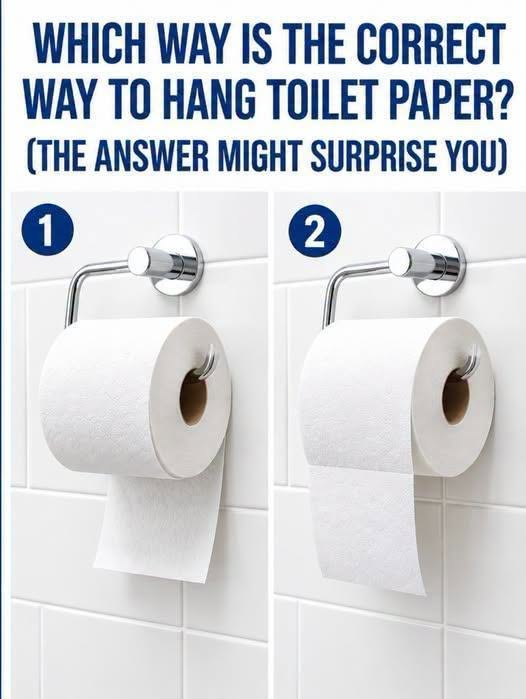
One tiny bathroom habit can turn a peaceful home into an unexpectedly heated battleground. It seems almost impossible that something as ordinary as a roll of toilet paper could create so much disagreement, yet households everywhere have experienced the familiar debate. Hang the toilet paper with the loose end coming over the front, and someone immediately argues that it should be the other way around. Tuck it underneath, and another person insists that the roll has been installed incorrectly. What appears to be a completely insignificant detail can quickly become a surprisingly stubborn disagreement between partners, family members, and even roommates. Both sides believe they have the better argument, and neither seems particularly interested in giving up their preferred arrangement. But this everyday disagreement has a history that goes back much further than most people realize. The origins of modern toilet paper holders, the practical advantages of each arrangement, and the habits people develop throughout childhood all help explain why this simple household decision continues to divide opinions. Perhaps the real question is not which direction is technically correct, but why such a small detail can inspire such strong reactions.
The case for hanging toilet paper over the front is straightforward, and its supporters have several practical reasons for defending it. When the loose end hangs in front of the roll, it is generally easier to see, reach, and tear off the amount needed without having to search behind the roll or touch more of the paper than necessary. Many people also consider this arrangement more attractive because the visible end creates a cleaner and more organized appearance. Interestingly, this preference is not simply a modern invention or a trend that appeared in recent decades. Some of the earliest illustrations associated with toilet paper holders and rolled bathroom paper during the late nineteenth century showed the loose end positioned over the front. These historical images provide evidence that the overhand arrangement was familiar from the early days of commercially available toilet paper holders. However, they do not establish that every household must follow the same arrangement or that the alternative is necessarily incorrect. Personal experience plays an important role, too. Someone who grew up seeing toilet paper positioned over the front may naturally consider that arrangement the normal one. Over time, a simple childhood routine can become a deeply established preference, making it surprisingly difficult to accept a different approach, even when there is no meaningful practical disadvantage.
Hanging the toilet paper underneath has its own practical advantages, and those who prefer this arrangement are not necessarily choosing it simply to be different. With the loose end positioned closer to the wall, there may be less opportunity for the paper to unravel accidentally when someone brushes against it. This can be particularly useful in households with curious pets, especially cats and dogs that enjoy playing with anything that moves, tears, or hangs within reach. Parents of small children may also appreciate an arrangement that makes it slightly less tempting for little hands to pull an entire roll onto the bathroom floor. In addition, the design of the toilet paper holder, the available space, and the position of nearby fixtures can influence which direction feels more convenient. Some bathrooms have holders positioned in places where one arrangement is clearly easier to reach than the other. Ultimately, neither direction deserves to become a test of intelligence, cleanliness, or someone’s ability to manage a household. The best arrangement is simply the one that works most comfortably for the people using the bathroom. And perhaps that is the most important lesson behind this surprisingly familiar disagreement: domestic harmony is rarely built by winning every little argument. Sometimes, allowing someone to hang the toilet paper their preferred way is a much easier solution than turning an ordinary bathroom habit into a battle that nobody really needs to win.