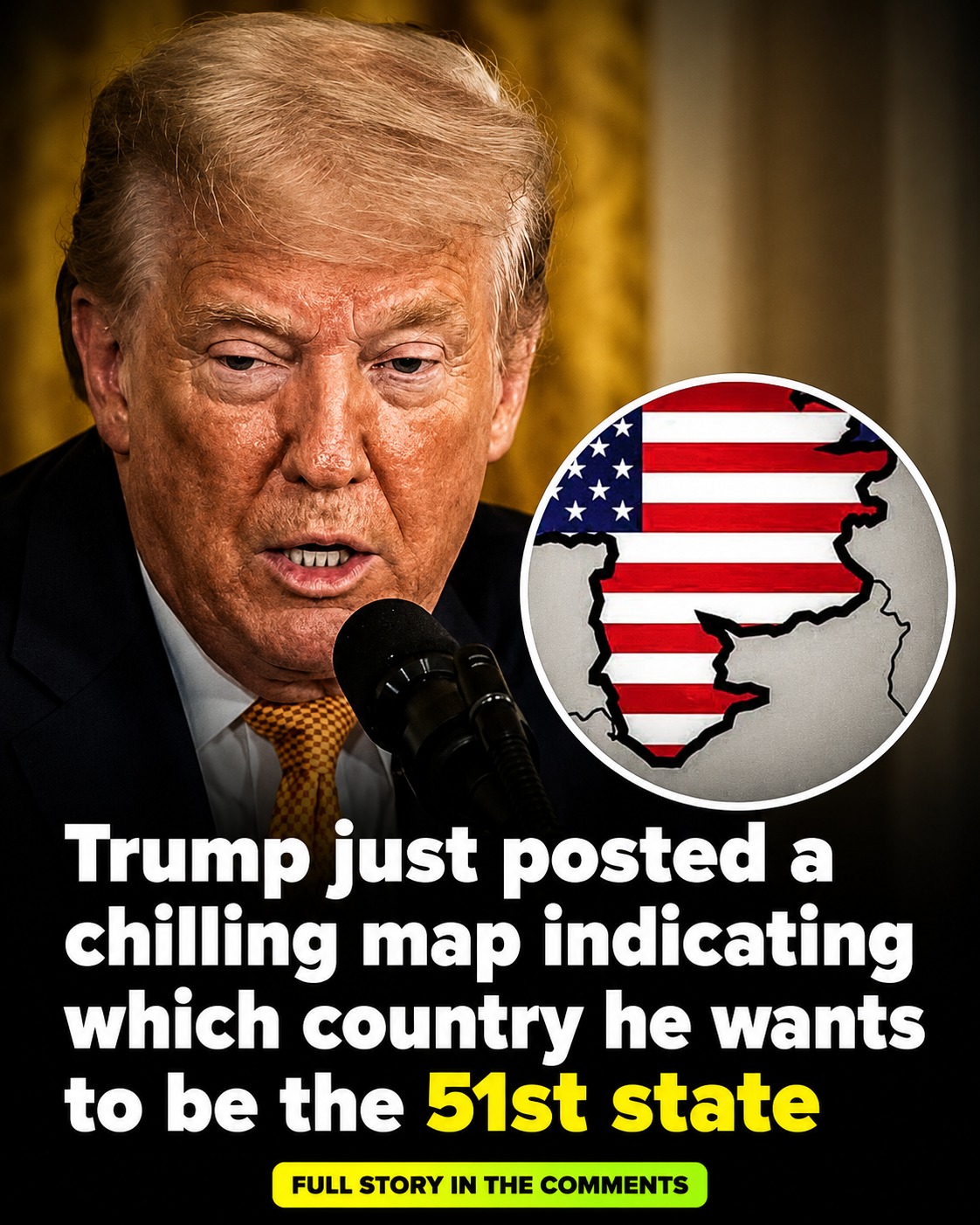
The latest controversy surrounding Donald Trump and Venezuela has exploded far beyond ordinary political rhetoric. A dramatic image posted to Truth Social showing Venezuela covered by the American flag and labeled “51st State” ignited outrage, fascination, and fear almost instantly. Combined with Trump’s public comments about “seriously considering” closer U.S. control over Venezuela after the capture of Nicolás Maduro, the post felt to many less like a joke and more like a declaration of geopolitical ambition.
Trump’s language has only intensified the speculation. Following the January 2026 U.S. operation that reportedly resulted in Maduro’s capture, Trump openly praised what he called military success in Venezuela and suggested the United States would help “run” the country during a transition period. He repeatedly emphasized Venezuela’s massive oil reserves, describing opportunities for American energy companies and celebrating what he framed as economic revival under U.S. influence.
For supporters, this rhetoric projects strength, dominance, and a willingness to aggressively reshape unstable regions. To critics, it sounds dangerously close to imperialism wrapped in modern branding. The image of Venezuela transformed visually into an American state struck a nerve because it touched one of the deepest fears in Latin American political history: foreign control disguised as partnership.
At the center of the political storm stands Delcy Rodríguez, who publicly rejected the idea that Venezuela could ever become part of the United States. She insisted the country is “not a colony” and reaffirmed Venezuelan sovereignty, even while attempting to navigate the fragile political reality created after Maduro’s removal. Analysts note that her response has been unusually restrained compared to past anti-American rhetoric from Venezuelan leadership, reflecting how dependent the country has become on delicate international negotiations and economic stabilization efforts.
Legally, the situation is far less dramatic than the online frenzy suggests. Under the U.S. Constitution, a president cannot simply declare another nation an American state. Admission of a new state would require congressional approval and, in practical terms, the consent of the people living in that territory. Any attempt to formally absorb Venezuela into the United States would face enormous constitutional, international, political, and military barriers. In reality, no serious legal pathway currently exists for Trump to unilaterally transform Venezuela into “America’s next state.”
But the deeper issue fueling anxiety is not whether annexation is literally imminent. It is the growing gray zone between influence and control. The United States already holds extraordinary leverage over Venezuela through sanctions policy, diplomatic recognition, military intervention, and economic partnerships tied to oil production. Trump’s comments amplified fears that geopolitical strategy, corporate interests, and national instability are becoming increasingly intertwined. Venezuela possesses some of the world’s largest oil reserves, making the country strategically valuable far beyond ideology alone.
That is why the symbolism of the image mattered so much. The American-flag map was not simply interpreted as internet trolling. To many viewers, it represented the merging of spectacle politics with real geopolitical power. In modern media culture, memes no longer stay confined to humor; they often function as emotional signals, testing public reaction to ideas that once seemed unthinkable.
At the same time, the public response revealed something broader about modern political psychology. The image became a projection screen for people’s existing fears and loyalties. Supporters saw confidence and strategic ambition. Opponents saw authoritarian fantasy and imperial overreach. Much like many viral political moments today, the reaction said as much about the audience as the original post itself.
Meanwhile, the human reality inside Venezuela remains painfully complex. Years of economic collapse, political repression, migration crises, inflation, sanctions, and instability have already left millions exhausted. For ordinary Venezuelans, the debate is not primarily about internet symbolism or political theater. It is about survival, sovereignty, and whether foreign involvement will stabilize the country or deepen its dependence and division further.
The danger, critics argue, lies in how easily spectacle can overshadow consequences. Maps, slogans, and provocative posts spread instantly online because they are emotionally powerful and visually simple. But behind those viral moments stand real nations, real economies, and real people whose futures can be shaped by rhetoric long before policies fully materialize.
In the end, the most unsettling aspect of Trump’s Venezuela rhetoric may not be whether annexation could actually happen. It is how quickly the boundaries between political performance, military power, economic ambition, and nationalist symbolism have started to blur. Between the American-flag map and constitutional reality lies a volatile space filled with oil, instability, strategic interests, and public emotion — a space where modern geopolitics increasingly feels less like diplomacy and more like spectacle with real-world consequences.