Stella walked slowly down the narrow airplane aisle with trembling hands wrapped around her purse. At eighty-five years old, she was taking her very first flight. She had spent years quietly saving for this moment, putting aside small amounts whenever she could, determined to finally experience the thing she once believed belonged only to other people.
She wore her best navy-blue dress for the occasion.
Her silver hair had been carefully styled.
Everything about her carried the nervous excitement of someone stepping into a lifelong dream at last.
When she finally reached her business class seat and settled carefully into it, relief softened her face.
Then the man beside her noticed her.
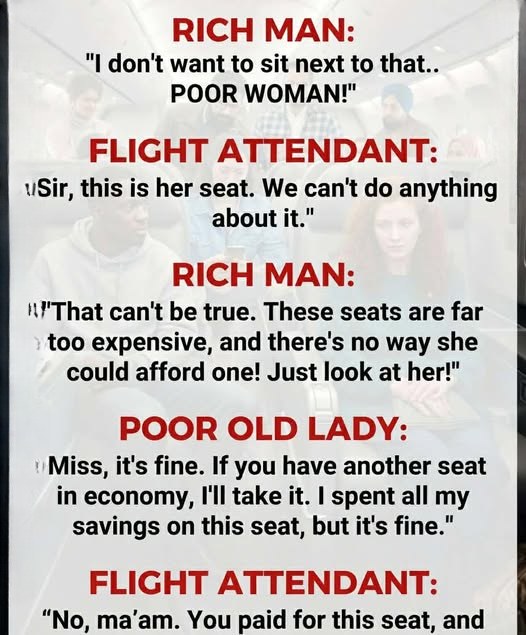
Franklin Delaney looked Stella over with visible irritation almost immediately. Dressed in an expensive blazer and accustomed to luxury travel, he clearly did not think she belonged there.
Within moments, he pressed the flight attendant call button.
“This has to be some mistake,” he complained loudly enough for nearby passengers to hear. “There’s no way she’s supposed to be sitting here.”
The words struck Stella harder than she expected.
Suddenly, she became painfully aware of her age, her modest clothes, her nervousness, and the fact that she was completely out of place among experienced travelers who seemed effortlessly comfortable in the premium cabin.
Embarrassed, Stella quietly offered to move to economy.
“I don’t want any trouble,” she whispered softly.
But the flight attendant remained calm and firm.
“Ma’am,” she said kindly, “you paid for this seat, and this is exactly where you belong.”
Franklin leaned back in frustration while Stella stared quietly out the window trying not to cry before the plane even left the ground.
Once the flight finally settled into the air, the tension slowly faded.
Then Stella accidentally dropped her purse.
Its contents scattered across the floor between the seats, and before she could bend down fully, Franklin instinctively reached over to help gather everything.
That was when he saw the ruby locket.
The moment he picked it up, his expression changed completely.
Franklin was an expert in antique jewelry, and he immediately recognized that the piece was extraordinarily valuable. The craftsmanship alone suggested history, rarity, and immense worth.
“You realize what this is?” he asked quietly.
Stella smiled faintly and took the necklace gently into her hands.
“Oh, its value has nothing to do with money,” she replied softly.
Then she told him the story.
Her father gave the locket to her mother before leaving to serve as a pilot during World War II. He promised he would return home safely.
He never did.
The necklace became one of the only physical pieces of him her family had left behind after the war stole him away forever. Stella explained how her mother struggled for years afterward trying to rebuild life alone while carrying grief that never truly disappeared.
For the first time since boarding, Franklin stopped seeing Stella as an inconvenience.
He started seeing her as a person.
And the more they talked, the more ashamed he became of his earlier cruelty.
Then Stella shared something even more painful.
When she was in her thirties, isolated and financially unstable, she became pregnant with no support system around her. Terrified she could not provide the life her baby deserved, she made the heartbreaking decision to place her son for adoption.
Franklin listened silently.
Years later, Stella said, she used modern technology to finally locate him. She sent a message introducing herself carefully and explaining who she was.
He answered only once.
He told her politely that he did not wish to build a relationship.
Franklin looked down at his hands, visibly shaken now by the quiet sadness in her voice.
Then he asked the question that had been bothering him since takeoff.
“If that happened,” he said gently, “why did you decide to take this flight?”
Stella stared ahead silently for several seconds before answering.
“Because my son is the pilot.”
Franklin blinked in shock.
“It’s his birthday today,” she continued quietly. “I didn’t expect anything from him. I just… wanted to be close to him for a little while.”
The words hit Franklin harder than anything else she had shared.
This entire journey—her savings, her excitement, her nervousness—was never really about flying.
It was about love.
A mother’s love surviving decades of silence and rejection.
As the airplane began descending toward New York City, Stella sat quietly by the window believing the trip would end the same way it began: with distance remaining between them.
Then the intercom clicked on.
The pilot’s voice filled the cabin.
But this time, the announcement was personal.
“I’d like to welcome someone very special onboard today,” the voice said carefully, slightly trembling. “My birth mother is with us on this flight… and if she’s willing, I’d really like her to wait for me after we land.”
Stella covered her mouth instantly as tears flooded her eyes.
The cabin fell completely silent before emotion swept through it all at once.
Even Franklin wiped at his face quietly.
The moment the plane reached the gate, the cockpit door opened, and Stella’s son hurried down the aisle toward her without hesitation.
Then he wrapped his arms around her tightly.
The entire cabin erupted into applause.
Passengers cried openly. Flight attendants smiled through tears. And Stella, after carrying decades of regret, loss, sacrifice, and unanswered love, finally experienced something she never allowed herself to fully believe might still happen:
She was wanted.
Not for what she owned.
Not for what she sacrificed.
But simply because she was his mother.
And in that crowded airplane cabin, thousands of feet above the life she once feared had passed her by, Stella finally understood that sometimes love takes the longest possible route before finding its way home.