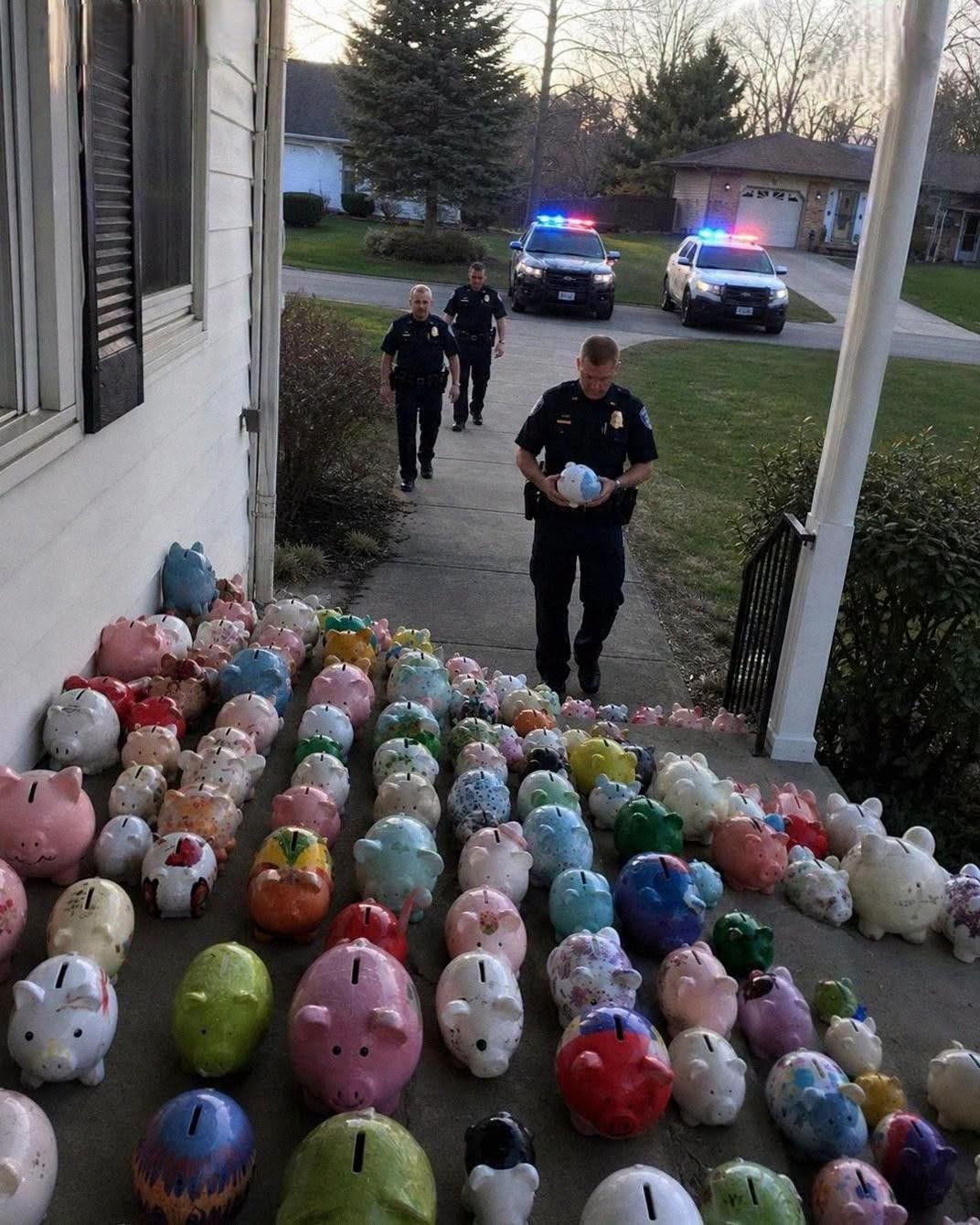
The sound of sirens shattered the peaceful silence of our neighborhood before sunrise. I looked through the front window expecting the worst—a serious accident, a crime scene, or some kind of emergency involving one of our neighbors. Instead, police cars slowly lined the street while people gathered outside their homes, confused and whispering to one another. Within an hour, the quiet road where everyone usually kept to themselves had become crowded with neighbors, reporters, volunteers, and something no one could possibly explain: hundreds of piggy banks appearing on front lawns, porches, and sidewalks.
At the center of it all stood my six-year-old son, completely unaware that his tiny act of kindness had started something far bigger than any of us could have imagined. The evening before, he had noticed our elderly neighbor sitting alone on her porch, looking worried as she quietly sorted through unopened bills. Without telling anyone, he ran into his bedroom, grabbed his little piggy bank, and carried it across the street. Smiling proudly, he handed it to her and said, “You can have my savings. Maybe they’ll help.”
The elderly woman accepted the gift with tears in her eyes. She hugged him gently and thanked him over and over, insisting she couldn’t possibly take his money. But my son refused to leave until she promised to keep it. To him, helping someone who looked sad was simply the right thing to do. He had no idea that another neighbor had quietly witnessed the exchange from across the street and shared the story online later that evening.
By morning, the story had spread throughout the town. People who had once lived in the neighborhood began recognizing the elderly woman’s name. One by one, they arrived carrying piggy banks of every shape and size—ceramic pigs, plastic jars, old coffee cans filled with coins, and small wooden boxes stuffed with cash. Some carried handwritten notes. Others brought photographs or simply stood silently, overwhelmed by memories they had not thought about in decades.
At first, no one understood why so many strangers were gathering outside her home. Then the stories began.
One man quietly explained that when he was a child, his family often struggled to afford groceries. Somehow, every Friday afternoon, his school lunch account mysteriously showed a positive balance, even though his parents hadn’t been able to pay. Years later, he discovered that the woman across the street had secretly covered the cost herself without ever telling anyone.
A local business owner stepped forward next. Fighting back tears, she remembered how, after her father lost his job, someone had anonymously left bags of groceries on their porch every Sunday evening for nearly three months. Her mother spent years wondering who their mysterious helper had been. Standing there now, she finally realized the answer had been living just across the street all along.
Another neighbor remembered being embarrassed because he couldn’t afford new school supplies. One Monday morning, he arrived at his desk to find fresh notebooks, pencils, and a backpack waiting for him with no name attached. He had never learned who bought them until now.
The stories continued for hours. Forgotten acts of generosity resurfaced one after another. Utility bills quietly paid. Winter coats left anonymously on doorsteps. Prescription medications purchased without recognition. Birthday gifts delivered without cards. Quiet kindness after quiet kindness, stretching back over decades, began forming a picture of a woman whose greatest habit had been helping others without ever asking for thanks.
As more piggy banks were opened, they revealed not only coins and folded dollar bills but handwritten messages from people whose lives had been changed by her compassion. Police officers, teachers, contractors, nurses, restaurant owners, mechanics, and parents all shared similar memories. Long before they became successful adults, they had each received help from someone who never expected repayment.
One retired police officer spoke softly as he held a cracked ceramic pig. “She bought me my first pair of winter boots,” he said. “Without them, I couldn’t have walked to school that winter. I never knew it was her.”
By afternoon, the focus had shifted completely. The gathering was no longer about unpaid bills or financial hardship. It had become a community rediscovering its own history through the quiet generosity of one person who had spent a lifetime giving without recognition. People realized that many of the opportunities they enjoyed as adults existed because someone had quietly believed in them when they had almost nothing.
Neighbors quickly organized ongoing support rather than offering a single donation. Volunteers created schedules to deliver groceries, drive her to medical appointments, help maintain her home, and visit regularly so she would never again feel forgotten. Local businesses donated repairs, pharmacies offered assistance, and community organizations stepped forward to ensure she would always have what she needed.
That evening, after the last visitor had gone home, my son climbed into bed believing he had simply shared his savings with someone who needed help. He smiled proudly, convinced that was the end of the story. I tucked him in, kissed his forehead, and realized he would not understand the true impact of his kindness until much later in life.
Because what he had really done was remind an entire town of a debt that could never be measured in dollars. One small piggy bank had unlocked decades of forgotten gratitude, exposing how easily we overlook the quiet heroes living beside us. His innocent gesture became the spark that reunited a community with the woman who had spent her entire life quietly holding it together. In the end, it wasn’t the money inside hundreds of piggy banks that mattered most—it was the memories they opened, the promises they inspired, and the simple truth they revealed: the smallest act of kindness can awaken an entire town to the goodness it almost forgot.