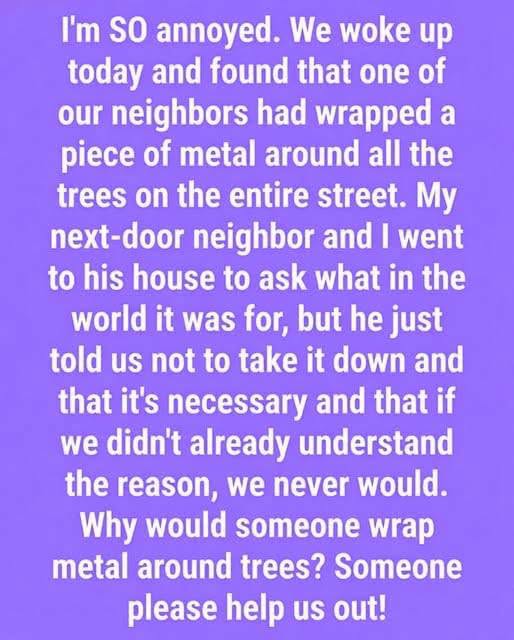
At first glance, they look strange—wide bands of shiny metal wrapped tightly around the trunks of otherwise healthy trees. To someone passing by, they might seem like part of a construction project, a treatment for disease, or even a sign that the tree is scheduled to be removed. Some people assume the metal is supporting a damaged trunk, while others believe it’s there to keep the tree from splitting. In reality, those simple collars serve an entirely different purpose. They are one of the most effective, humane, and surprisingly simple ways to protect both trees and nearby homes from unwanted animal visitors.
The danger often begins long before homeowners realize anything is wrong.
As daylight fades and neighborhoods grow quiet, squirrels begin searching for fruit, nuts, and bird nests. Raccoons emerge under the cover of darkness, climbing trees with remarkable agility as they search for food or pathways onto rooftops. Rats, opossums, and other climbing animals can use tree trunks like natural ladders, traveling effortlessly from the ground to branches that stretch over houses, garages, sheds, and gardens.
Most people never witness these nighttime visitors.
They only notice the consequences.
Missing fruit.
Destroyed bird nests.
Chewed branches.
Damaged bark.
Noisy footsteps above the ceiling late at night.
Sometimes homeowners discover raccoons or squirrels nesting inside attics after animals used overhanging branches as convenient bridges to the roof. What seemed like harmless wildlife in the yard suddenly becomes an expensive problem requiring repairs, cleanup, and professional removal.
That’s where the metal bands come in.
Known as tree baffles or tree guards, these smooth collars are designed to interrupt an animal’s climb before it ever reaches the canopy. Instead of gripping rough bark with sharp claws, climbing animals encounter a wide sheet of slippery metal that provides almost no traction. Without something solid to grasp, they simply cannot continue upward.
They slide back down.
Again and again.
Unlike traps, poisons, or harmful deterrents, these barriers don’t injure wildlife.
They simply redirect it.
Most tree guards are made from durable materials such as aluminum or galvanized steel. These metals resist rust, withstand changing weather conditions, and remain effective for years with very little maintenance. Many are painted in muted colors that blend naturally with tree bark, making them surprisingly difficult to notice unless someone intentionally looks for them.
Their appearance may be simple.
Their effectiveness is impressive.
The placement of the barrier is equally important.
Most experts recommend installing the metal collar approximately four to six feet above the ground. At that height, many climbing animals cannot leap over it from below, while still remaining high enough to prevent them from reaching it by climbing nearby objects. The band also needs to be wide enough that animals cannot simply stretch across it using their claws.
Installation requires careful attention to the health of the tree itself.
A properly designed tree guard should never be fastened tightly around the trunk. Trees continue growing every year, slowly increasing in diameter. If the metal were secured too tightly, it could eventually damage the bark or interfere with healthy growth. Instead, quality installations leave room for expansion or use adjustable mounting systems that allow the collar to move as the tree naturally grows larger.
The goal is protection.
Not restriction.
These barriers are especially valuable in orchards.
Fruit trees attract an astonishing variety of wildlife. Apples, peaches, pears, plums, cherries, and other crops often become irresistible midnight feasts for squirrels, raccoons, and rats. A single family of hungry animals can destroy an entire season’s harvest in only a few nights, leaving homeowners frustrated after months of careful pruning, watering, and tending.
A simple sheet of metal can dramatically reduce those losses.
Gardeners who install tree guards frequently discover that more fruit remains untouched until harvest, allowing both people and wildlife to benefit without direct conflict. Animals naturally seek food elsewhere while the protected trees continue producing healthy crops.
Bird conservation also benefits from these barriers.
Many songbirds build nests in backyard trees each spring, raising vulnerable chicks that cannot escape climbing predators. Raccoons, snakes in some regions, squirrels, and rats are all capable of raiding nests in search of eggs or young birds. By preventing predators from reaching the branches, tree guards create a safer environment for nesting birds without harming the animals attempting to climb.
Homeowners often appreciate another important advantage.
Reduced roof access.
Trees growing close to houses frequently provide convenient pathways for wildlife to enter attics through damaged vents, loose shingles, or small openings beneath rooflines. Blocking access at the tree trunk often prevents those expensive household invasions before they begin, saving considerable time, stress, and repair costs.
Perhaps the greatest strength of tree guards is what they don’t require.
No chemicals.
No poison.
No dangerous traps.
No constant monitoring.
Once installed correctly, they work quietly every day and every night, allowing people and wildlife to coexist with far fewer conflicts. Animals simply learn that particular tree is no longer worth climbing and move on to more accessible food sources in their natural environment.
Of course, tree guards aren’t a complete solution for every wildlife problem.
If branches already touch rooftops, animals may bypass the trunk entirely by jumping from nearby structures or neighboring trees. Regular pruning remains important to eliminate those aerial pathways. Likewise, homeowners should continue removing easily accessible food sources, securing garbage containers, and sealing openings around buildings to discourage unwanted visitors.
Still, few protective measures are as simple, affordable, and environmentally friendly.
Those smooth bands of aluminum or galvanized steel may appear insignificant to casual observers, but they quietly perform an important job every single night. They protect harvests without poison, safeguard nesting birds without traps, reduce property damage without harming wildlife, and remind us that effective solutions don’t always require force.
Sometimes, the smartest form of protection isn’t about fighting nature at all.
It’s about gently changing the path nature takes.
The next time you notice a wide metal band wrapped around a tree trunk, you’ll know it isn’t there because the tree is sick or damaged. It’s there because someone chose a thoughtful, humane way to protect both the tree and everything that depends on it. In that quiet strip of metal lies a simple lesson: sometimes the best defense isn’t louder, stronger, or harsher—it is simply smarter.